MissVickie loaf pan batter planner
How Much Batter In Loaf Pan Calculator
Estimate batter volume, pan fill, rise room, scaled recipe yield, and slice count for banana bread, pound cake, sandwich bread, and mini loaf pans.
Start with a common loaf, then adjust the pan size, batter type, fill target, recipe yield, and safety margin for your bake.
Loaf Batter Breakdown
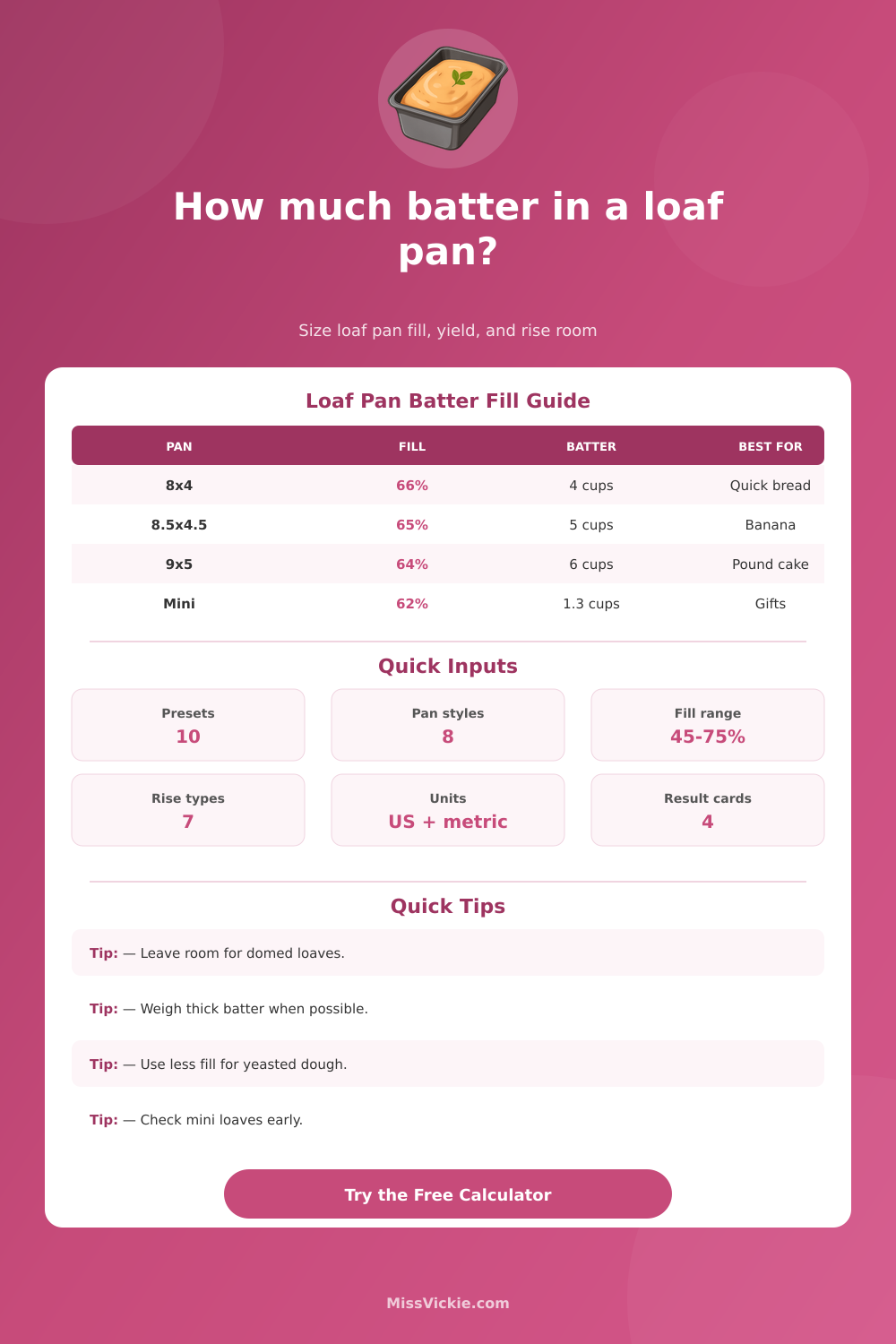
| Pan Size | Approx Rim Capacity | Classic Batter Fill | Best Use | Watch Point |
|---|---|---|---|---|
| Mini 5.75 x 3 inch | About 2 cups | 1.1 to 1.4 cups | Gift loaves and sample bakes | Short bake time and fast browning |
| 8 x 4 inch | About 6 cups | 3.8 to 4.2 cups | Banana bread and quick breads | Can overflow with wet fruit batters |
| 8.5 x 4.5 inch | About 7.5 cups | 4.7 to 5.1 cups | Standard loaf recipes | Good middle ground for most batters |
| 9 x 5 inch | About 9 cups | 5.6 to 6.2 cups | Pound cake and large quick breads | Shallow fill may bake flatter |
| Small Pullman | About 10 cups | 5.0 to 6.5 cups | Square sandwich bread | Lid needs more headspace |
| Batter Type | Typical Fill | Density Used | Rise Behavior | Calculator Adjustment |
|---|---|---|---|---|
| Quick bread | 62 to 68 percent | 1.05 g per ml | Moderate dome from chemical leavening | Classic fill with medium rise room |
| Banana or zucchini bread | 60 to 66 percent | 1.08 g per ml | Heavy moist batter, slower center | Slightly lower fill for fruit moisture |
| Pound cake | 58 to 65 percent | 1.10 g per ml | Steady dome and dense crumb | Lower overflow risk but heavier slices |
| Yeasted dough | 45 to 55 percent | 0.78 g per ml | Large proof and oven spring | Big headspace credit before baking |
| Gluten-free loaf | 58 to 64 percent | 1.06 g per ml | Set structure can be fragile | Conservative fill and medium risk |
| Measure | Milliliters | Fluid Ounces | Typical Batter Weight | Kitchen Use |
|---|---|---|---|---|
| 1/2 cup | 118 ml | 4 fl oz | 124 to 130 g | Small fill adjustment |
| 1 cup | 237 ml | 8 fl oz | 249 to 261 g | Common batter scoop unit |
| 4 cups | 946 ml | 32 fl oz | 990 to 1040 g | Typical 8 x 4 loaf fill |
| 5 cups | 1183 ml | 40 fl oz | 1240 to 1300 g | Typical 8.5 x 4.5 fill |
| 6 cups | 1420 ml | 48 fl oz | 1490 to 1560 g | Typical 9 x 5 fill |
Best for sandwich bread dough, pullman lids, high-rising batters, and cautious test bakes.
Good target for quick breads when the recipe has fruit, nuts, or a domed top.
Useful for dense pound cake or meatloaf, but risky for wet quick breads.
Extra batter margin covers bowl scrape loss, uneven pan capacity, and topping displacement.
| Goal | Pan Setup | Batter Per Pan | Total Batter | Recipe Note |
|---|---|---|---|---|
| Small household loaf | 1 pan, 8 x 4 | About 4 cups | About 4.2 cups with reserve | Fits many banana bread recipes |
| Standard bake sale pair | 2 pans, 8.5 x 4.5 | About 5 cups | About 10.5 cups with reserve | Often needs a double recipe |
| Large pound cake | 1 pan, 9 x 5 | About 6 cups | About 6.3 cups with reserve | Check center with a skewer |
| Gift mini loaves | 6 mini pans | About 1.3 cups | About 8.2 cups with reserve | Reduce bake time substantially |
Baking a loaf of bread or cake require you to manage the amount of batter that you put into an pan. If you put too much batter into a pan, it will overflow the pan. If you put to little batter into a pan, your loaf will be flat.
Most recipe include one measurement of batter for one pan size. However, if you use a pan of a different size, you will need to adjust the amount of batter to that pan size. The amount of batter that a pan can hold is not simply determined by the length times the width times the depth of that pan.
How to Match Batter Amount to Pan Size
Most loaf pans has a tapered shape that will hold more batter before it reaches the rim of the pan than if it had a rectangular pan shape. To calculate the amount of batter that a pan of any size can hold, you must enter the pan’s inside length, inside width, and inside depth into the calculator. Additionally, you must choose the shape of the pan so that the pan’s shape can be factored into the calculation of the batter volume.
The type of batter that will be used in the pan can also impact the volume of batter that a pan can hold. For instance, a dense pound cake will behave more differently than a loose quick bread because dense pound cake will rise less in the pan than quick bread. The rise allowance for a recipe can help to account for this difference in behavior of each type of batter.
A fill percentage is also determined for each type of batter. The reason that many people ignore this percentage is because different batters require different headspace in the pan. For instance, quick breads will rise higher in the center of the pan then a loaf of meatloaf.
Additionally, yeasted doughs will rise even more in the center of the pan than quick breads due to the proofing stage of the recipe. If you dont set the fill style to the correct value for the type of batter that will be used, the baked good may have a sunken center or a cracked top. The recipe can be scaled to any amount of batter.
If the amount of batter that you have does not match the batter amount that the pan size calculator determined that you should use, you can use the scale factor to adjust the recipe to the amount of batter that you have. The scale factor will indicate the factor by which you should multiply or divide the recipe to match the amount of batter that you have. Additionally, it is also possible to enter a reserve percentage for the recipe.
This percentage will account for batter that will remain in the mixing bowl and on the spatula. Finally, you can enter the number of slice that the baked good will make into the slice count field. The number of slices will be useful for making breads that will be sold at a bake sale or sandwich bread.
The density of the batter will impact the weight of the batter that will be used. Additionally, batter density will also impact the volume of batter that will fill the pan. For instance, a dense batter will weigh more than a light batter of the same volume.
The pan size calculator uses typical densities of each type of batter so that the weight of the batter that is calculated will be realistic. The weight of the batter can be useful in determining whether or not a recipe can be adjusted to fit into a smaller pan. Many people make a mistake with baking by treating the labels on the pans as the exact measurements of that pan.
An 8 by 4 pan may measure differently from another brand of pan, leading to overflow of batter. To avoid this mistake, you should measure the inside dimensions of the pan. For instance, many people use a fill level of two thirds for their pans.
However, a two-thirds fill level for a pan containing yeasted dough will likely result in overflow of batter into the pan. Additionally, a two thirds fill level for a pan containing meatloaf will result in baking of the meatloaf too shallow in the pan. To avoid these problems, you should match the fill target to the type of batter that will be used in the recipe.
Additionally, the moisture that is contained in some ingredients will impact how much the batter rise in the pan. For instance, banana bread contains bananas that will release steam while baking. The steam will push the center of the bread higher in the pan than light quick bread.
Therefore, the setting of batter type for banana and zucchini will lower the fill level percentage that is recommended for the recipe. Pound cake will rise more slowly than quick bread but will not rise as high out of the pan. Thus, using pound cake as the type of batter for the recipe allows for more batter to be used before the risk of overflow of batter occurs.
By accounting for these variables in the recipe, people can better avoid wasting their ingredient and their time in the kitchen. Additionally, reference tables are provided for each recipe that contain the amount of batter that different pan sizes can hold when filled to different amounts. These tables can be used to cross-check the measurements that are calculated with the recipe that is to be utilized in the pan.
The tables also contain information regarding the rise of each type of batter to the pan. Additionally, there is a volume and weight conversion table that cooks that use the metric system and measure their ingredient in grams or cups can reference. These tables will allow cooks to avoid the mathematics that can become difficult to calculate while following a recipe.
Finally, while this pan size calculator can calculate the volume of batter that a pan can hold based off its dimensions, the type of batter that will be used in the recipe, and variables related to that batter, there are other variable that can still impact the rise of the batter in the pan. For instance, the hot spots in the oven will heat the batter differently depending upon where the loaf is placed in the oven. Additionally, the age of the baking powder may impact the rise of the batter in the pans.
Finally, the temperature of the ingredients can have an impact upon the rise of the batter. Thus, any amount of batter that is calculated by this tool should still be watched in the oven, and the oven should be periodically tested to determine if baking is complete. Additionally, if the first batch of batter baked is different from the expectations of the baker, that batter should be adjusted in the following batches of batter prepared according to the recipe.
Thus, the baker can control the variable of batter amount, rise allowance, and fill target to prepare batches of batter that will have even baking results.