Cupcake frosting, filling, piping, toppings, and reserve
How Much Frosting For Cupcakes Calculator
Estimate frosting for mini, standard, jumbo, and filled cupcakes by batch size, top style, frosting type, swirl height, filling, topping loss, and spare allowance.
Choose a real cupcake scenario, then adjust the batch, frosting, piping, filling, decoration, and recipe yield.
Full Cupcake Frosting Breakdown
| Cupcake style | Frosting per cupcake | 12 cupcakes | 24 cupcakes |
|---|---|---|---|
| Mini flat top | 1 to 1.5 teaspoons | 1/4 to 1/2 cup | 1/2 to 3/4 cup |
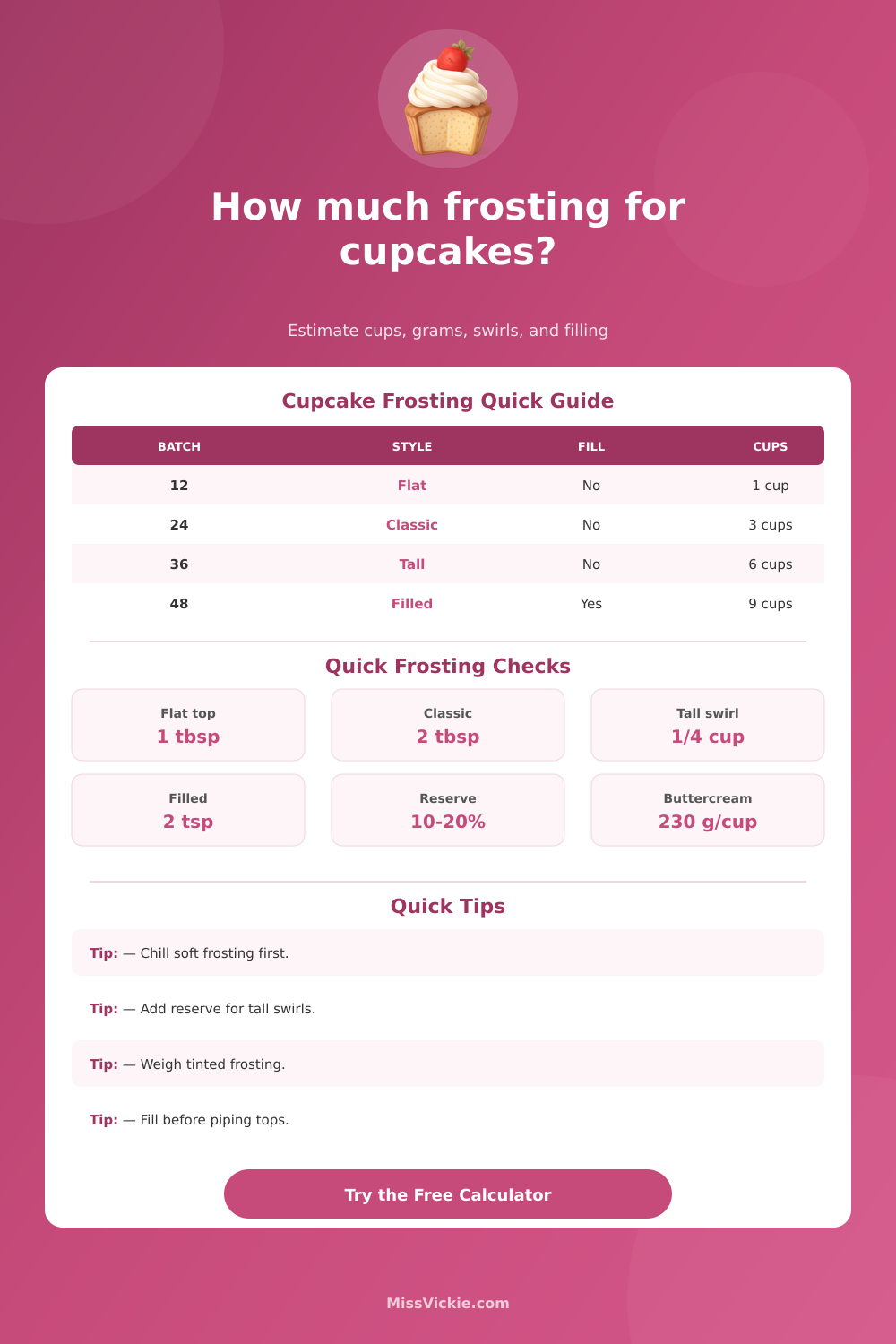
| Standard flat top | 1 tablespoon | 3/4 cup | 1 1/2 cups |
| Classic low swirl | 2 tablespoons | 1 1/2 cups | 3 cups |
| Rosette swirl | 2 1/2 tablespoons | 1 7/8 cups | 3 3/4 cups |
| Tall bakery swirl | 1/4 cup | 3 cups | 6 cups |
| Jumbo tall swirl | 1/3 to 1/2 cup | 4 to 6 cups | 8 to 12 cups |
| Frosting type | Approx weight per cup | Texture | Best cupcake use |
|---|---|---|---|
| American buttercream | 230 g per cup | Firm and sweet | Tall swirls, borders, and party trays |
| Swiss meringue buttercream | 220 g per cup | Silky and light | Smooth rosettes and less sweet cupcakes |
| Cream cheese frosting | 245 g per cup | Soft and dense | Red velvet, carrot, spice, and filled cupcakes |
| Whipped ganache | 255 g per cup | Rich and sturdy | Chocolate cupcakes and clean piped tops |
| Stabilized whipped cream | 175 g per cup | Airy and soft | Same-day chilled cupcakes |
| Ermine frosting | 215 g per cup | Fluffy and smooth | Soft bakery-style swirls |
| Vegan buttercream | 225 g per cup | Firm but temperature sensitive | Dairy-free decorated cupcakes |
| Batch size | Flat tops | Classic swirls | Tall swirls |
|---|---|---|---|
| 12 cupcakes | 3/4 cup | 1 1/2 cups | 3 cups |
| 18 cupcakes | 1 1/8 cups | 2 1/4 cups | 4 1/2 cups |
| 24 cupcakes | 1 1/2 cups | 3 cups | 6 cups |
| 36 cupcakes | 2 1/4 cups | 4 1/2 cups | 9 cups |
| 48 cupcakes | 3 cups | 6 cups | 12 cups |
| 72 cupcakes | 4 1/2 cups | 9 cups | 18 cups |
| Add-on | Typical amount | Calculator setting | Planning note |
|---|---|---|---|
| Tiny frosting core | 1 teaspoon each | Tiny core | Good for mini surprise filling. |
| Small frosting fill | 2 teaspoons each | Small fill | Works for most cored standard cupcakes. |
| Standard frosting fill | 1 tablespoon each | Standard fill | Adds visible filling without overloading. |
| Sprinkle handling | About 4% extra | Light sugar | Allows for touching up damaged tops. |
| Multiple piping bags | 8% to 12% extra | Bag holdback | Useful for several colors or small bags. |
| Event reserve | 18% to 25% extra | Event buffer | Protects against color matching and rework. |
Best for lunchbox cupcakes, glaze-style finishes, and simple sprinkle tops.
The balanced party look: enough height for piping without doubling the batch.
Uses a little more because the star ridges cover the full cupcake crown.
Bakery-height piping can use twice as much frosting as a classic low swirl.
When you decide to decorate cupcake, you must decide on an appropriate amount of frosting to use. The amount of frosting that will be used will change the experience of eat the cupcake. For instance, too much frosting may make it difficult for an individual to eat the cupcake, and the flavor of the frosting may not balance with the flavor of the cupcake.
Thus, it is important to determine an appropriate amount of frosting prior to beginning decorating the cupcakes. The size of the cupcake will impact the amount of frosting require for decorating. Mini cupcakes will have a small area of the cupcake that needs to be frosted, so only a thin layer of frosting will be required.
How Much Frosting You Need for Cupcakes
Standard and tall bakery cupcakes will have a larger area of the cupcake that must be frosted, so more frosting will be required. Finally, jumbo cupcakes will have an even larger area of the cupcake that must be frosted than standard cupcakes, so an even larger amount of frosting will be required. Thus, an individual will need to determine the size of the cupcake that will be decorated prior to determining the amount of frosting.
The piping style will have an impact upon the amount of frosting that will be required. For instance, using a flat spatula finish will require less frosting than other decorative piping design. As the piping design becomes taller, the amount of frosting that will be required will increase.
For instance, designs such as rosettes or tall bakery swirls will require more frosting than designs such as classic low swirls or a flat spatula finish. Designs such as double-height show swirls will require the most frosting for decorating cupcakes. Thus, an individual can use a calculator to determine the amount of frosting that will be required for decorating cupcakes with specific piping style.
An additional factor that will impact the amount of frosting required is if the cupcake is to be filled with frosting. If the cupcake is to be iced with frosting along the top of the cupcake, the frosting that is used for filling the center of the cupcake will come from the same batch of frosting as the frosting that is used for icing the cupcakes. Thus, if the cupcake is to be iced with frosting along the top of the cupcake, the icing will reduce the amount of frosting available for icing the top of the cupcake.
Thus, an individual may have to make an extra half-batch of frosting to use for the filling of the cupcake, or may have to purchase additional frosting to fill the cupcake. The type of frosting that is to be used may also impact the amount of frosting that will be required for decorating cupcakes. For instance, types of frosting such as American buttercream are firm frostings, and will hold their shape when piping.
Types of frosting such as Swiss meringue buttercream and ermine frosting are lighter in consistency with the buttercream, and will spread across the cupcakes more. Cream cheese frosting may become softer once it is piped onto the cupcakes, so the height of the cream cheese frostings may be less than expected. Finally, ganache and stabiilzed whipped cream may behave differently from buttercream frosting, so adjustments may need to be made to the total amount of frosting that will be used.
Loss of frosting and the amount of frosting that must be reserved for other use is another factor in the determination of the amount of frosting that will be required for decorating cupcakes. Loss of frosting may occur with changes in piping tips or frosting colors. Additionally, frosting is lost with the use of sprinkles or heavy toppers for the cupcakes.
Finally, an amount of frosting can be reserved to ensure that additional frosting can be made for decorating cupcakes with specific colors or for providing an extra swirl of frosting to a guest who desire an extra serving of frosting. These percentages can be included in a calculator for determining the total amount of frosting that will be required. The total volume of frosting can be used to scale the frosting recipe that is created for decorating cupcakes.
If the frosting recipe yields four cups of frosting, but the calculation of the number of cupcakes and the frosting required for each cupcake indicates that six cups of frosting is required, the recipe will need to be multiplied by 1.5. Thus, calculations will prevent frosting from being made in excess, and will also prevent frosting from being wasted when attempting to make sufficient frosting for decorating cupcakes. The temperature of the frosting and the timing of the frosting application will impact the frosting recipe for decorating cupcakes.
For instance, buttercream frosting that is allowed to sit out of the fridge for an hour will be softer than buttercream that is kept in the fridge. Finally, warm kitchens may impact the amount of pressure with which an individual pipes the frosting onto the cupcakes, thus changing the amount of frosting that is piped onto each cupcake. Thus, an individual will need to pipe a cupcake first to test the behavior of the frosting, so that adjustments may be made prior to decorating the remaining cupcakes.
A calculation will transform an idea into an experience. An individual may not have an exact amount of frosting that will be required to decorate the cupcakes, but a calculation will produce a target amount of frosting to use for decorating cupcakes. Thus, an individual may still need to adjust the amount of frosting used for decorating cupcakes, based on the frosting that is piped onto the cupcakes.
However, having a target amount of frosting will eliminate the worries of frosting being depleted too soon while decorating the cupcakes. When you decide to decorate cupcake, you must decide on an appropriate amount of frosting to use. The amount of frosting that will be used will change the experience of eat the cupcake.
For instance, too much frosting may make it difficult for an individual to eat the cupcake, and the flavor of the frosting may not balance with the flavor of the cupcake. Thus, it is important to determine an appropriate amount of frosting prior to beginning decorating the cupcakes. The size of the cupcake will impact the amount of frosting require for decorating.
Mini cupcakes will have a small area of the cupcake that needs to be frosted, so only a thin layer of frosting will be required. Standard and tall bakery cupcakes will have a larger area of the cupcake that must be frosted, so more frosting will be required. Finally, jumbo cupcakes will have an even larger area of the cupcake that must be frosted than standard cupcakes, so an even larger amount of frosting will be required.
Thus, an individual will need to determine the size of the cupcake that will be decorated prior to determining the amount of frosting. The piping style will have an impact upon the amount of frosting that will be required. For instance, using a flat spatula finish will require less frosting than other decorative piping design.
As the piping design becomes taller, the amount of frosting that will be required will increase. For instance, designs such as rosettes or tall bakery swirls will require more frosting than designs such as classic low swirls or a flat spatula finish. Designs such as double-height show swirls will require the most frosting for decorating cupcakes.
Thus, an individual can use a calculator to determine the amount of frosting that will be required for decorating cupcakes with specific piping style. An additional factor that will impact the amount of frosting required is if the cupcake is to be filled with frosting. If the cupcake is to be iced with frosting along the top of the cupcake, the frosting that is used for filling the center of the cupcake will come from the same batch of frosting as the frosting that is used for icing the cupcakes.
Thus, if the cupcake is to be iced with frosting along the top of the cupcake, the icing will reduce the amount of frosting available for icing the top of the cupcake. Thus, an individual may have to make an extra half-batch of frosting to use for the filling of the cupcake, or may have to purchase additional frosting to fill the cupcake. The type of frosting that is to be used may also impact the amount of frosting that will be required for decorating cupcakes.
For instance, types of frosting such as American buttercream are firm frostings, and will hold their shape when piping. Types of frosting such as Swiss meringue buttercream and ermine frosting are lighter in consistency with the buttercream, and will spread across the cupcakes more. Cream cheese frosting may become softer once it is piped onto the cupcakes, so the height of the cream cheese frostings may be less than expected.
Finally, ganache and stabiilzed whipped cream may behave differently from buttercream frosting, so adjustments may need to be made to the total amount of frosting that will be used. Loss of frosting and the amount of frosting that must be reserved for other use is another factor in the determination of the amount of frosting that will be required for decorating cupcakes. Loss of frosting may occur with changes in piping tips or frosting colors.
Additionally, frosting is lost with the use of sprinkles or heavy toppers for the cupcakes. Finally, an amount of frosting can be reserved to ensure that additional frosting can be made for decorating cupcakes with specific colors or for providing an extra swirl of frosting to a guest who desire an extra serving of frosting. These percentages can be included in a calculator for determining the total amount of frosting that will be required.
The total volume of frosting can be used to scale the frosting recipe that is created for decorating cupcakes. If the frosting recipe yields four cups of frosting, but the calculation of the number of cupcakes and the frosting required for each cupcake indicates that six cups of frosting is required, the recipe will need to be multiplied by 1.5. Thus, calculations will prevent frosting from being made in excess, and will also prevent frosting from being wasted when attempting to make sufficient frosting for decorating cupcakes.
The temperature of the frosting and the timing of the frosting application will impact the frosting recipe for decorating cupcakes. For instance, buttercream frosting that is allowed to sit out of the fridge for an hour will be softer than buttercream that is kept in the fridge. Finally, warm kitchens may impact the amount of pressure with which an individual pipes the frosting onto the cupcakes, thus changing the amount of frosting that is piped onto each cupcake.
Thus, an individual will need to pipe a cupcake first to test the behavior of the frosting, so that adjustments may be made prior to decorating the remaining cupcakes. A calculation will transform an idea into an experience. An individual may not have an exact amount of frosting that will be required to decorate the cupcakes, but a calculation will produce a target amount of frosting to use for decorating cupcakes.
Thus, an individual may still need to adjust the amount of frosting used for decorating cupcakes, based on the frosting that is piped onto the cupcakes. However, having a target amount of frosting will eliminate the worries of frosting being depleted too soon while decorating the cupcakes. When you decide to decorate cupcake, you must decide on an appropriate amount of frosting to use.
The amount of frosting that will be used will change the experience of eat the cupcake. For instance, too much frosting may make it difficult for an individual to eat the cupcake, and the flavor of the frosting may not balance with the flavor of the cupcake. Thus, it is important to determine an appropriate amount of frosting prior to beginning decorating the cupcakes.
The size of the cupcake will impact the amount of frosting require for decorating. Mini cupcakes will have a small area of the cupcake that needs to be frosted, so only a thin layer of frosting will be required. Standard and tall bakery cupcakes will have a larger area of the cupcake that must be frosted, so more frosting will be required.
Finally, jumbo cupcakes will have an even larger area of the cupcake that must be frosted than standard cupcakes, so an even larger amount of frosting will be required. Thus, an individual will need to determine the size of the cupcake that will be decorated prior to determining the amount of frosting. The piping style will have an impact upon the amount of frosting that will be required.
For instance, using a flat spatula finish will require less frosting than other decorative piping design. As the piping design becomes taller, the amount of frosting that will be required will increase. For instance, designs such as rosettes or tall bakery swirls will require more frosting than designs such as classic low swirls or a flat spatula finish.
Designs such as double-height show swirls will require the most frosting for decorating cupcakes. Thus, an individual can use a calculator to determine the amount of frosting that will be required for decorating cupcakes with specific piping style. An additional factor that will impact the amount of frosting required is if the cupcake is to be filled with frosting.
If the cupcake is to be iced with frosting along the top of the cupcake, the frosting that is used for filling the center of the cupcake will come from the same batch of frosting as the frosting that is used for icing the cupcakes. Thus, if the cupcake is to be iced with frosting along the top of the cupcake, the icing will reduce the amount of frosting available for icing the top of the cupcake. Thus, an individual may have to make an extra half-batch of frosting to use for the filling of the cupcake, or may have to purchase additional frosting to fill the cupcake.
The type of frosting that is to be used may also impact the amount of frosting that will be required for decorating cupcakes. For instance, types of frosting such as American buttercream are firm frostings, and will hold their shape when piping. Types of frosting such as Swiss meringue buttercream and ermine frosting are lighter in consistency with the buttercream, and will spread across the cupcakes more.
Cream cheese frosting may become softer once it is piped onto the cupcakes, so the height of the cream cheese frostings may be less than expected. Finally, ganache and stabiilzed whipped cream may behave differently from buttercream frosting, so adjustments may need to be made to the total amount of frosting that will be used. Loss of frosting and the amount of frosting that must be reserved for other use is another factor in the determination of the amount of frosting that will be required for decorating cupcakes.
Loss of frosting may occur with changes in piping tips or frosting colors. Additionally, frosting is lost with the use of sprinkles or heavy toppers for the cupcakes. Finally, an amount of frosting can be reserved to ensure that additional frosting can be made for decorating cupcakes with specific colors or for providing an extra swirl of frosting to a guest who desire an extra serving of frosting.
These percentages can be included in a calculator for determining the total amount of frosting that will be required. The total volume of frosting can be used to scale the frosting recipe that is created for decorating cupcakes. If the frosting recipe yields four cups of frosting, but the calculation of the number of cupcakes and the frosting required for each cupcake indicates that six cups of frosting is required, the recipe will need to be multiplied by 1.5.
Thus, calculations will prevent frosting from being made in excess, and will also prevent frosting from being wasted when attempting to make sufficient frosting for decorating cupcakes. The temperature of the frosting and the timing of the frosting application will impact the frosting recipe for decorating cupcakes. For instance, buttercream frosting that is allowed to sit out of the fridge for an hour will be softer than buttercream that is kept in the fridge.
Finally, warm kitchens may impact the amount of pressure with which an individual pipes the frosting onto the cupcakes, thus changing the amount of frosting that is piped onto each cupcake. Thus, an individual will need to pipe a cupcake first to test the behavior of the frosting, so that adjustments may be made prior to decorating the remaining cupcakes. A calculation will transform an idea into an experience.
An individual may not have an exact amount of frosting that will be required to decorate the cupcakes, but a calculation will produce a target amount of frosting to use for decorating cupcakes. Thus, an individual may still need to adjust the amount of frosting used for decorating cupcakes, based on the frosting that is piped onto the cupcakes. However, having a target amount of frosting will eliminate the worries of frosting being depleted too soon while decorating the cupcakes.
When you decide to decorate cupcake, you must decide on an appropriate amount of frosting to use. The amount of frosting that will be used will change the experience of eat the cupcake. For instance, too much frosting may make it difficult for an individual to eat the cupcake, and the flavor of the frosting may not balance with the flavor of the cupcake.
Thus, it is important to determine an appropriate amount of frosting prior to beginning decorating the cupcakes. The size of the cupcake will impact the amount of frosting require for decorating. Mini cupcakes will have a small area of the cupcake that needs to be frosted, so only a thin layer of frosting will be required.
Standard and tall bakery cupcakes will have a larger area of the cupcake that must be frosted, so more frosting will be required. Finally, jumbo cupcakes will have an even larger area of the cupcake that must be frosted than standard cupcakes, so an even larger amount of frosting will be required. Thus, an individual will need to determine the size of the cupcake that will be decorated prior to determining the amount of frosting.
The piping style will have an impact upon the amount of frosting that will be required. For instance, using a flat spatula finish will require less frosting than other decorative piping design. As the piping design becomes taller, the amount of frosting that will be required will increase.
For instance, designs such as rosettes or tall bakery swirls will require more frosting than designs such as classic low swirls or a flat spatula finish. Designs such as double-height show swirls will require the most frosting for decorating cupcakes. Thus, an individual can use a calculator to determine the amount of frosting that will be required for decorating cupcakes with specific piping style.
An additional factor that will impact the amount of frosting required is if the cupcake is to be filled with frosting. If the cupcake is to be iced with frosting along the top of the cupcake, the frosting that is used for filling the center of the cupcake will come from the same batch of frosting as the frosting that is used for icing the cupcakes. Thus, if the cupcake is to be iced with frosting along the top of the cupcake, the icing will reduce the amount of frosting available for icing the top of the cupcake.
Thus, an individual may have to make an extra half-batch of frosting to use for the filling of the cupcake, or may have to purchase additional frosting to fill the cupcake. The type of frosting that is to be used may also impact the amount of frosting that will be required for decorating cupcakes. For instance, types of frosting such as American buttercream are firm frostings, and will hold their shape when piping.
Types of frosting such as Swiss meringue buttercream and ermine frosting are lighter in consistency with the buttercream, and will spread across the cupcakes more. Cream cheese frosting may become softer once it is piped onto the cupcakes, so the height of the cream cheese frostings may be less than expected. Finally, ganache and stabiilzed whipped cream may behave differently from buttercream frosting, so adjustments may need to be made to the total amount of frosting that will be used.
Loss of frosting and the amount of frosting that must be reserved for other use is another factor in the determination of the amount of frosting that will be required for decorating cupcakes. Loss of frosting may occur with changes in piping tips or frosting colors. Additionally, frosting is lost with the use of sprinkles or heavy toppers for the cupcakes.
Finally, an amount of frosting can be reserved to ensure that additional frosting can be made for decorating cupcakes with specific colors or for providing an extra swirl of frosting to a guest who desire an extra serving of frosting. These percentages can be included in a calculator for determining the total amount of frosting that will be required. The total volume of frosting can be used to scale the frosting recipe that is created for decorating cupcakes.
If the frosting recipe yields four cups of frosting, but the calculation of the number of cupcakes and the frosting required for each cupcake indicates that six cups of frosting is required, the recipe will need to be multiplied by 1.5. Thus, calculations will prevent frosting from being made in excess, and will also prevent frosting from being wasted when attempting to make sufficient frosting for decorating cupcakes. The temperature of the frosting and the timing of the frosting application will impact the frosting recipe for decorating cupcakes.
For instance, buttercream frosting that is allowed to sit out of the fridge for an hour will be softer than buttercream that is kept in the fridge. Finally, warm kitchens may impact the amount of pressure with which an individual pipes the frosting onto the cupcakes, thus changing the amount of frosting that is piped onto each cupcake. Thus, an individual will need to pipe a cupcake first to test the behavior of the frosting, so that adjustments may be made prior to decorating the remaining cupcakes.
A calculation will transform an idea into an experience. An individual may not have an exact amount of frosting that will be required to decorate the cupcakes, but a calculation will produce a target amount of frosting to use for decorating cupcakes. Thus, an individual may still need to adjust the amount of frosting used for decorating cupcakes, based on the frosting that is piped onto the cupcakes.
However, having a target amount of frosting will eliminate the worries of frosting being depleted too soon while decorating the cupcakes. When you decide to decorate cupcake, you must decide on an appropriate amount of frosting to use. The amount of frosting that will be used will change the experience of eat the cupcake.
For instance, too much frosting may make it difficult for an individual to eat the cupcake, and the flavor of the frosting may not balance with the flavor of the cupcake. Thus, it is important to determine an appropriate amount of frosting prior to beginning decorating the cupcakes. The size of the cupcake will impact the amount of frosting require for decorating.
Mini cupcakes will have a small area of the cupcake that needs to be frosted, so only a thin layer of frosting will be required. Standard and tall bakery cupcakes will have a larger area of the cupcake that must be frosted, so more frosting will be required. Finally, jumbo cupcakes will have an even larger area of the cupcake that must be frosted than standard cupcakes, so an even larger amount of frosting will be required.
Thus, an individual will need to determine the size of the cupcake that will be decorated prior to determining the amount of frosting. The piping style will have an impact upon the amount of frosting that will be required. For instance, using a flat spatula finish will require less frosting than other decorative piping design.
As the piping design becomes taller, the amount of frosting that will be required will increase. For instance, designs such as rosettes or tall bakery swirls will require more frosting than designs such as classic low swirls or a flat spatula finish. Designs such as double-height show swirls will require the most frosting for decorating cupcakes.
Thus, an individual can use a calculator to determine the amount of frosting that will be required for decorating cupcakes with specific piping style. An additional factor that will impact the amount of frosting required is if the cupcake is to be filled with frosting. If the cupcake is to be iced with frosting along the top of the cupcake, the frosting that is used for filling the center of the cupcake will come from the same batch of frosting as the frosting that is used for icing the cupcakes.
Thus, if the cupcake is to be iced with frosting along the top of the cupcake, the icing will reduce the amount of frosting available for icing the top of the cupcake. Thus, an individual may have to make an extra half-batch of frosting to use for the filling of the cupcake, or may have to purchase additional frosting to fill the cupcake. The type of frosting that is to be used may also impact the amount of frosting that will be required for decorating cupcakes.
For instance, types of frosting such as American buttercream are firm frostings, and will hold their shape when piping. Types of frosting such as Swiss meringue buttercream and ermine frosting are lighter in consistency with the buttercream, and will spread across the cupcakes more. Cream cheese frosting may become softer once it is piped onto the cupcakes, so the height of the cream cheese frostings may be less than expected.
Finally, ganache and stabiilzed whipped cream may behave differently from buttercream frosting, so adjustments may need to be made to the total amount of frosting that will be used. Loss of frosting and the amount of frosting that must be reserved for other use is another factor in the determination of the amount of frosting that will be required for decorating cupcakes. Loss of frosting may occur with changes in piping tips or frosting colors.
Additionally, frosting is lost with the use of sprinkles or heavy toppers for the cupcakes. Finally, an amount of frosting can be reserved to ensure that additional frosting can be made for decorating cupcakes with specific colors or for providing an extra swirl of frosting to a guest who desire an extra serving of frosting. These percentages can be included in a calculator for determining the total amount of frosting that will be required.
The total volume of frosting can be used to scale the frosting recipe that is created for decorating cupcakes. If the frosting recipe yields four cups of frosting, but the calculation of the number of cupcakes and the frosting required for each cupcake indicates that six cups of frosting is required, the recipe will need to be multiplied by 1.5. Thus, calculations will prevent frosting from being made in excess, and will also prevent frosting from being wasted when attempting to make sufficient frosting for decorating cupcakes.
The temperature of the frosting and the timing of the frosting application will impact the frosting recipe for decorating cupcakes. For instance, buttercream frosting that is allowed to sit out of the fridge for an hour will be softer than buttercream that is kept in the fridge. Finally, warm kitchens may impact the amount of pressure with which an individual pipes the frosting onto the cupcakes, thus changing the amount of frosting that is piped onto each cupcake.
Thus, an individual will need to pipe a cupcake first to test the behavior of the frosting, so that adjustments may be made prior to decorating the remaining cupcakes. A calculation will transform an idea into an experience. An individual may not have an exact amount of frosting that will be required to decorate the cupcakes, but a calculation will produce a target amount of frosting to use for decorating cupcakes.
Thus, an individual may still need to adjust the amount of frosting used for decorating cupcakes, based on the frosting that is piped onto the cupcakes. However, having a target amount of frosting will eliminate the worries of frosting being depleted too soon while decorating the cupcakes. When you decide to decorate cupcake, you must decide on an appropriate amount of frosting to use.
The amount of frosting that will be used will change the experience of eat the cupcake. For instance, too much frosting may make it difficult for an individual to eat the cupcake, and the flavor of the frosting may not balance with the flavor of the cupcake. Thus, it is important to determine an appropriate amount of frosting prior to beginning decorating the cupcakes.
The size of the cupcake will impact the amount of frosting require for decorating. Mini cupcakes will have a small area of the cupcake that needs to be frosted, so only a thin layer of frosting will be required. Standard and tall bakery cupcakes will have a larger area of the cupcake that must be frosted, so more frosting will be required.
Finally, jumbo cupcakes will have an even larger area of the cupcake that must be frosted than standard cupcakes, so an even larger amount of frosting will be required. Thus, an individual will need to determine the size of the cupcake that will be decorated prior to determining the amount of frosting. The piping style will have an impact upon the amount of frosting that will be required.
For instance, using a flat spatula finish will require less frosting than other decorative piping design. As the piping design becomes taller, the amount of frosting that will be required will increase. For instance, designs such as rosettes or tall bakery swirls will require more frosting than designs such as classic low swirls or a flat spatula finish.
Designs such as double-height show swirls will require the most frosting for decorating cupcakes. Thus, an individual can use a calculator to determine the amount of frosting that will be required for decorating cupcakes with specific piping style. An additional factor that will impact the amount of frosting required is if the cupcake is to be filled with frosting.
If the cupcake is to be iced with frosting along the top of the cupcake, the frosting that is used for filling the center of the cupcake will come from the same batch of frosting as the frosting that is used for icing the cupcakes. Thus, if the cupcake is to be iced with frosting along the top of the cupcake, the icing will reduce the amount of frosting available for icing the top of the cupcake. Thus, an individual may have to make an extra half-batch of frosting to use for the filling of the cupcake, or may have to purchase additional frosting to fill the cupcake.
The type of frosting that is to be used may also impact the amount of frosting that will be required for decorating cupcakes. For instance, types of frosting such as American buttercream are firm frostings, and will hold their shape when piping. Types of frosting such as Swiss meringue buttercream and ermine frosting are lighter in consistency with the buttercream, and will spread across the cupcakes more.
Cream cheese frosting may become softer once it is piped onto the cupcakes, so the height of the cream cheese frostings may be less than expected. Finally, ganache and stabiilzed whipped cream may behave differently from buttercream frosting, so adjustments may need to be made to the total amount of frosting that will be used. Loss of frosting and the amount of frosting that must be reserved for other use is another factor in the determination of the amount of frosting that will be required for decorating cupcakes.
Loss of frosting may occur with changes in piping tips or frosting colors. Additionally, frosting is lost with the use of sprinkles or heavy toppers for the cupcakes. Finally, an amount of frosting can be reserved to ensure that additional frosting can be made for decorating cupcakes with specific colors or for providing an extra swirl of frosting to a guest who desire an extra serving of frosting.
These percentages can be included in a calculator for determining the total amount of frosting that will be required. The total volume of frosting can be used to scale the frosting recipe that is created for decorating cupcakes. If the frosting recipe yields four cups of frosting, but the calculation of the number of cupcakes and the frosting required for each cupcake indicates that six cups of frosting is required, the recipe will need to be multiplied by 1.5.
Thus, calculations will prevent frosting from being made in excess, and will also prevent frosting from being wasted when attempting to make sufficient frosting for decorating cupcakes. The temperature of the frosting and the timing of the frosting application will impact the frosting recipe for decorating cupcakes. For instance, buttercream frosting that is allowed to sit out of the fridge for an hour will be softer than buttercream that is kept in the fridge.
Finally, warm kitchens may impact the amount of pressure with which an individual pipes the frosting onto the cupcakes, thus changing the amount of frosting that is piped onto each cupcake. Thus, an individual will need to pipe a cupcake first to test the behavior of the frosting, so that adjustments may be made prior to decorating the remaining cupcakes. A calculation will transform an idea into an experience.
An individual may not have an exact amount of frosting that will be required to decorate the cupcakes, but a calculation will produce a target amount of frosting to use for decorating cupcakes. Thus, an individual may still need to adjust the amount of frosting used for decorating cupcakes, based on the frosting that is piped onto the cupcakes. However, having a target amount of frosting will eliminate the worries of frosting being depleted too soon while decorating the cupcakes.
When you decide to decorate cupcake, you must decide on an appropriate amount of frosting to use. The amount of frosting that will be used will change the experience of eat the cupcake. For instance, too much frosting may make it difficult for an individual to eat the cupcake, and the flavor of the frosting may not balance with the flavor of the cupcake.
Thus, it is important to determine an appropriate amount of frosting prior to beginning decorating the cupcakes. The size of the cupcake will impact the amount of frosting require for decorating. Mini cupcakes will have a small area of the cupcake that needs to be frosted, so only a thin layer of frosting will be required.
Standard and tall bakery cupcakes will have a larger area of the cupcake that must be frosted, so more frosting will be required. Finally, jumbo cupcakes will have an even larger area of the cupcake that must be frosted than standard cupcakes, so an even larger amount of frosting will be required. Thus, an individual will need to determine the size of the cupcake that will be decorated prior to determining the amount of frosting.
The piping style will have an impact upon the amount of frosting that will be required. For instance, using a flat spatula finish will require less frosting than other decorative piping design. As the piping design becomes taller, the amount of frosting that will be required will increase.
For instance, designs such as rosettes or tall bakery swirls will require more frosting than designs such as classic low swirls or a flat spatula finish. Designs such as double-height show swirls will require the most frosting for decorating cupcakes. Thus, an individual can use a calculator to determine the amount of frosting that will be required for decorating cupcakes with specific piping style.
An additional factor that will impact the amount of frosting required is if the cupcake is to be filled with frosting. If the cupcake is to be iced with frosting along the top of the cupcake, the frosting that is used for filling the center of the cupcake will come from the same batch of frosting as the frosting that is used for icing the cupcakes. Thus, if the cupcake is to be iced with frosting along the top of the cupcake, the icing will reduce the amount of frosting available for icing the top of the cupcake.
Thus, an individual may have to make an extra half-batch of frosting to use for the filling of the cupcake, or may have to purchase additional frosting to fill the cupcake. The type of frosting that is to be used may also impact the amount of frosting that will be required for decorating cupcakes. For instance, types of frosting such as American buttercream are firm frostings, and will hold their shape when piping.
Types of frosting such as Swiss meringue buttercream and ermine frosting are lighter in consistency with the buttercream, and will spread across the cupcakes more. Cream cheese frosting may become softer once it is piped onto the cupcakes, so the height of the cream cheese frostings may be less than expected. Finally, ganache and stabiilzed whipped cream may behave differently from buttercream frosting, so adjustments may need to be made to the total amount of frosting that will be used.
Loss of frosting and the amount of frosting that must be reserved for other use is another factor in the determination of the amount of frosting that will be required for decorating cupcakes. Loss of frosting may occur with changes in piping tips or frosting colors. Additionally, frosting is lost with the use of sprinkles or heavy toppers for the cupcakes.
Finally, an amount of frosting can be reserved to ensure that additional frosting can be made for decorating cupcakes with specific colors or for providing an extra swirl of frosting to a guest who desire an extra serving of frosting. These percentages can be included in a calculator for determining the total amount of frosting that will be required. The total volume of frosting can be used to scale the frosting recipe that is created for decorating cupcakes.
If the frosting recipe yields four cups of frosting, but the calculation of the number of cupcakes and the frosting required for each cupcake indicates that six cups of frosting is required, the recipe will need to be multiplied by 1.5. Thus, calculations will prevent frosting from being made in excess, and will also prevent frosting from being wasted when attempting to make sufficient frosting for decorating cupcakes. The temperature of the frosting and the timing of the frosting application will impact the frosting recipe for decorating cupcakes.
For instance, buttercream frosting that is allowed to sit out of the fridge for an hour will be softer than buttercream that is kept in the fridge. Finally, warm kitchens may impact the amount of pressure with which an individual pipes the frosting onto the cupcakes, thus changing the amount of frosting that is piped onto each cupcake. Thus, an individual will need to pipe a cupcake first to test the behavior of the frosting, so that adjustments may be made prior to decorating the remaining cupcakes.
A calculation will transform an idea into an experience. An individual may not have an exact amount of frosting that will be required to decorate the cupcakes, but a calculation will produce a target amount of frosting to use for decorating cupcakes. Thus, an individual may still need to adjust the amount of frosting used for decorating cupcakes, based on the frosting that is piped onto the cupcakes.
However, having a target amount of frosting will eliminate the worries of frosting being depleted too soon while decorating the cupcakes. When you decide to decorate cupcake, you must decide on an appropriate amount of frosting to use. The amount of frosting that will be used will change the experience of eat the cupcake.
For instance, too much frosting may make it difficult for an individual to eat the cupcake, and the flavor of the frosting may not balance with the flavor of the cupcake. Thus, it is important to determine an appropriate amount of frosting prior to beginning decorating the cupcakes. The size of the cupcake will impact the amount of frosting require for decorating.
Mini cupcakes will have a small area of the cupcake that needs to be frosted, so only a thin layer of frosting will be required. Standard and tall bakery cupcakes will have a larger area of the cupcake that must be frosted, so more frosting will be required. Finally, jumbo cupcakes will have an even larger area of the cupcake that must be frosted than standard cupcakes, so an even larger amount of frosting will be required.
Thus, an individual will need to determine the size of the cupcake that will be decorated prior to determining the amount of frosting. The piping style will have an impact upon the amount of frosting that will be required. For instance, using a flat spatula finish will require less frosting than other decorative piping design.
As the piping design becomes taller, the amount of frosting that will be required will increase. For instance, designs such as rosettes or tall bakery swirls will require more frosting than designs such as classic low swirls or a flat spatula finish. Designs such as double-height show swirls will require the most frosting for decorating cupcakes.
Thus, an individual can use a calculator to determine the amount of frosting that will be required for decorating cupcakes with specific piping style. An additional factor that will impact the amount of frosting required is if the cupcake is to be filled with frosting. If the cupcake is to be iced with frosting along the top of the cupcake, the frosting that is used for filling the center of the cupcake will come from the same batch of frosting as the frosting that is used for icing the cupcakes.
Thus, if the cupcake is to be iced with frosting along the top of the cupcake, the icing will reduce the amount of frosting available for icing the top of the cupcake. Thus, an individual may have to make an extra half-batch of frosting to use for the filling of the cupcake, or may have to purchase additional frosting to fill the cupcake. The type of frosting that is to be used may also impact the amount of frosting that will be required for decorating cupcakes.
For instance, types of frosting such as American buttercream are firm frostings, and will hold their shape when piping. Types of frosting such as Swiss meringue buttercream and ermine frosting are lighter in consistency with the buttercream, and will spread across the cupcakes more. Cream cheese frosting may become softer once it is piped onto the cupcakes, so the height of the cream cheese frostings may be less than expected.
Finally, ganache and stabiilzed whipped cream may behave differently from buttercream frosting, so adjustments may need to be made to the total amount of frosting that will be used. Loss of frosting and the amount of frosting that must be reserved for other use is another factor in the determination of the amount of frosting that will be required for decorating cupcakes. Loss of frosting may occur with changes in piping tips or frosting colors.
Additionally, frosting is lost with the use of sprinkles or heavy toppers for the cupcakes. Finally, an amount of frosting can be reserved to ensure that additional frosting can be made for decorating cupcakes with specific colors or for providing an extra swirl of frosting to a guest who desire an extra serving of frosting. These percentages can be included in a calculator for determining the total amount of frosting that will be required.
The total volume of frosting can be used to scale the frosting recipe that is created for decorating cupcakes. If the frosting recipe yields four cups of frosting, but the calculation of the number of cupcakes and the frosting required for each cupcake indicates that six cups of frosting is required, the recipe will need to be multiplied by 1.5. Thus, calculations will prevent frosting from being made in excess, and will also prevent frosting from being wasted when attempting to make sufficient frosting for decorating cupcakes.
The temperature of the frosting and the timing of the frosting application will impact the frosting recipe for decorating cupcakes. For instance, buttercream frosting that is allowed to sit out of the fridge for an hour will be softer than buttercream that is kept in the fridge. Finally, warm kitchens may impact the amount of pressure with which an individual pipes the frosting onto the cupcakes, thus changing the amount of frosting that is piped onto each cupcake.
Thus, an individual will need to pipe a cupcake first to test the behavior of the frosting, so that adjustments may be made prior to decorating the remaining cupcakes. A calculation will transform an idea into an experience. An individual may not have an exact amount of frosting that will be required to decorate the cupcakes, but a calculation will produce a target amount of frosting to use for decorating cupcakes.
Thus, an individual may still need to adjust the amount of frosting used for decorating cupcakes, based on the frosting that is piped onto the cupcakes. However, having a target amount of frosting will eliminate the worries of frosting being depleted too soon while decorating the cupcakes.