🥧 MissVickie pie filling math
How Much Milk for Pudding Pie Filling Calculator
Scale milk for instant, cooked, sugar-free, and layered pudding pies using box size, crust depth, slice count, firmness target, mix-ins, topping space, and chill time.
Choose a real pie scenario, then fine-tune the milk, box count, crust, and filling texture before chilling.
Regular instant pudding usually sets softer at 2 cups milk per small box, but pie filling needs less milk so the slices hold cleanly.
This calculator starts from box-equivalent milk, reduces it for pie firmness, then adjusts for crust volume, mix-ins, dairy richness, and chill reliability.
Full Breakdown
Firm instant pie
Uses less milk than bowl pudding, sets fast, and suits graham, cookie, and pastry shells when chilled at least four hours.
Creamy deep dish
Needs enough filling volume for a tall slice but still benefits from a reduced milk ratio so the center does not slump.
Whipped layer
Whipped topping expands volume, so the calculator subtracts milk gently and warns when the filling may exceed the crust.
Fruit folded pie
Fruit adds water and bulk, so drained fruit, longer chill time, and firmer milk ratios help the slice stay tidy.
| Pudding Setup | Small-Box Equivalent | Pie Milk Target | Texture Result |
|---|---|---|---|
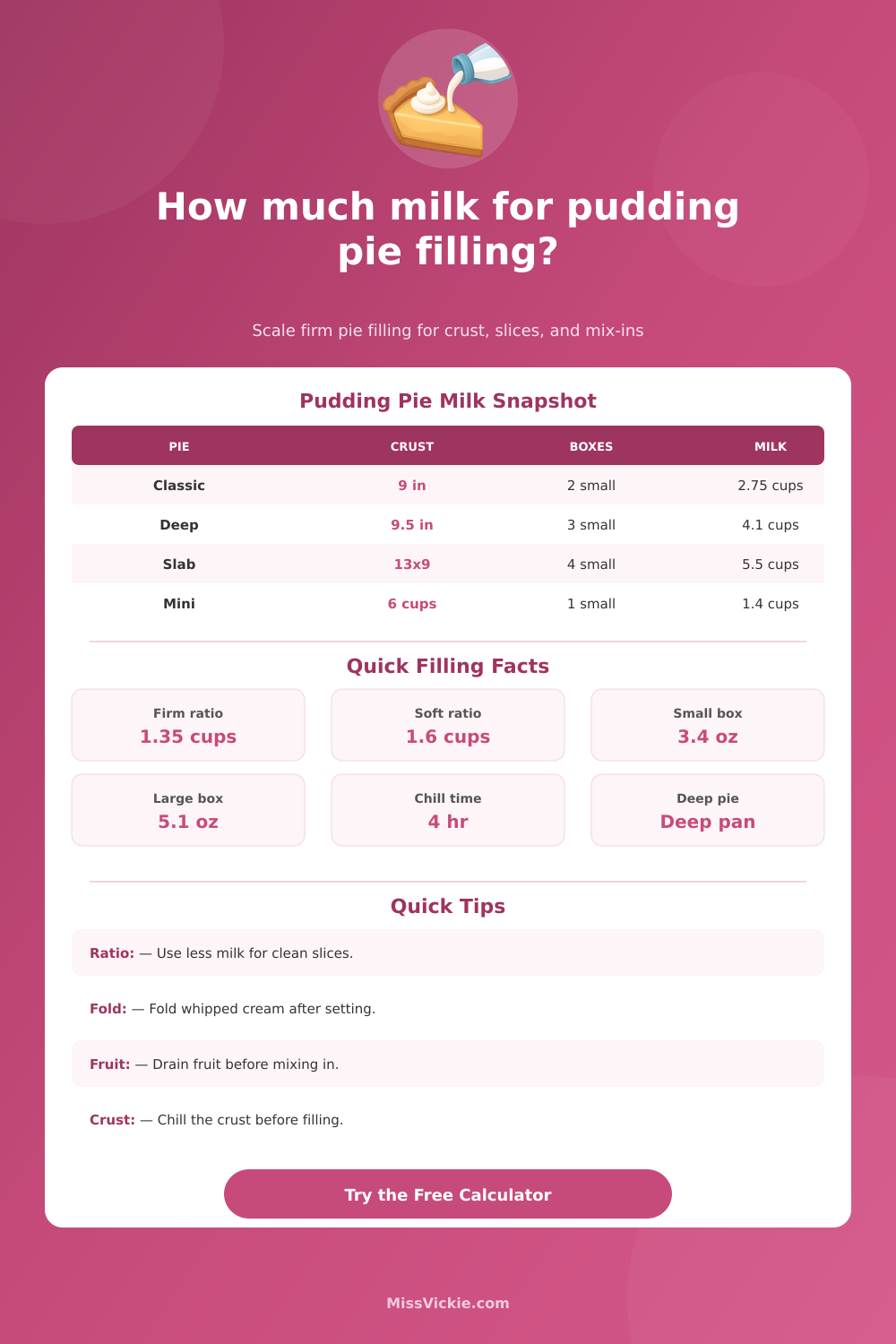
| Classic instant pudding pie | 1 small box | 1.30 to 1.45 cups | Firm, clean slice |
| Soft cream pie filling | 1 small box | 1.50 to 1.65 cups | Creamy and softer |
| Layered whipped filling | 1 small box | 1.15 to 1.35 cups | Room for topping fold-in |
| Cooked pudding pie | 1 small box | 1.55 to 1.85 cups | Silky, denser set |
| Crust or Pan | Useful Filling Capacity | Common Box Plan | Best Slice Count |
|---|---|---|---|
| Standard 9 inch pie shell | 3.6 to 4.0 cups | 2 small boxes | 8 slices |
| Deep 9.5 inch pie shell | 5.0 to 5.6 cups | 3 small boxes | 8 to 10 slices |
| Ten inch pie shell | 5.8 to 6.5 cups | 3 to 4 small boxes | 10 slices |
| Thirteen by nine slab pan | 8.5 to 10 cups | 4 to 5 small boxes | 16 to 20 squares |
| Mix-In | Volume Effect | Milk Adjustment | Handling Note |
|---|---|---|---|
| Whipped topping | Adds airy bulk | Reduce 8 to 14 percent | Fold after pudding thickens |
| Banana slices | Adds soft layers | Reduce 4 to 8 percent | Keep slices thin and dry |
| Drained berries | Adds moisture risk | Reduce 7 to 12 percent | Drain and pat dry first |
| Cookie crumbs | Absorbs moisture | Add 2 to 5 percent | Stir gently to avoid paste |
| Dairy Choice | Set Strength | Flavor Body | Calculator Bias |
|---|---|---|---|
| Whole milk | Reliable | Classic creamy | Baseline |
| Two percent milk | Reliable | Lighter dairy | Slightly less rich |
| Half milk, half cream | Very thick | Rich and dense | Allows a touch more liquid |
| Evaporated milk blend | Strong body | Cooked milk note | Good for tall pies |
The difference between a pudding pie with good slices and a pudding pie with slumped slices are the amount of milk you use. You need to use less milk than the amount called for on the pudding box. This is because the instruction on the pudding box are for when the pudding is to be served in a bowl.
The pudding in a bowl does not need to hold its shape, but the pudding pies filling must hold its shape in order to cut the pie into neat slice. The pudding mix come designed to be mixed quick, using two cup of milk to one small box of pudding mix. This ratio are appropriate for serving the pudding in a bowl.
How Much Milk to Use for a Pudding Pie
This ratio of milk to pudding mix are not appropriate for pie. The pie must hold the weight of the topping, and it must hold the weight of the slice of pie to support the weight of the pie’s topping. Using less milk than called for on the pudding box cause the pudding to set firm enough to hold the weight of the pie’s crust and any toppings.
The size of your pie crust is another factor that will influence the amount of pudding filling require. A deep crust will hold more pudding filling than a shallow crust. The depth of the crust will also impact the amount of time require for the center of the pie to set.
Using a slab pan to evenly spread the pudding filling across the crust will require more time for the center of the pie to set. Using a calculator will help you determine the proper amount of milk for the amount of pie crust you are using. The calculator will help you by removing the guesswork involve with determining the amount of milk to use in your pie.
Mix-ins for your pie will change the texture of the pie and change the amount of milk you need to use. Fold in whipped topping to the pudding mix will increase the amount of volume of the pudding. To balance the volume of the whipped topping, you will need to make the base of the pudding stiffer.
Adding fruit to the pie will add moisture to the pudding. To make up for the moisture that the fruit will add to the pie, you may need to use less pudding mix. Adding cookie crumbs to the pudding will absorb the liquid from the pudding.
To balance this ingredient, you may need to add more milk to the pie so that the pudding doesnt become too pasty. The type of dairy you use will impact the structure and flavor of your pie. Using whole milk will work best for the structure of the pie.
Using half-and-half will make the pie richer, and you can use more liquid because of the half-and-half. Skim milk will not contain the body to set the pudding as well as whole milk, so you will need to use a firmer ratio of milk to pudding mix. Using evaporated milk will add body to the pie.
This will help tall pies maintain there height. Chilling time is necessary to set the structure of the pudding. Chilling the pie for two hours may make the surface of the pudding look set.
However, the center of the pie may still be soft after only two hours of chilling. Four hour will allow the center of the pie to set proper. Chilling the pie overnight will produce the cleanest slices of pie.
The temperature at which you will serve the pie is another factor that will impact the amount of milk to use in the pie. Using the same amount of milk that will produce firm pudding in the refrigerator will result in soft pudding if the pie sits on a warm buffet table. To prevent the pie from becoming too soft, you will need to use even more milk if you plan on serving the pie on a warm table.
If you serve the pie directly from the refrigerator, you may use a slightly higher amount of milk than recommend. The goal that you have for your pie will impact the amount of milk in the pudding. If you want the pie to have clean bakery slices, you will need to use less milk and allow it to chill for a longer time.
For a soft pie that you will eat with a spoon, you can use more milk. Once you have measured the milk and mixed the pudding with the remaining pie ingredients, you will know if you used the correct amount of milk when you serve the pie. If the slice of pie slumps, it means you use too much milk.
However, using a calculator will help you avoid this problem by taking into account the type of crust to use, the type of dairy, the amount of mix-ins to the pie, and the temperature at which you will serve the pie.