Fresh pasta egg math, yolk richness, flour balance, and correction water
How Much Flour and Eggs for Pasta Calculator
Estimate the flour, whole eggs, yolks, water, salt, oil, and bench flour needed for fresh pasta dough, then see how the egg count changes the feel of the dough before you knead.
Choose a starting dough style, then adjust serving size, flour blend, egg size, yolk richness, and hydration target.
Calculation Breakdown
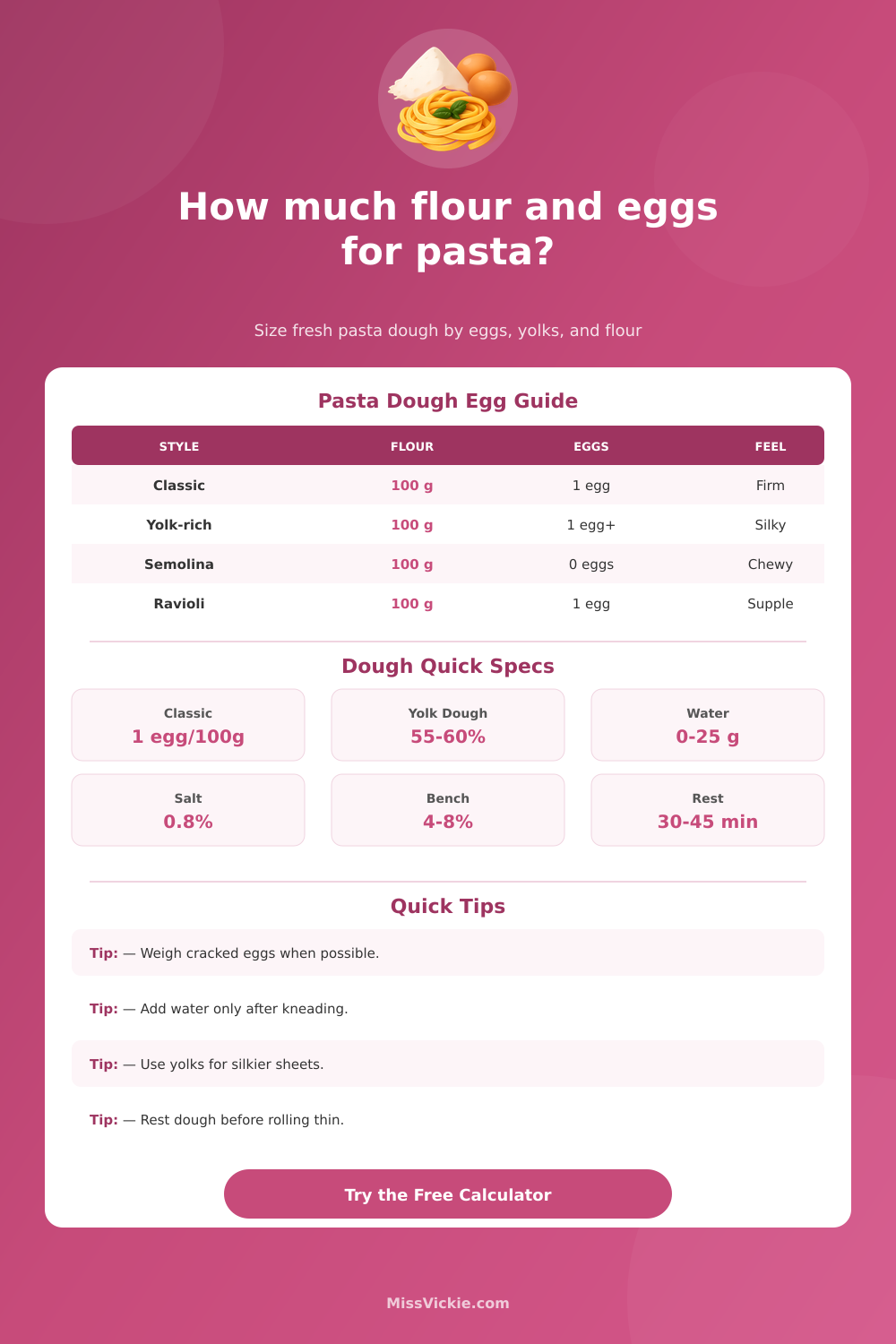
One large egg per 100 g flour gives firm, familiar hand-rolled pasta.
Extra yolks add color and tenderness, especially for filled pasta sheets.
Durum-heavy dough likes a slightly lower water target and longer kneading.
Spinach puree contributes water, so egg weight should be checked carefully.
| Pasta style | Flour per serving | Egg plan | Hydration cue | Best use |
|---|---|---|---|---|
| Classic noodles | 80 to 95 g | 1 egg per 100 g flour | 50 to 55% | Tagliatelle, fettuccine, simple sheets |
| Ravioli sheets | 85 to 105 g | Whole egg plus some yolk | 55 to 60% | Supple sheets that seal around filling |
| Lasagna sheets | 75 to 95 g | Moderate egg | 51 to 56% | Layered baked pasta with sauce |
| Semolina short pasta | 75 to 90 g | Optional egg or none | 42 to 50% | Cavatelli, trofie, rough hand shapes |
| Gluten-free pasta | 80 to 105 g | Egg plus moisture help | 58 to 66% | Sheet dough with binder-heavy blends |
| Egg size | Cracked weight | Flour matched at 52% | When to use | Correction note |
|---|---|---|---|---|
| Medium egg | 44 g | 85 g flour | Small batches and delicate dough | Add a few grams of water if crumbly |
| Large egg | 50 g | 96 g flour | Default home pasta ratio | Round to one egg per 95 to 100 g flour |
| Extra-large egg | 56 g | 108 g flour | Larger noodles and richer dough | Hold back water until dough hydrates |
| Egg yolk | 18 g | Adds richness, not structure | Ravioli, tajarin, pappardelle | Balance with less whole egg or water |
| Flour blend | Absorption | Texture | Suggested change | Rolling cue |
|---|---|---|---|---|
| Tipo 00 | Medium | Smooth and elastic | Use baseline hydration | Rolls thin with less dusting |
| All-purpose | Medium-high | Reliable and slightly springy | Add 1 to 2% liquid if dry | Rest fully before final passes |
| Semolina blend | Slow | Chewy and toothsome | Lower hydration, knead longer | Hydrates more during rest |
| Whole wheat blend | High | Nutty and firmer | Add 4 to 7% liquid | Roll a little thicker |
| Gluten-free blend | Variable | Tender, less elastic | Add moisture and oil | Roll between light dusting layers |
| Batch size | Fresh dough | Approx flour | Typical eggs | Use case |
|---|---|---|---|---|
| 2 servings | 240 to 280 g | 155 to 180 g | 2 large eggs | Weeknight noodles |
| 4 servings | 480 to 560 g | 310 to 365 g | 3 to 4 large eggs | Family dinner |
| 6 servings | 720 to 870 g | 465 to 565 g | 5 to 6 large eggs | Ravioli or guests |
| 10 servings | 1.2 to 1.4 kg | 780 to 910 g | 8 to 9 large eggs | Sunday batch |
| 20 servings | 2.4 to 2.8 kg | 1.55 to 1.82 kg | 16 to 18 large eggs | Party prep |
Making fresh pasta requires use the right ratio of flour to egg. The ratio of flour to eggs will ultimatly determine the texture of the fresh pasta that you make. If you use too little liquid in the pasta dough, the dough will be too tough to easy eat.
However, if you use too much liquid in your pasta, the pasta will be too sticky. Because the flour to eggs ratio are important, using a calculator will allow you to determine the exact weight of the flour and the exact weight of the eggs that you need in your recipe. Using a calculator allow you to avoid guessing what the proper weight are, and using a calculator will allow you to consistently prepare the correct amount of dough for each batch of pasta that you make.
Find the right flour and egg amounts for pasta
The amount of flour that you use in your recipe will depend on the number of people that will be eating the pasta. You will have to decide how many serving you need, and how much pasta dough you want to give to each person. A calculator will allow you to calculate the weight of the flour that you will need for your pasta.
Additionally, the calculator will also calculate the amount of bench flour that you will need. Bench flour is the flour that you will use on your countertop to prevent the pasta dough from sticking to your countertop. It is essential to remember to use separate amount of bench flour and dough flour.
You will use the dough flour for your recipe, and you will only use the bench flour for your countertop. The eggs that you will use in your pasta will contain both whole egg and egg yolks. A whole egg will contain both water and fat, while egg yolks will contain mostly fat and very little water.
Using more egg yolks in your pasta will create a product that has more fat than pasta that use less egg yolks. Additionally, pasta that contains more egg yolks will be a color that contains more yellow than pastas that contain less egg yolks. The calculator will allow you to adjust the number of whole eggs and extra yolk that you will use in your pasta.
Hydration refers to the amount of liquid that is present in your pasta dough in relation to the amount of flour that you use. Different types of flour will absorb the liquid in your pasta at different rate. For instance, Tipo 00 flour and all-purpose flour will absorb the liquid at a moderate rate and allow for the creation of a smooth pasta dough.
Semolina flour will absorb the liquid more slow than all-purpose flour and will require more kneading of the pasta to allow the dough to set. Lastly, whole wheat flour will require more liquid than white flour because the whole wheat flour is drier. The calculator will allow you to select the type of flour that you would like to use for your pasta.
Additionally, the calculator will adjust the hydration settings according to the type of flour that is selected. Salt and oil will be added to your pasta dough to increase the quality of the pasta. Salt will be added to the pasta dough to increase the strength of the gluten in your pasta.
Additionally, salt will enhance the flavor of the pasta. Oil will be added to the pasta to make it easier to roll the pasta, and oil can help prevent the pasta from tearing. These ingredient will be added in small amount to the pasta, but they are still essential ingredients to the pasta-making process.
Using the calculator allow you to determine the amount of ingredients needed for different styles of pasta, such as ravioli and tagliatelle. Ravioli recipes will require more egg yolks to the pasta, as the ravioli will contain fillings. However, tagliatelle will have a different ratio of flour and eggs.
The calculator will have presets for the ingredients needed for both these pasta styles, and allow you to customize those amounts according to your specification. After you recieve the measurements from the calculator, you can measure out the amount of flour that is needed by weight. Additionally, you can weigh out the amount of cracked egg that will be needed for the recipe.
Weighing the eggs is more accurate than simply counting how many eggs you will use in the pasta dough. Weighing the eggs will account for the difference in the weight of each egg. Mixing the flour and eggs will create the pasta dough, which will require time to rest.
During this resting period, the flour will become hydrated with the eggs, and the gluten in the flour will relax. If you allow the pasta dough to rest for thirty to forty-five minutes, the pasta will be easier to roll into thin sheet and less likely to tear when rolled. The calculator will help you to determine when the dough should rest, so you dont rush the process of making your pasta dough.
Finally, you will have to use your own set of hands to complete the pasta making process. The calculator cannot account for the humidity in your kitchen or the temperature of the eggs. Using your own pair of hands will allow you to feel the dough to determine if it is too dry or too wet.
If your dough is too dry, you can add a small amount of liquid to the dough. However, if the dough is too wet, you will have to add a small amount of flour to the dough. Your calculator provided you with measurement and specifications for your pasta dough, but your own pair of hands will allow for the last adjustments to be made to the dough.