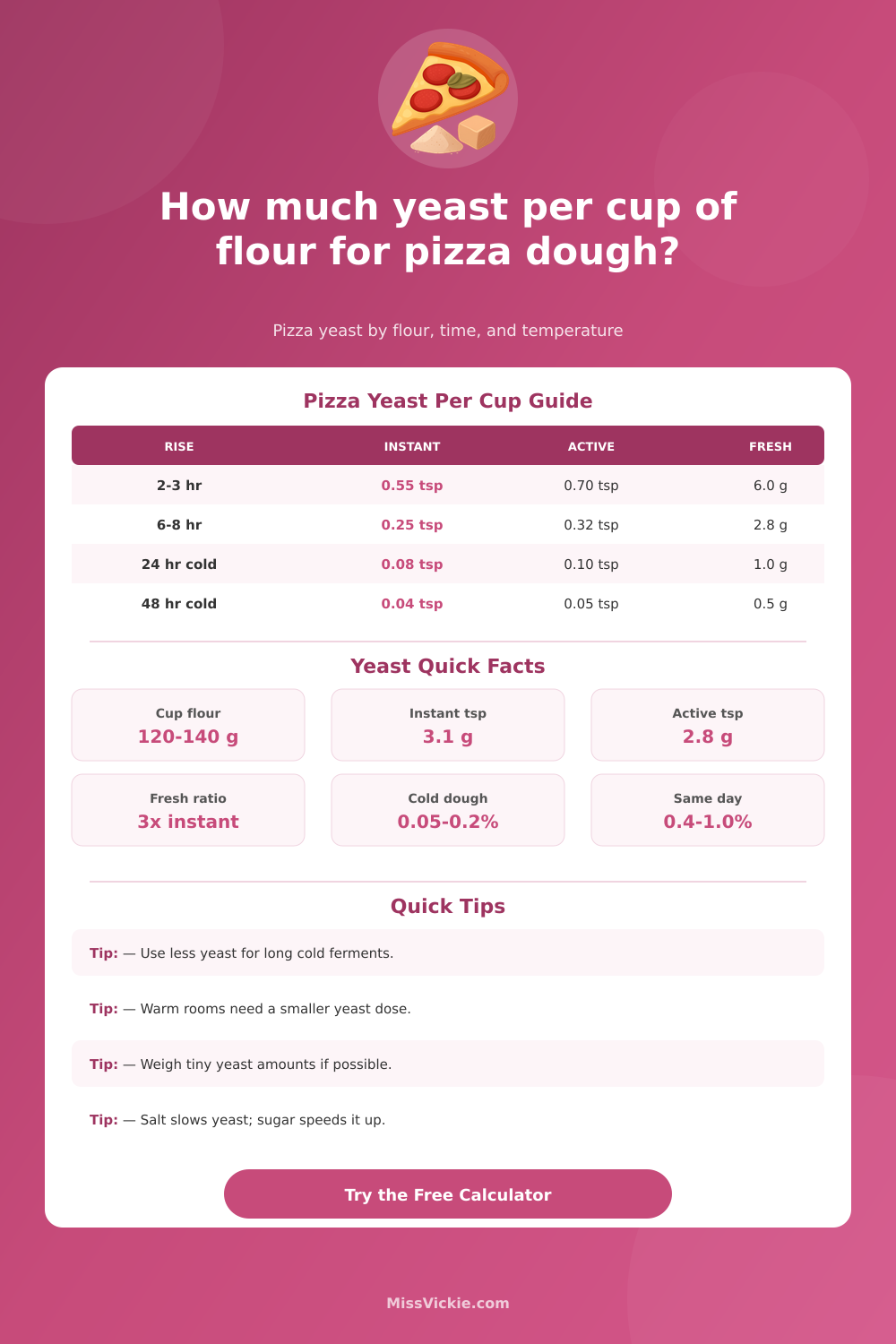
How Much Yeast Per Cup of Flour for Pizza Dough
Estimate instant, active dry, or fresh yeast for pizza dough using flour cups or grams, planned ferment time, room temperature, hydration, salt, oil, sugar, and dough ball targets.
Each preset loads a real pizza dough schedule so the calculator can show how yeast per cup changes between fast room rise dough and slow cold fermentation.
Pizza Dough Breakdown
| Pizza Schedule | Instant Yeast | Active Dry Yeast | Fresh Yeast | Best Use |
|---|---|---|---|---|
| Fast room rise, 2 to 3 hr | 0.45 to 0.75 tsp per cup | 0.55 to 0.95 tsp per cup | 5 to 8 g per cup | Last-minute pizza nights |
| Same-day dough, 5 to 8 hr | 0.18 to 0.35 tsp per cup | 0.22 to 0.45 tsp per cup | 2 to 4 g per cup | Balanced home pizza flavor |
| Overnight room or cool room | 0.08 to 0.18 tsp per cup | 0.10 to 0.23 tsp per cup | 1 to 2 g per cup | More flavor, less rush |
| 24 hour cold ferment | 0.04 to 0.12 tsp per cup | 0.05 to 0.15 tsp per cup | 0.5 to 1.4 g per cup | Leopard spotting and extensibility |
| 48 to 72 hour cold ferment | 0.02 to 0.07 tsp per cup | 0.03 to 0.09 tsp per cup | 0.25 to 0.8 g per cup | Slow flavor development |
| Flour Type | Grams per Cup | Typical Hydration | Yeast Behavior | Pizza Notes |
|---|---|---|---|---|
| All-purpose flour | 120 g | 60 to 67% | Predictable and moderate | Good for home ovens and thin crusts |
| Bread flour | 127 g | 62 to 70% | Strong gluten handles longer rests | Chewy New York style and pan pizza |
| Tipo 00 flour | 125 g | 58 to 65% | Use a lighter yeast hand | Neapolitan-style high heat bakes |
| Whole wheat blend | 130 g | 68 to 78% | Can ferment faster from nutrients | Use slightly more water and watch rise |
| High-gluten flour | 132 g | 62 to 72% | Forgiving for cold fermentation | Large slices, bagel-shop style chew |
| Gluten-free blend | 140 g | 75 to 90% | Often needs recipe-specific timing | Use the blend maker's liquid guidance |
| Room Temperature | Yeast Adjustment | Cold Ferment Note | Handling Cue |
|---|---|---|---|
| 60 to 64°F | Add 15 to 25% | Warm dough briefly before balling | Dough rises slowly and feels firm |
| 65 to 69°F | Add 5 to 10% | Good for overnight counter starts | Watch volume rather than the clock |
| 70 to 74°F | Use the base estimate | Standard home kitchen assumption | Dough should relax without sagging |
| 75 to 79°F | Reduce 10 to 20% | Shorten room start before chilling | Ball earlier if dough feels puffy |
| 80 to 85°F | Reduce 25 to 40% | Cold ferment quickly after mixing | Use cool water to protect timing |
| Batch | Flour | Dough Balls | Yeast Range | Useful Schedule |
|---|---|---|---|---|
| Two 10-inch pizzas | 2.5 cups / 310 g | 2 x 220 g | 0.2 to 2.5 g instant | Same-day or 24 hour cold |
| Four 12-inch pizzas | 4.2 cups / 525 g | 4 x 250 g | 0.4 to 4.5 g instant | Home oven family dinner |
| Six Neapolitan balls | 5.8 cups / 725 g | 6 x 240 g | 0.4 to 3.8 g instant | 24 to 48 hour cold ferment |
| Detroit 9x13 tray | 3 cups / 380 g | 1 tray | 0.3 to 3.2 g instant | Room proof plus pan rise |
| Party batch | 10 cups / 1250 g | 10 x 250 g | 0.8 to 10 g instant | Cold ferment and stagger bakes |
Mixes directly into flour, strong for tiny measured amounts, and is the calculator baseline.
Use a little more by weight than instant yeast and hydrate if the granules are coarse.
Soft cake yeast is heavier because it contains more water, so gram amounts look larger.
Useful in sweet or rich pan doughs where sugar and fat slow normal yeast activity.
The amount of yeast that you use in your pizza dough has a criticall influence on your dough. The amount of yeast that you use will determines both the rise of the dough and the flavor of the dough. If you use too much yeast, the dough will rise too quick and will either taste flat or tear when you attempt to shaping the dough.
Conversely, if you use too little yeast, the dough will not rise enough and will result in a dense and gummy dough. Consequently, you must adjust the amount of yeast that you use in your pizza dough to an ingredients that you use and the environment in which you prepare your dough. The type of yeast that you use will change the amount of yeast that you need.
How Much Yeast to Use in Pizza Dough
Instant yeast will work directly into the flour and will work at fast speed to allow for quick rising of the dough. Active dry yeast requires a hydration step prior to add the active dry yeast to your dough. Additionally, fresh yeast contains more moisture then other types of yeast, so you will need to measure the fresh yeast by weight.
Each of these types of yeast have different levels of biological activity. Consequently, you will need to adjust the amount of yeast to the type of yeast that you chooses to use. Fermentation time will influence the amount of yeast that you need.
If you need the dough to rise quickly, you will need to use more yeast to produce the gases that will enable the dough to rise quick. However, if the dough ferments for long period of time, such as when you allow the dough to rise in the refrigerator overnight, you can use less yeast because the long fermentation period replace the need for a large amount of yeast. Cooler temperatures will allow the enzymes in the dough to break down the starches to sugars and will prevent the dough from over proofing.
The kitchen temperature will influence the amount of yeast that you use in your recipe. If the temperature of your kitchen is warm, the yeast will work faster. In contrast, if it is cool in your kitchen, the dough will rise at a slower rate.
Additionally, other ingredient will influence the amount of yeast that you use. For instance, salt will slow the yeast, whereas sugar will give the yeast energy to work faster. Oil will also slow the rise of the dough because it will coat the gluten strand.
These ingredients will alter the fermentation process of your dough, so you must adjust the amount of yeast based off these ingredients. The type of flour that you use will also influence the behavior of the yeast. If you use all-purpose flour, the yeast will ferment at a steady rate.
However, bread flour contains more protein to create more gluten to enable the dough to rise more faster. Additionally, whole wheat flour contains more minerals and enzyme that will allow the yeast to work faster then if you used white flour. Consequently, you will need to adjust the amount of yeast to the type of flour that you use.
If you are preparing large batches of dough, you cannot simply use the same amount of yeast for each batch of dough. The masses of dough will hold heat differently, and the larger mass of dough will rise at different rates than smaller batches of dough. Additionally, the surface area of the dough will influence how fast it proofs.
Many people make mistakes in their dough. For instance, they do not consider the different amount of yeast needed for different climates and flours. Additionally, they dont have the tools to measure the small amounts of yeast that are needed.
Instead, they should of use a calculator to determine the amount of yeast that they will need. They should also consider the time and the temperature in the kitchen when preparing the dough. By adjusting the amount of yeast according to the time and temperature, each individual can create their own process for preparing pizza dough.