How Much Yeast to Add to Sourdough Starter Calculator
Estimate the tiny amount of instant, active dry, or fresh yeast to add after feeding a slow starter, then plan peak timing, hydration balance, jar volume, and whether the boost is gentle enough for sourdough flavor.
Load a real starter situation, then adjust the feeding ratio, room temperature, yeast type, and urgency. These doses are intentionally much smaller than bread dough yeast.
Starter Boost Breakdown
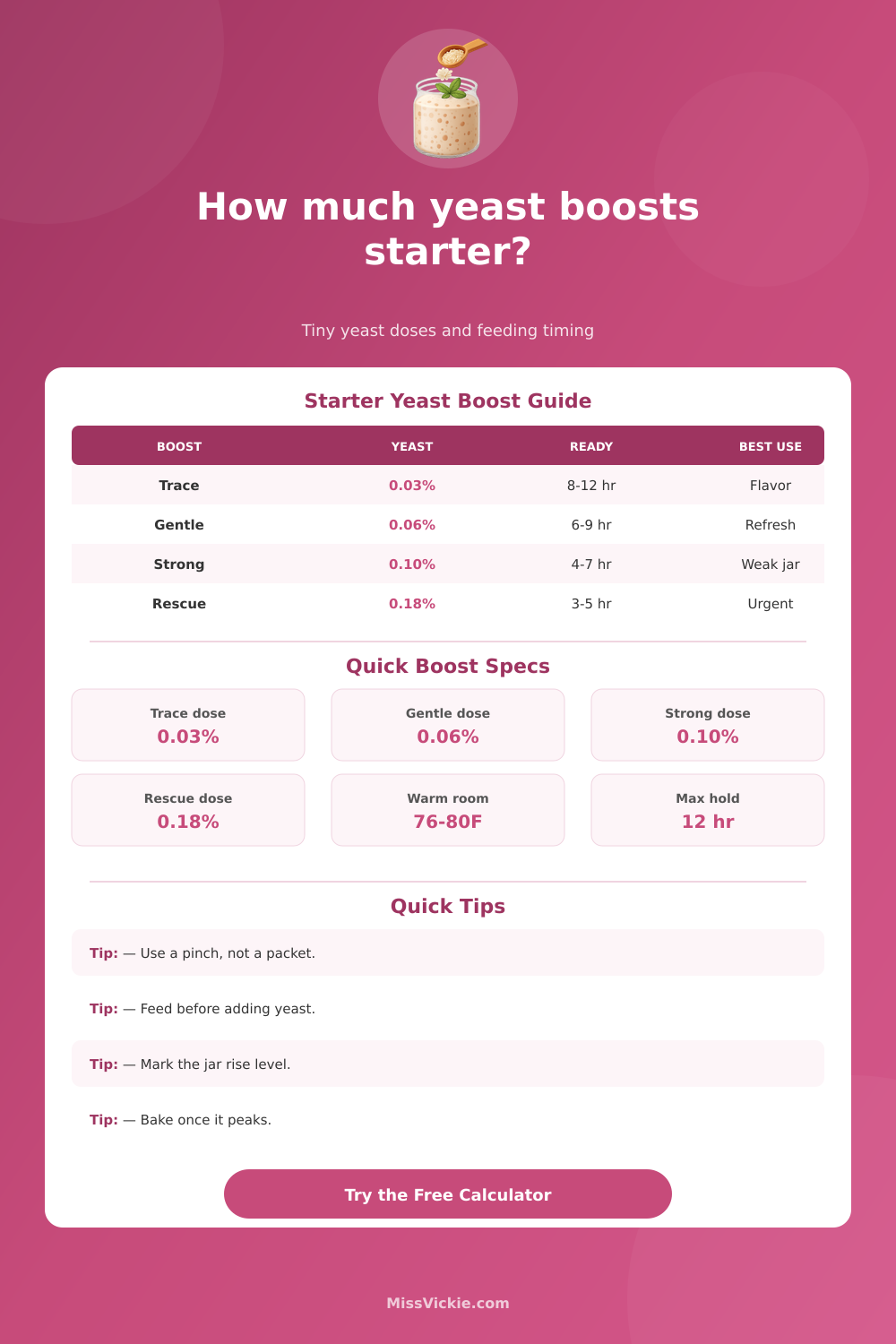
| Boost level | Instant yeast basis | Active dry amount | Fresh yeast amount | Use when |
|---|---|---|---|---|
| Trace | 0.03% of flour in the fed jar | about 1.25 times instant | about 3 times instant | Starter rises, but you want insurance without much flavor change. |
| Gentle | 0.06% of flour in the fed jar | about 1.25 times instant | about 3 times instant | Common choice for a sluggish starter that still smells pleasantly sour. |
| Strong | 0.10% of flour in the fed jar | about 1.25 times instant | about 3 times instant | Use after a full feed when the starter has been neglected or refrigerated. |
| Rescue | 0.18% of flour in the fed jar | about 1.25 times instant | about 3 times instant | For a one-time same-day bake; keep a separate unboosted starter if possible. |
| Room temperature | Trace boost | Gentle boost | Strong boost | Rescue boost |
|---|---|---|---|---|
| 64-68F / 18-20C | 10-14 hours | 8-12 hours | 6-9 hours | 4-7 hours |
| 70-74F / 21-23C | 8-12 hours | 6-9 hours | 5-7 hours | 3.5-5.5 hours |
| 76-80F / 24-27C | 6-10 hours | 5-8 hours | 4-6 hours | 3-5 hours |
| 82-86F / 28-30C | 5-8 hours | 4-6 hours | 3-5 hours | 2.5-4 hours |
| Starter state | Best boost | Feed first? | Keep separate? | Practical note |
|---|---|---|---|---|
| Healthy but slow | Trace or gentle | Yes | Optional | Use yeast only after the starter has fresh flour to ferment. |
| Hungry and collapsed | Gentle | Yes | Recommended | Discard hooch, feed, then add yeast after mixing the feed. |
| New starter | Trace | Yes | Yes | Yeast can make bubbles before the sourdough culture is mature. |
| Very acidic jar | Strong only for baking | Yes | Yes | Refresh the main culture separately for better long-term balance. |
| Fed starter size | Gentle instant yeast | Spoon estimate | Jar needed | Expected rise |
|---|---|---|---|---|
| 100 g starter mix | 0.03 g to 0.04 g | dusting pinch | 250 ml or larger | roughly double at peak |
| 250 g starter mix | 0.06 g to 0.08 g | small pinch | 500 ml or larger | double to triple if warm |
| 500 g starter mix | 0.12 g to 0.16 g | about 1/16 tsp | 1 liter or larger | leave headroom for foam |
| 1000 g starter mix | 0.25 g to 0.32 g | about 1/8 tsp | 2 liters or larger | stir down only if overflowing |
Best flavor and strongest sourdough identity, but a weak starter may miss your baking window.
A trace or gentle dose gives more predictable lift while keeping the starter-style feeding math.
A full packet overwhelms the jar and behaves like commercial preferment instead of starter rescue.
Boost only a levain for today's dough, and keep the mother starter unyeasted for future bakes.
This calculator is for kitchen planning, not food safety testing. Discard starter that smells rotten, shows mold, or has unusual colored growth.
When you add yeast to an sourdough starter, you will find that the amount of yeast that you add will change how the sourdough starter act. Adding too much yeast to a sourdough starter can make the sourdough culture act like commercial bread dough. You should only add a small amount of yeast to your sourdough culture.
A small amount of yeast will nudge the sourdough starter, but the sourdough starter will still contain the yeast and bacteria that create the sourdough flavor. To calculate the amount of yeast to add to your sourdough starter, you need to enter three different value into the calculator. First, enter the current weight of the sourdough starter.
How to Add Yeast to Your Sourdough Starter
Second, enter how much flour you will use for feeding the sourdough starter. Lastly, you need to enter the temperature of your room. The amount of flour you use will change the percentage of yeast in the sourdough starter.
The temperature of the room will change the action of the yeast in your sourdough culture. If it is warmer in your kitchen, the yeast will work fast. If it is cooler in your kitchen, the sourdough starter will take longer to reach its peak.
Before you add yeast to your sourdough starter, feed the sourdough starter with flour and water. This will provide food for the microbe in the sourdough starter. It also will ensure that adding the commercial yeast will only speed up the sourdough starter’s activities.
Using the calculator, you can determine the hydration of your sourdough starter after feeding it. The hydration will tell you whether the sourdough starter will be stiff or loose. Stiffer sourdough starters take longer to rise than loose sourdough starters.
The calculator will ask for the original hydration percentage of your sourdough starter so that it can calculate the time for your boosted sourdough starter to reach its peak. The temperature in the kitchen is one of the variable that will affect the sourdough starter. If it is 70 degrees in the kitchen, the sourdough starter will take longer to reach its peak than if the temperature in the kitchen is 78 degrees.
The calculator takes the temperature into account in calculating how long it will take for the sourdough starter to reach its peak. However, you must also consider the temperature of the sourdough starter. If the sourdough starter is directly from the refrigerator, it will take longer for the sourdough starter to reach its peak because the temperature of the starter is much warmer than the kitchen.
Additionally, if your sourdough starter smells very acidic, it may take longer for the added yeast to affect the sourdough starter. The reference table to the sourdough starter illustrates the difference between adding a trace amount of yeast (trace boost) to your sourdough starter and adding a rescue dose of yeast to rescue a sourdough starter that is struggling. The trace amount of yeast uses a very small percentage of yeast to the weight of the sourdough starter.
A rescue dose will use a larger percentage of yeast. You want to use a small percentage of yeast to boost a sourdough starter because once the percentage of yeast is over 0.1%, the sourdough starter will begin to act more like commercial bread dough than sourdough starter. The calculator will show you the amount of yeast in grams and common kitchen measurements so you can decide whether the amount is a small amount of yeast or a large amount of yeast to be added to your sourdough starter.
Many sourdough starters have a separate jar for the levain portion of the sourdough starter. If you use a separate jar for this portion of the sourdough starter, you will protect your sourdough starter culture. Additionally, having a separate jar will ensure that if the levain portion begins to rise faster than you would like, you will not negatively affect your sourdough culture.
The calculator will show you the total volume of the sourdough starter after you feed it. This will allow you to determine whether your jar has enough space for the sourdough starter or if you need to purchase a second jar for your levain portion. Because many home bakers dont have a digital scale to measure the amount of yeast in grams, the calculator will provide spoon estimate for the amount of yeast to be used in your sourdough starter.
The most accurate way to measure the amount of yeast is to use a digital scale that reads to 0.01 gram of weight. However, the calculator will translate the digital scale into spoon measurements so that anyone can use this tool in their kitchen that may not have a digital kitchen scale. Depending on the condition of your sourdough starter, it will change how the yeast affect the sourdough starter.
If you are using a new sourdough starter that is less than two weeks old, it may produce bubbles from the commercial yeast before the sourdough starter’s microbes are ready to perform. In this case, use the “new” sourdough starter setting in the calculator. Sourdoah starter that is hungry for flour need to be fed generously.
Remove the liquid from the sourdough starter, known as hooch, before feeding the sourdough starter. The calculator will show the high and low hours that the sourdough starter will reach its peak. The calculator can adjust according to the different conditions of the sourdough starter.
Another decision you must make is whether you are attempting to rescue your sourdough starter or protecting the sourdough culture. Adding yeast to a sourdough starter will allow the sourdough starter to reach its peak sooner. However, the sourdough starter may lose its flavor.
If you want your sourdough starter to have its flavor, use a small amount of yeast or no yeast at all. The calculator will help you make this decision about how much yeast to add to your sourdough starter. Finally, you should continue to watch your sourdough starter.
When sourdough starter reaches its peak, the surface will dome up, and the sides of the jar will have a rise line on them. The state of your sourdough starter is more important than the clock or the calculator to determine when to add your sourdough starter to your bread to bake. The sourdough starter will tell you when it is ready to be baked into sourdough bread.