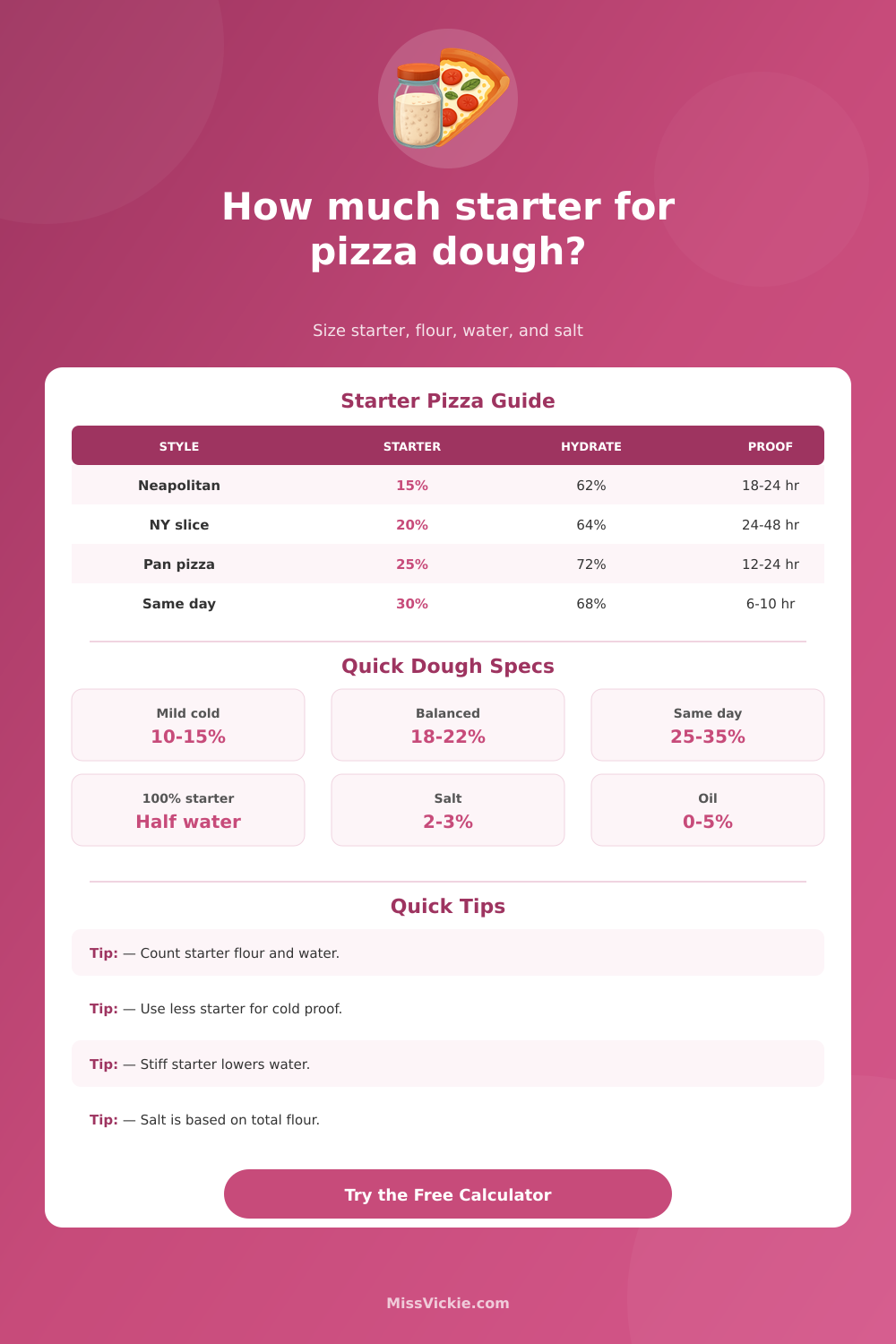
Starter, total flour, hydration, salt, oil, and proof timing
How Much Sourdough Starter For Pizza Dough Calculator
Build a sourdough pizza dough formula from total dough weight or dough balls, then see exactly how much starter, fresh flour, added water, salt, oil, and sugar to mix.
Choose a pizza style or proofing schedule, then fine-tune starter percentage, starter hydration, target hydration, and dough ball weight.
Formula Breakdown
| Schedule | Starter % | Best Use | Flavor Result |
|---|---|---|---|
| 48-72 hour cold proof | 8% to 14% | Slow dough, strong starter, high flavor | Mild tang, open rim, less risk of overproofing |
| 24-48 hour cold proof | 15% to 22% | Balanced home pizza schedule | Sweet wheat flavor with gentle sourdough notes |
| Overnight room proof | 18% to 26% | Cool kitchen or evening mix | More fermentation aroma and a tender bite |
| Same day warm proof | 25% to 35% | Fast sourdough pizza without commercial yeast | Noticeable starter flavor and quicker rise |
| Pizza Style | Dough Ball Or Tray | Hydration | Salt And Fat |
|---|---|---|---|
| Neapolitan round | 240 g to 280 g ball | 58% to 64% | 2.5% to 3% salt, usually no oil |
| New York slice | 380 g to 480 g ball | 60% to 66% | 2.3% to 2.8% salt, 1% to 3% oil |
| Cast iron pan pizza | 450 g to 700 g per pan | 68% to 76% | 2.2% to 2.7% salt, 3% to 5% oil |
| Detroit tray pizza | 550 g to 950 g per tray | 70% to 78% | 2.2% to 2.8% salt, 2% to 4% oil |
| Thin crust | 170 g to 240 g ball | 54% to 60% | 2% to 2.7% salt, optional oil |
| Whole grain pizza | 260 g to 320 g ball | 65% to 72% | 2.4% to 2.9% salt, oil optional |
| Starter Hydration | Flour In 100 g Starter | Water In 100 g Starter | How It Changes Dough |
|---|---|---|---|
| 50% stiff starter | 66.7 g flour | 33.3 g water | Adds strength and requires more fresh water |
| 65% stiff levain | 60.6 g flour | 39.4 g water | Good for long proof pizza with lower acidity |
| 100% liquid starter | 50 g flour | 50 g water | Easiest formula: half flour and half water |
| 125% loose starter | 44.4 g flour | 55.6 g water | Raises water contribution, so add less water |
| Pizza Plan | Total Dough | Typical Starter | Mixing Note |
|---|---|---|---|
| Two 10-inch rounds | 500 g to 560 g | 55 g to 120 g | Use lower starter if refrigerating overnight |
| Four 12-inch rounds | 960 g to 1120 g | 110 g to 240 g | Ball after bulk for easier shaping |
| One 10x14 Detroit tray | 650 g to 800 g | 130 g to 220 g | High hydration makes the crumb lighter |
| Six pizza party rounds | 1500 g to 1800 g | 220 g to 430 g | Keep balls chilled until topping time |
Best for long cold proofing, strong gluten, and mild acidity.
A reliable middle ground for most sourdough pizza dough.
Useful for same-day dough, but watch warmth and overproofing.
Adds more flour than water, so the calculator raises added water.
The amount of sourdough starter that is use in the pizza dough will affect the flavor, texture, and fermentation speed of the dough. Using too little starter will result in a long fermentation time. Using too much will make the dough ferment too quick and result in over-fermented dough that is difficult to stretch.
The amount of sourdough starter that you use will change the colors of the crust and the structure of the crumb of the pizza. Sourdough starter contain both flour and water. Thus, the amount of sourdough starter that is used will change the amount of flour and the amount of water that is used in the pizza dough.
How Much Sourdough Starter to Use in Pizza Dough
The hydration percentage of the sourdough starter must also be accounted for in the hydration of the pizza dough. A 100% hydration sourdough starter contains equal parts flour and water. A sourdough starter that is 65% hydration contains more flour than water.
Because the 65% hydration sourdough starter have more flour than water, more liquid will be needed in the pizza dough to account for the hydration. These calculations are important to make because the dough may be mixed too much or too little by feel alone. Different styles of pizza requires different amounts of sourdough starter.
For instance, Neapolitan pizza dough uses a small amount of sourdough starter but undergoes a cold fermentation process to develop the flavor in the dough. New York style pizza dough require more sourdough starter because it is more acidic and it also contains oil to help it to stretch. Pan and Detroit style pizza dough contain more oil and is more hydrated so the amount of sourdough starter must be adjusted for the warmer fermentation times required by these two style.
The style of the pizza will impact the amount of sourdough starter, as will the temperature and length of time in which the dough is proofed. Cold proofing is a process where the pizza dough is allowed to sit in a location that is much colder than the room temperature. Because cold proofing slows the fermentation process, it is possible to use less sourdough starter if the pizza dough is going to sit in a proofing location for twenty-four to forty-eight hours.
After longer proofing time, a lower amount of sourdough starter will result in an open crumb pizza dough. Same day sourdough pizzas will require more sourdough starter because the proofing time will be shorter. In making same day pizzas, it is important to monitor the temperature in the kitchen where the pizza is being made because a high room temperature will make the dough proof too quickly.
The room temperature in the kitchen in which the pizza is to be made will impact the sourdough starter in the pizza. Higher temperatures will speed up the sourdough starter fermentation process. A 20% sourdough starter may act like a 30% sourdough if used in a warm kitchen.
A cool kitchen will slow the sourdough starter fermentation process. A proof schedule can assist in the selection of the proper amount of sourdough starter. Although salt and oil do not factor into the calculation of the sourdough starter, they do have an impact upon the behavior of the dough.
Salt will slow the sourdough starter fermentation process and enhance the gluten in the dough. Pizza dough can contain more salt than other bread. Oil will soften the dough and assist in the handling of high hydration dough but spoils the dough faster after baking the pizza.
Sugar and malt can assist in the browning of the pizza crust in ovens that reach temperatures that are lower than the required temperatures for browning the crust. Although sourdough starter does not have to be mathematically calculated when salt and oil are accounted for, the behavior of sourdough starter will be affected. The dough will lose some of its mass when it is moved from one location to another.
Whether it is moved from a bowl to a counter, or from a scale to a ball, some of the dough will stick to these locations. Allowances must be made for this loss of dough so that the ball of dough end up with the same weight. Allowing for dough loss will make each ball of dough the same weight, which is important if making many balls of dough for a group of people.
The reference tables provides examples of the amount of sourdough starter that has worked for various styles of pizza and proofing times. These amounts are starting points for making pizza. Depending upon the type of dough that is made and the sourdough starter that is used, adjustments can be made to the amount of sourdough starter or oil in the recipe.
For instance, using a stiffer sourdough starter may allow for more sourdough starter to be added if the pizza dough will undergo a long period of cold proofing. In the same manner, if the dough will be high in hydration, more oil may be needed to assist in the handling of that type of dough. Sourdough pizza dough recipes require that you understand the relationship between sourdough starter, time, and temperature.
A calculator for sourdough starter will assist in the recipe by making the calculations for you. By understanding the temperature and time that the sourdough starter will be in the dough, and by understanding the amount of sourdough starter that will be used, you can make it easy to manage the sourdough starter.