How Much Bread Flour To Feed Sourdough Starter
Calculate the bread flour and water for a sourdough starter feed by seed weight, current hydration, target hydration, feeding ratio, bread flour absorption, temperature, schedule, and jar size.
Pick a starter plan, then fine tune the bread flour ratio, target hydration, temperature, and jar capacity.
Bread Flour Feeding Breakdown
Use when the starter is hungry and you need a quick same-day refresh.
The steady bread flour routine for a predictable liquid starter.
Builds enough starter for dough while diluting old acidity.
Best for overnight timing, mild flavor, or a warm kitchen.
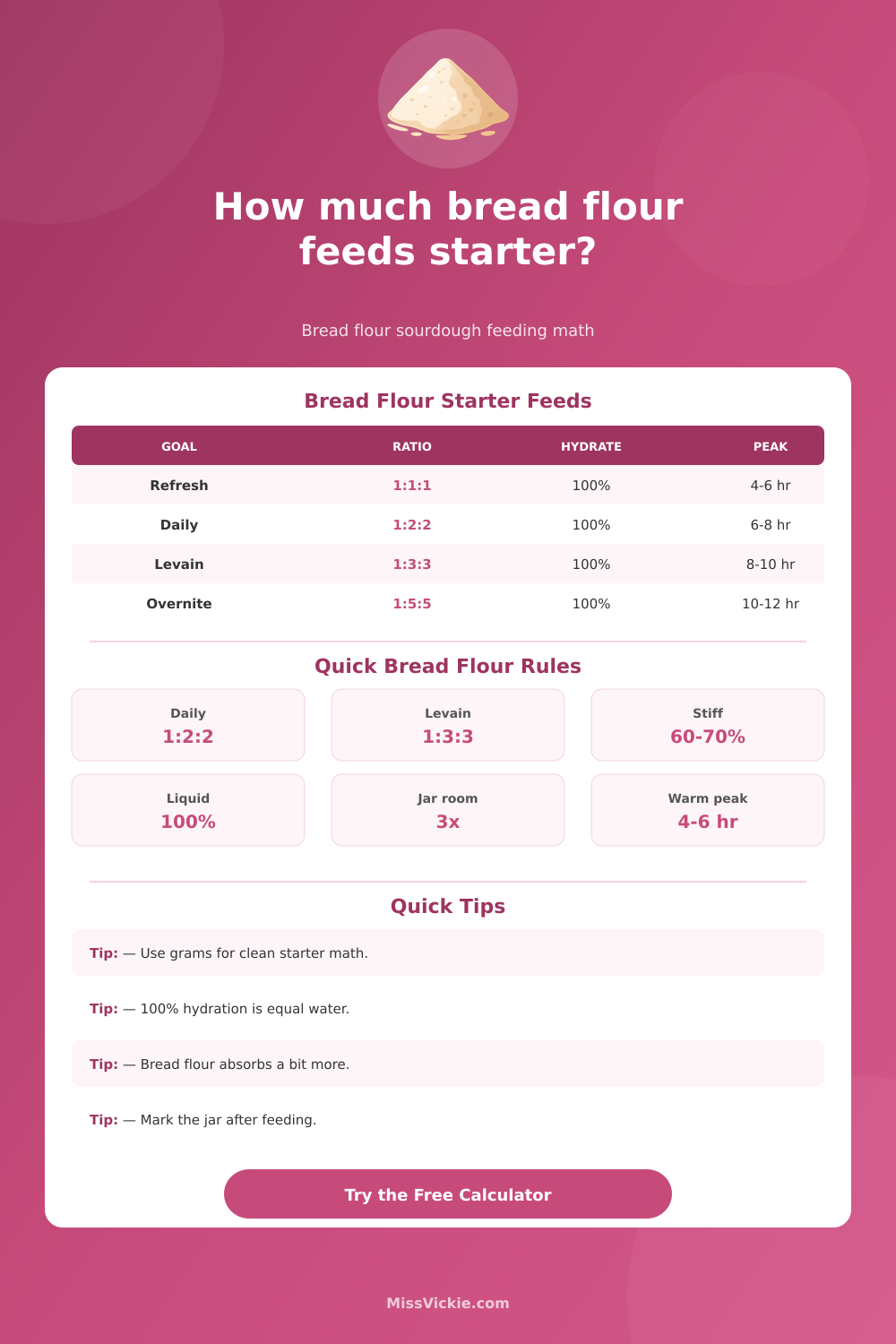
| Feeding Ratio | Example With 25 g Starter | Best Use | Typical Peak Window |
|---|---|---|---|
| 1:1:1 | 25 g starter + 25 g bread flour + about 25 g water | Fast refresh before baking | 4 to 6 hours in a warm room |
| 1:2:2 | 25 g starter + 50 g bread flour + about 50 g water | Daily countertop feeding | 6 to 8 hours in a normal kitchen |
| 1:3:3 | 25 g starter + 75 g bread flour + about 75 g water | Levain build for bread dough | 8 to 10 hours depending on strength |
| 1:5:5 | 25 g starter + 125 g bread flour + about 125 g water | Overnight feed or milder starter | 10 to 12 hours at moderate temperature |
| 1:3:2 | 25 g starter + 75 g bread flour + about 50 g water | Stiffer starter with bread flour chew | 8 to 12 hours, often slower |
| Target Hydration | What It Means | Bread Flour Texture | Best Starter Use |
|---|---|---|---|
| 60% to 70% | Water weighs 60% to 70% of total flour | Firm dough ball or paste | Stiff sweet levain, slower fermentation |
| 80% to 90% | Water is slightly lower than flour weight | Thick spoonable starter | Cool kitchens and stronger bread flour |
| 100% | Equal total flour and water by weight | Loose paste that domes and bubbles | Most everyday sourdough starters |
| 110% to 125% | Water weighs more than total flour | Very loose, fast-moving starter | Warm rooms, rye boosts, quick levains |
| Flour Style | Absorption Feel | Fermentation Effect | Adjustment Note |
|---|---|---|---|
| Standard bread flour | Baseline, slightly stronger than AP flour | Reliable rise and dome | Start at 100% hydration for liquid starter |
| Strong bread flour | Can feel tighter at the same water level | Holds structure well | Add 2% to 4% water if it seems dry |
| Malted bread flour | Softens as fermentation speeds up | Often peaks a little faster | Watch peak, especially in a warm kitchen |
| Bread flour plus rye | Thicker and more aromatic | Rye can wake a sluggish starter | Use 5% to 20% rye boost, not all rye |
| Bread flour plus whole wheat | Absorbs more water and ferments actively | Nutty, vigorous build | Increase water if the paste turns stiff |
| Kitchen Temperature | Bread Flour Starter Behavior | Typical Peak Cue | Feeding Adjustment |
|---|---|---|---|
| 64 to 68 F | Slow, steady fermentation | Peaks late and may dome gently | Use 1:1:1 or warmer water when you need speed |
| 69 to 74 F | Balanced daily rhythm | Doubles or triples near the normal window | 1:2:2 is a practical bread flour routine |
| 75 to 80 F | Fast rise with more acid buildup | Peaks sooner, then collapses faster | Use a larger feed, such as 1:3:3 or 1:5:5 |
| Above 80 F | Very fast and easy to overproof | Sharp aroma and quick fall after peak | Reduce seed amount or move the jar cooler |
| Starter Goal | Seed Starter | Bread Flour To Feed | Approx Final Starter |
|---|---|---|---|
| Small maintenance jar | 10 g | 20 g bread flour | 50 g at 100% hydration |
| Daily medium jar | 25 g | 50 g bread flour | 125 g at 100% hydration |
| Single loaf levain | 20 g | 60 g bread flour | 140 g at 100% hydration |
| Two loaf bake | 30 g | 120 g bread flour | 270 g at 100% hydration |
| Overnight mild levain | 15 g | 75 g bread flour | 165 g at 100% hydration |
Feeding a sourdough starter play a vital role in determining how the sourdough starter will perform during the baking process. Using a correct amount of bread flour will allow the sourdough starter to remains lively, but using incorrect amount of bread flour will cause the sourdough starter to becomes sluggish or even cause the dough to collapse on itself. The amount of bread flour to use when feeding the sourdough starter depend on the amount of sourdough starter you keep, the temperature of the room in which you will perform these activities, and the type of sourdough starter you want to create.
Bread flour is most commonly used to feed a sourdough starter because it has a higher protein content than other type of flour, such as all-purpose flour. Using bread flour will maintain the structure of the sourdough starter, and if the sourdough starter begin to become too thick during the feeding process, you can always add more water to compensate for the difference in the absorption of the bread flour. Bread flour is the most common flour used to feed a sourdough starter, and many individuals will stick to this type of flour unless the sourdough starter become too thick to stir.
How to Feed Your Sourdough Starter
The amount of sourdough starter that you keep will determine the feeding process. The larger the amount of sourdough starter that you keep, the more acidity that will be introduced into the sourdough starter prior to feeding it. If you have a small amount of sourdough starter, the new bread flour will have a more greater influence on the flavor of the sourdough starter.
A one-to-one feeding ratio will create a sourdough starter that remains lively, but a two-to-one or three-to-one ratio will allow the sourdough starter to becomes sluggish. A larger ratio will allow the sourdough starter to reach its peak later during the 24-hour period, as this feeding ratio will provide the sourdough starter with more food. The temperature of the room will play a vital role in the sourdough starter’s peak.
In a cooler room, it will take longer for the sourdough starter to reach its peak, while in a warmer room, the sourdough starter will reach its peak more quick. In a warm room, where a sourdough starter will reach its peak more quickly, you will utilize a larger feeding ratio. A sluggish sourdough starter will require feeding with a generous amount of bread flour and water to allow it to become lively again.
A sourdough starter that is too strong and vigorous active can be fed with a higher ratio of bread flour and water without peaking too quickly. Hydration is the ratio of water to bread flour in the sourdough starter. Many bakers use a hydration level of 100 percent for their daily maintenance of their sourdough starter.
Using 100 percent hydration level create a paste that is easy to mix. If you use a lower percentage of hydration, you will create a stiffer sourdough starter that ferments more slow. Using a higher percentage of hydration will ferment your sourdough starter faster.
You will want to use a higher percentage of hydration if the temperature in your kitchen is very warm. You must use a hydration level based off the type of flour that you use and your schedule for feeding the sourdough starter. The portion of the sourdough starter that you remove before you add fresh bread flour and water is called the discard.
By removing the sourdough starter, you allow the fresh bread flour and water to influence the flavor of the sourdough starter. Without removing enough sourdough starter, the sourdough starter could become too acidic. You can use the discard from the sourdough starter to make other foods, such as crackers or pancakes.
One more consideration when feeding the sourdough starter is the size of the jar. When the sourdough starter ferments, it will expand in size. You need to use a jar that can hold the amount of sourdough starter after it has triple in size.
One strategy is to begin with a jar that is only one quarter full of sourdough starter. This will provide enough room for the sourdough starter to expand. If there is too much room in the jar, you will not be able to see the bubbles and the dome that are created when the sourdough starter has peaked.
You must also consider how to determine when the sourdough starter has reached its peak. You can use a clock to help you determine when to stop feeding the sourdough starter, but you should also observe the sourdough starter. The length of time it takes for the sourdough starter to peak will change depending on the temperature in the kitchen, the type of bread flour that you use, and the ratio in which you feed the sourdough starter.
If the kitchen where you are feeding the sourdough starter is warm, the sourdough starter will reach its peak in a shorter amount of time than if the kitchen was cooler in temperature. Once you have observed how long it takes for the sourdough starter to peak under various conditions in your kitchen, you will understand the feeding schedule for the sourdough starter that you will use in your baking kitchen. Depending on your goals in feeding the sourdough starter, you can use a small amount of sourdough starter or a large amount of sourdough starter.
One goal in feeding the sourdough starter is to become familiar with how the feeding ratio influence the sourdough starter’s speed, flavor, and strength. Once you understand the effect that the feeding ratio has upon the sourdough starter, you can adjust the amount of bread flour and water that you feed to the sourdough starter to match your schedule. If you manage the sourdough starter correctly, the sourdough starter will exhibit predictable behavior and it will be easier for you to bake the bread that you create with the sourdough starter.