Lemon juice, baking soda, liquid reduction, flour weight, and bake timing
How Much Lemon Juice to Substitute for Baking Powder
Calculate a baking powder substitute using lemon juice and baking soda, then adjust batter liquid, sweetness, acidity, and timing for pancakes, muffins, biscuits, cakes, quick breads, waffles, and cookies.
Choose a real baking situation, then tune the original baking powder amount, flour, liquid, sweetness, bake delay, and lemon strength.
Substitution Breakdown
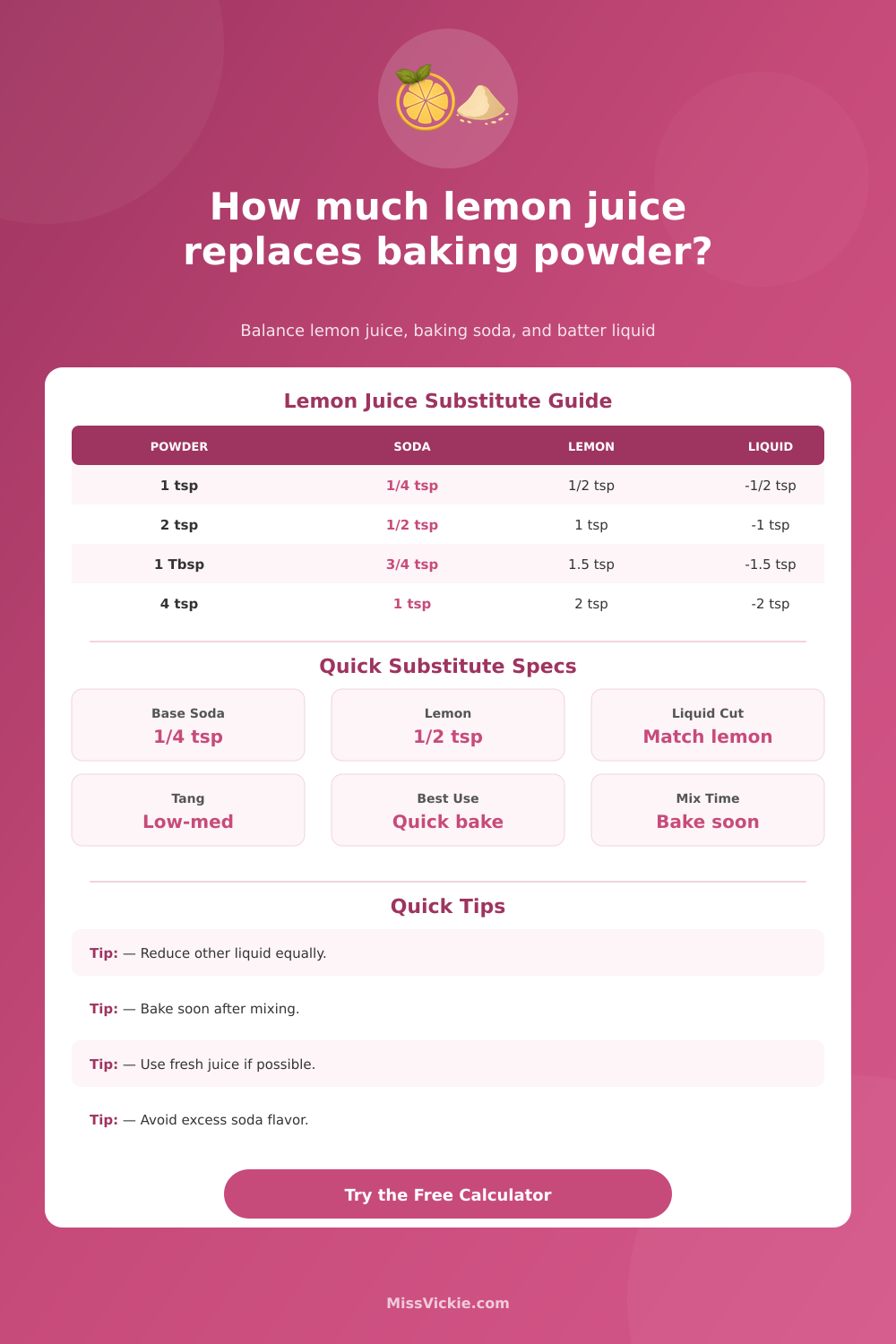
| Baking powder called for | Baking soda to use | Lemon juice to add | Liquid to remove | Best fit |
|---|---|---|---|---|
| 1/2 tsp baking powder | 1/8 tsp baking soda | 1/4 tsp lemon juice | 1/4 tsp other liquid | Small cookie or half batch |
| 1 tsp baking powder | 1/4 tsp baking soda | 1/2 tsp lemon juice | 1/2 tsp other liquid | Single cup flour batters |
| 2 tsp baking powder | 1/2 tsp baking soda | 1 tsp lemon juice | 1 tsp other liquid | Pancakes, waffles, muffins |
| 1 Tbsp baking powder | 3/4 tsp baking soda | 1 1/2 tsp lemon juice | 1 1/2 tsp other liquid | Large quick breads |
| 4 tsp baking powder | 1 tsp baking soda | 2 tsp lemon juice | 2 tsp other liquid | Double batch or tall cake |
| Baked good | Powder range | Soda cap | Lemon tolerance | Timing note |
|---|---|---|---|---|
| Pancakes | 1 1/2 to 2 tsp per cup flour | 1/2 tsp per cup | Noticeable but pleasant | Cook as soon as bubbles form |
| Muffins | 1 to 2 tsp per cup flour | 1/2 tsp per cup | Works with fruit flavors | Fill tins promptly |
| Biscuits | 1 to 1 1/2 tsp per cup flour | 3/8 tsp per cup | Keep lemon modest | Bake while dough is cold |
| Snack cake | 1 to 1 1/4 tsp per cup flour | 1/4 to 3/8 tsp per cup | Needs enough sugar | Avoid long counter rest |
| Cookies | 1/2 to 1 tsp per cup flour | 1/8 to 1/4 tsp per cup | Can taste sharp | Use gentle lift setting |
| Acid source | Strength factor | Flavor impact | Use when | Adjustment |
|---|---|---|---|---|
| Fresh lemon juice | 1.00x | Clean citrus tang | Most sweet quick batters | Base calculator setting |
| Bottled lemon juice | 0.95x | Slightly flatter citrus | Reliable pantry backup | Use a small extra splash |
| Meyer lemon juice | 0.82x | Sweeter and floral | Cakes and tender muffins | Needs more juice for same acid |
| Concentrated lemon | 1.18x | Sharper if overused | Very small substitutions | Use less than fresh juice |
| White vinegar | 1.05x | Neutral once baked | When citrus flavor is unwanted | Same liquid reduction rule |
Strong griddle lift, low risk when cooked right after mixing.
Works well with berries, banana, apple, and citrus batters.
Keep the acid small so the dough stays flaky and not tangy.
Use gentle lift because extra soda spreads and browns faster.
When a recipe call for baking powder but you find that the baking powder tin are empty, you can use lemon juice and baking soda to replace baking powder. Baking powder contains baking soda and an acid; using lemon juice and baking soda is a way to separate these two ingredient. The balance of acid, liquid, flour weight and timing will determine the amount that the batter will rise and the flavor of the baked goods.
Baking soda require an acid to react to create the carbon dioxide that will make the dough rise. Lemon juice contain the acid required to activate the baking soda, but it also add liquid to the batter. If you do not remove liquid from the recipe to compensate for the liquid in the lemon juice, the batter will be too thin.
Replace Baking Powder with Lemon Juice and Baking Soda
You should remove an equal amount of liquid from the recipe for every teaspoon of lemon juice that you use. Removing the same amount of liquid from the recipe that you add in lemon juice will allow the recipe to maintain the same ratio of wet to dry ingredients as the recipe that called for baking powder. The weight of the flour for the recipe will determine how much baking soda that the batter can contain.
Using too much baking soda will lead to a soapy aftertaste of the baking soda once the acid in the recipe has reacted and broken down the baking soda. Using too little baking soda will prevent the batter from rising enough to properly form the baked good. Whisking the baking soda into the flour will ensure that the baking soda does not clump in the batter and create brown spots in the finished baked good.
The amount of sugar and other acids in the recipe will alter the amount of lemon juice that you can taste in the batter. Products that contain alot of sugar, like cakes, will mask the taste of the lemon juice. Products that contain very little sugar, like cornbread, will allow the flavor of the lemon juice to be more noticeable.
Most baked goods also contain some acid already; recipes that contain buttermilk, yogurt or fruit will require less lemon juice than recipes that use only liquid ingredients. Using less lemon juice to compensate for the acids already in the recipe will prevent the final baked good from having an sour taste. Timing is also important in making the lemon juice and baking soda substitute.
The lemon juice and baking soda react to one another the moment that they come in contact with each other; the carbon dioxide begins to form at the same time. If the batter sit on the counter too long, the batter will lose it height due to the reaction between the lemon juice and baking soda. This baking soda and lemon juice substitute works best in baked goods that cook quickly, like pancakes and biscuits; you have more time to prepare the baking soda and lemon juice mixture when baking these goods.
For baked goods that take longer to cook, like cookies, you will have to be more careful in your preparation of the batter. Depending upon the type of baked good that you are making, the lemon juice and baking soda mixture will work in different ways. Pancakes and waffles can handle the lemon flavor; the heat of the griddle cooks the batter quickly and the syrup that is used to cook the pancakes will mask the lemon flavor.
Muffins and quick breads that contain fruit or bananas will balance the lemon flavor. Biscuits and scones require more caution in their use with lemon juice and baking soda; the extra acid will make the crumb of the biscuit or scone tough. Lastly, cookies is the most difficult of the baked goods to prepare with this baking soda and lemon juice mixture; the baking soda will alter how the cookies spread and brown.
The type of lemon juice that you use will alter the outcome of your recipe. Using fresh lemon juice will yield a different result then if you used bottled lemon juice; fresh lemon juice has a bright aroma. Meyer lemon juice is also different from regular lemon juice; it is sweeter so you will need to use a larger volume of Meyer lemon juice than regular lemon juice.
Concentrated lemon juice is also different from regular lemon juice; the concentrated juice will be stronger so you will need to use less concentrated lemon juice. If you would like to avoid the citrus flavor, you can use white vinegar in place of lemon juice; however, it does not contain the same aromatic oils as lemon juice. The salt levels in the recipe will interact with the baking soda.
If there is a high level of salt in the baked good, the soapy flavor of the baking soda will be more noticeable once the baking soda has reacted with the acid. Using slightly less baking soda or increasing the amount of sugar will prevent the baking soda from exhibiting this flavor. Baking soda that has been opened will lose some of its strength over time.
If you use baking soda that has been open for a long period of time, you may need to increase the amount of baking soda in the recipe. Depending upon the type of baked good that you are making and for how long you will have to wait for the baked good to reach the oven, you can decide how to make the substitution for baking powder. If you are baking pancakes you will cook in ten minutes, you can use the standard recipe for baking soda and lemon juice with a stronger flavor of lemon.
However, if you are baking cookies that will need to sit for awhile, you will need to use less baking soda and be more careful in your preparation. You can find the calculator on this blog to assist you with the mathematical preparations necessary to make this substitution. The type of baked good that will be made, the weight of the flour, the amount of existing acids in the batter and the length of time that the batter will sit before baking can all be entered into the calculator.
Based upon these variables, the calculator will provide the amount of baking soda, lemon juice and liquid to remove from the recipe to make this substitution. Additionally, a reference table will allow you to see if the type of baked good that you are making falls into the length of time required for baking category. In order to make the substitution of lemon juice and baking soda for baking powder, there are three main rule that you must follow.
First, you should balance the amount of liquid in the recipe with the addition of lemon juice. Second, the amount of baking soda that is added should not be more than the recipe allows for the weight of flour that is used. Third, you should cook the baked good quickly after mixing together the lemon juice and baking soda.
Following these three rules will ensure that your use of lemon juice and baking soda as a substitute for baking powder will be successful.