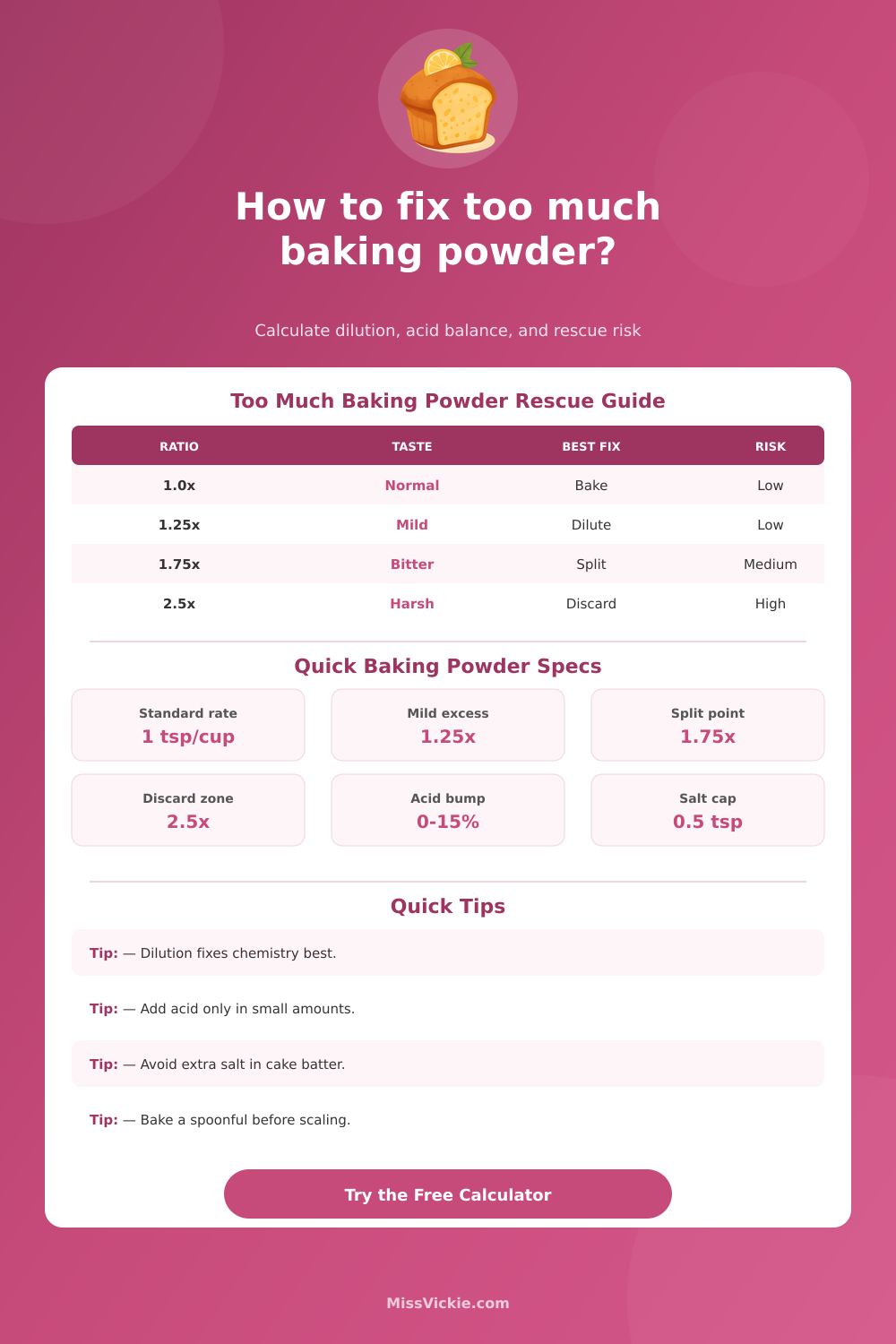
Excess baking powder ratio, dilution flour, acid balance, and discard guidance
How To Fix Too Much Baking Powder Calculator
Estimate whether a batter or dry mix can be rescued after adding too much baking powder, then size the flour dilution, liquid correction, acid nudge, salt caution, and pan scaling.
Choose the closest baking situation, then adjust the flour, baking powder, stage, acid, sugar, salt, liquid, and split strategy before deciding whether to bake, dilute, split, or start over.
Detailed Rescue Breakdown
| Recipe type | Typical baking powder rate | Excess warning point | Common rescue limit |
|---|---|---|---|
| Layer cake or cupcakes | About 1 tsp per cup flour | Over 1.35x can taste sharp and dome fast | Dilute early; discard if already baking and harsh. |
| Pancakes or waffles | 1 to 1.5 tsp per cup flour | Over 1.6x can taste bitter but is often testable | Cook one spoonful, then split or thin gently. |
| Muffins or quick bread | 1 to 1.25 tsp per cup flour | Over 1.5x can tunnel, brown, and collapse | Add plain base if batter is not overmixed. |
| Biscuits, scones, cornbread | 1.5 to 2 tsp per cup flour | Over 1.4x can taste metallic or salty | Split dry mix when possible; avoid extra salt. |
| Excess ratio | Likely taste and texture | Best repair | When to stop |
|---|---|---|---|
| 1.00x to 1.20x | Usually normal, sometimes a slightly faster rise | Bake as planned or add a tiny plain-flour adjustment | Do not add acid unless the flavor needs it. |
| 1.21x to 1.50x | Mildly bitter, more browning, taller early lift | Dilute with a partial plain base or bake a test portion | Stop mixing once the added base disappears. |
| 1.51x to 2.00x | Bitter or soapy risk, tunneling, center collapse | Split batch and build up each half with plain base | Discard if the test bite is strongly alkaline. |
| Over 2.00x | Harsh taste and unstable structure become likely | Use only if dry mix can be diluted accurately | Start over for delicate cakes or panned batter. |
| Batch stage | What still works | Main risk | Calculator interpretation |
|---|---|---|---|
| Dry ingredients only | Add flour and other dry ingredients in recipe ratio | Forgetting to scale sugar, salt, fat, and liquid later | Highest rescue score because leavening has not reacted. |
| Wet and dry combined | Fold in a plain half batch, then portion quickly | Gluten, dense crumb, and uneven mixing | Good rescue window for muffins, pancakes, and quick breads. |
| Rested or panned | Bake a small test or gently divide into thinner pans | Lost gas and damaged batter structure | Score drops because dilution can deflate the batter. |
| Already baking | Lower expectations; finish and taste before serving | Collapsed center, bitter finish, dark crust | Calculator favors discard or repurpose guidance. |
| Correction ingredient | Helpful range | What it can fix | What it cannot fix |
|---|---|---|---|
| Plain flour base | Enough to restore the target tsp per cup ratio | Actual chemical balance and batter volume | Overmixed batter or leavening already spent. |
| Lemon juice or vinegar | 1 to 2 tsp per cup flour, only if flavor fits | Some alkaline bitterness from excess leavener | The physical extra baking powder salts. |
| Sugar or cocoa | Small flavor adjustment after dilution | Masks a mild bitter edge | Collapse, tunneling, or soapy aftertaste. |
| Extra liquid | Only to match the extra flour or plain base | Returns batter thickness after dilution | A too-high leavening ratio by itself. |
Add plain recipe base with no baking powder until the tsp-per-cup ratio returns to target.
Divide the batch, then add smaller plain-base amounts so each portion needs less mixing.
Bake a tablespoon of batter before scaling a rescue that could double your recipe.
Start over when the ratio is extreme, the batter is panned, or the sample tastes soapy.
If you find that you have added too much baking powder to a recipe, there are several way to correct the mistake. You can adjust the recipe, you can split the recipe into smaller portions, or you can start the recipe over from the beginning. Each of these options will depend upon several factor, such as the amount of baking powder that you added to the recipe, the stage of the baking recipe that the batter is at, the amount of acid that is already in the recipe, and the amount of space that you have in your baking pan for the recipe to set.
Each of these factors will impact your recipe in several ways. For instance, the amount of baking powder that you add to the recipe will impact the taste and the texture of the recipe, as well as whether or not the center of the baked good will remain upright once the baked good has finished cooling. When using the baking powder rescue calculator, it will provide you with a rescue score and a recommendation after you input the measurement of your recipe into the calculator.
How to Fix a Recipe with Too Much Baking Powder
In the recipe calculation, you must enter the amount of flour that you intended to use, the amount of flour that you actualy used, and the amount of baking powder that you intended to use. Additionally, you must also input the amount of baking powder that you actually used in the recipe. Based upon this information, as well as the type of recipe that you are making, the stage of the batter, the amount of acid in the recipe, and the dilution strategy, the rescue calculator can tell you a rescue score.
This rescue score allow you to weigh the options for the recipe before you begin to bake your recipe. While the rescue calculator doesnt provide a guarantee for the outcome of your recipe, it does allow you to evaluate the situation before you use the oven to prepare your batter. One of the most common methods that individuals use to attempt to fix the taste of the recipe is to add acid to the recipe.
Baking powder often has a soapy taste to it, and adding acid like lemon juice or vinegar softens that taste. However, adding acid does not remove the extra baking powder (leavening salts) from the recipe. These extra leavening salts will continue to make the batter rise out of the pan after it is baked.
The most reliable method of fixing the recipe is through the process of dilution. Dilution means adding more of the original recipes ingredient (except baking powder) to the recipe. The rescue calculator will tell you how much extra flour and how much extra liquid you should add to the recipe in order to even out the baking powder, as well as whether or not you have enough space in your baking pan.
The stage of the batter that you use is one of the most important factor in determining how much you will be able to fix the baking recipe. If the ingredients for the recipe are still dry, they can still be scaled to restore the balance of the recipe. However, if the liquids have already been added to the recipe, the gas has already been released from the baking batter.
In this instance, the rescue base will have to be folded into the batter very gentle. If the baking batter has already been poured into the baking pan or has already been placed into the oven, there are few option for fixing the recipe. The rescue score will be lower if the recipe has already been poured into the pan.
The type of recipe that you are preparing will also help to indicate how much excess baking powder that the food can handle. For instance, pancakes and waffles can typically handle a higher ratio of baking powder than, say, a layer cake. Additionally, pancakes and waffles can be cooked in small portions, so if one pancake is tasted and found to be correct, the remainder can be cooked.
However, if one portion of a cake is undercooked or overcooked, the entire batch of cake can be affected. The rescue calculator takes into account the type of recipe being prepared. Additionally, if the recipe also contains salt or baking soda, these will play a role in the outcome of the baking powder recipe.
Both salt and baking soda can create a bitter taste in the recipe. Sugar can be used to mask the bitter taste of salt and baking soda, but sugar will not fix the structural problem caused by the excess baking powder. If the recipe already contains salt and baking soda, the rescue calculator will account for this in it’s score.
If the recipe has not yet been cooked, using the spoon test can be used to determine how to proceed with the recipe. Before adding more ingredients to the recipe, one tablespoon of the recipe can be cooked or microwaved. If the taste and texture of one tablespoon of the recipe are correct, the recipe can safely proceed.
However, if the taste of the recipe is bitter or if the recipe begins to rise and then fall when spooned, the recipe has the potential to create structural issues, and it may be better to start the recipe over. It is common for cooks to desire to add more acid or more sugar instead of using dilution to even out the baking powder. While adding sugar or acid is an easy fix to a problem, it will not fix the recipe in the manner that it should be baked.
Using the recipe rescue calculator allows cooks to make certain that they are correcting the problem and restoring the correct ratio of baking powder to recipe ingredients. If the rescue score remains high after adjusting the recipe, cooks should follow the recommendation of the recipe rescue calculator. If the rescue score drops, cooks should start the recipe over.
The recipe rescue calculator allows cooks to avoid guesswork about what the outcome of the recipe will be, and to make certain that the decision that is made is based off solid information.