How Much Flour And Water To Add To Sourdough Starter
Calculate the flour and water to add when feeding sourdough starter by retained starter, current hydration, target hydration, feed ratio, flour blend, temperature, and schedule.
Choose a real starter feeding scenario, then adjust the kept starter, flour ratio, hydration, room temperature, and flour blend.
Feeding Math Breakdown
Good when starter is mature and you need it to peak in a warm kitchen.
The classic daily refresh for a predictable liquid sourdough starter.
Builds enough starter for bread while diluting old acidity.
Useful for overnight timing, warm rooms, or a milder starter aroma.
| Feeding Ratio | Example With 20 g Starter | Best Use | Typical Timing |
|---|---|---|---|
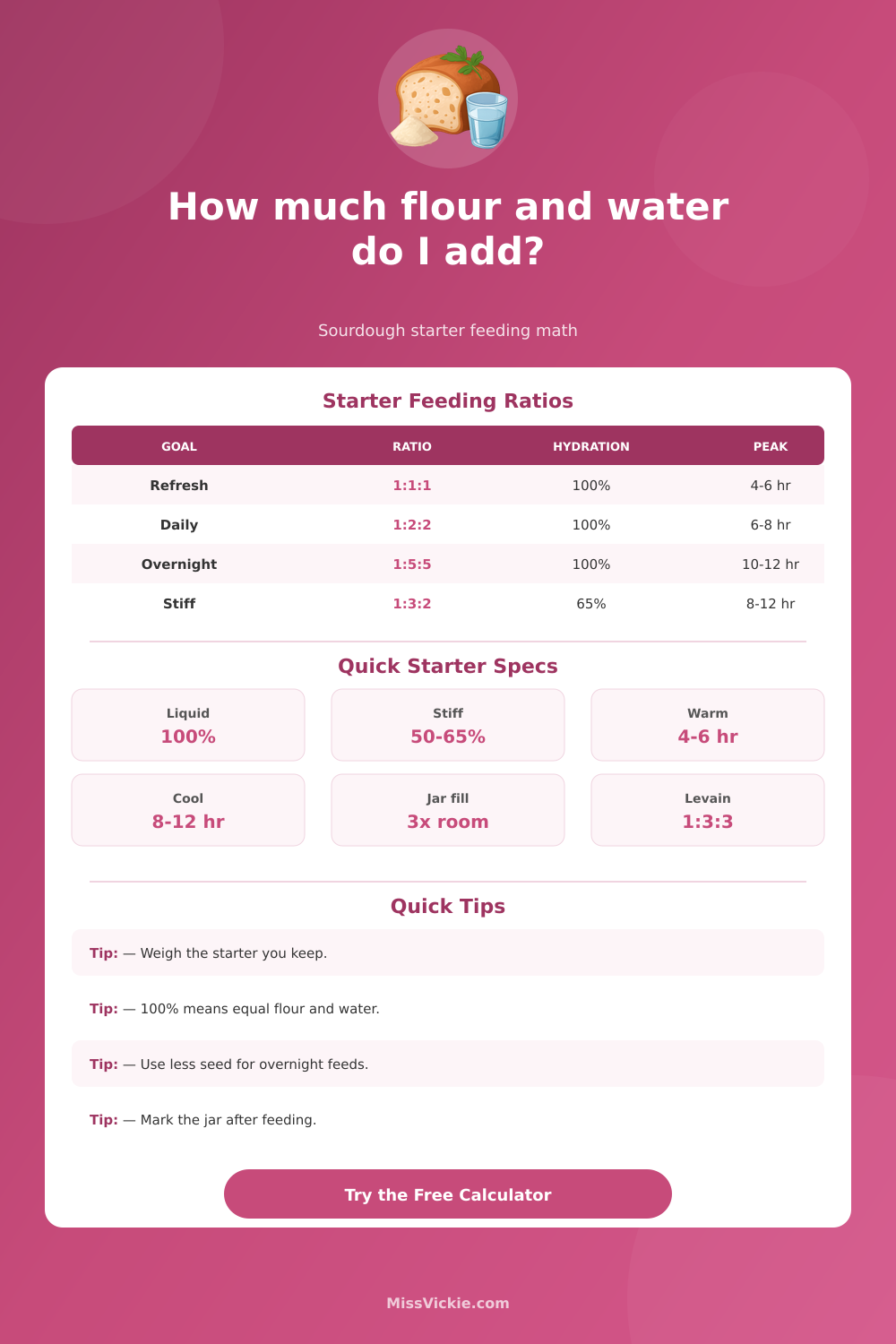
| 1:1:1 at 100% | 20 g starter, 20 g flour, 20 g water | Quick refresh when starter is healthy and close to baking time | About 4 to 6 hours in a warm room |
| 1:2:2 at 100% | 20 g starter, 40 g flour, 40 g water | Everyday maintenance for a liquid starter | About 6 to 8 hours at normal room temperature |
| 1:3:3 at 100% | 20 g starter, 60 g flour, 60 g water | Levain build for one or two loaves | About 7 to 10 hours depending on temperature |
| 1:5:5 at 100% | 20 g starter, 100 g flour, 100 g water | Overnight feed, warm room control, or mild flavor | About 10 to 14 hours in a cool to normal room |
| 1:3:2 at 65% | 20 g starter, 60 g flour, about 35 g water | Stiff starter, travel starter, or slower fermentation | Often 8 to 12 hours because the mixture is firmer |
| Target Hydration | What The Math Means | Texture In The Jar | Best Starter Use |
|---|---|---|---|
| 50% to 65% | Water is roughly half to two-thirds of total flour | Firm paste or dough ball | Stiff levain, slower feed, lower acidity swing |
| 75% to 90% | Water is less than flour but still easy to mix | Thick paste that domes well | Cool overnight feeds and stronger flour blends |
| 100% | Total water equals total flour by weight | Spoonable paste with clear rise marks | Standard liquid starter and simple 1:1:1 math |
| 110% to 125% | Water weighs more than total flour | Loose batter, faster fermentation | Whole grain refreshes or quick warm levain builds |
| Flour Added | Fermentation Effect | Water Feel | Adjustment Note |
|---|---|---|---|
| All-purpose flour | Moderate, familiar rise | Looser at the same hydration | Good for maintenance if the starter is already active. |
| Bread flour | Steady rise and stronger dome | Absorbs a little more water | Reliable baseline for levain builds and daily feeding. |
| Whole wheat blend | Faster from bran and minerals | Thicker after a short rest | Use when a sluggish starter needs a gentle boost. |
| Rye flour boost | Often the fastest and most aromatic | Paste-like rather than stretchy | Watch peak closely because rye can ferment quickly. |
| Spelt blend | Active but softer structure | Can feel slack | Handle gently and avoid judging strength by gluten stretch. |
| Room Temperature | Starter Behavior | Typical Peak Window | Feeding Adjustment |
|---|---|---|---|
| 64 to 68 F | Slow rise, mild aroma | 8 to 14 hours for normal feeds | Use warmer water or a lower feed ratio if you need it sooner. |
| 69 to 74 F | Balanced yeast and acidity | 6 to 10 hours for common ratios | Start with 1:2:2 or 1:3:3 and adjust from your actual peak. |
| 75 to 80 F | Faster rise, fruitier aroma | 4 to 7 hours for moderate feeds | Use a larger feed ratio for overnight timing. |
| Above 80 F | Acidity can build quickly | 3 to 6 hours for small feeds | Feed larger, use cooler water, or move the jar before collapse. |
| Starter Goal | Starter Kept | Feeding Style | Approx Final Starter |
|---|---|---|---|
| Small jar refresh | 10 g | 1:2:2 at 100% | About 50 g fed starter |
| Daily counter jar | 25 g | 1:2:2 at 100% | About 125 g fed starter |
| One loaf levain | 30 g | 1:3:3 at 100% | About 210 g fed starter |
| Overnight levain | 20 g | 1:5:5 at 100% | About 220 g fed starter |
| Stiff starter | 30 g | 1:3:2 at about 65% | About 185 g fed starter |
Feeding a sourdough starter require adding the correct amount of flour and water to the sourdough starter itself. The amount of flour and water you add will determine how fast the sourdough starter will move, how much flavor it will produce, and how long it will take for the sourdough starter to be ready for bake sourdough bread. Many people makes mistakes when feeding there sourdough starter.
One of the most common mistake with sourdough starters is feeding it too little or too much. Feeding the sourdough starter the proper amount of flour and water will ultimatey save you time and dough, as well as provide you with more control over the baking process. The first step in feeding your sourdough starter is to determine how much sourdough starter you want to keep.
How to Feed Your Sourdough Starter
If you have a sourdough starter in a jar, you may have some leftover sourdough starter after baking sourdough bread. In this case, you will have to decide how much sourdough starter to use as a seed for the next feeding of the sourdough starter. Keeping too much sourdough starter require you to discard some of the sourdough starter.
Keeping too little sourdough starter will lead to an extreme feeding ratio for flour and water. Therefore, you have to decide how much sourdough starter you would like to maintain for your baking routine, because this will determine how much flour and water to feed the sourdough starter. The ratio of flour to water determine the pace in which your sourdough starter will produce bubbly dough.
Using a one-to-one ratio of flour to water will force your sourdough starter to move quite quick. A one-to-two ratio will allow your sourdough starter to move at a more balanced rate. A one-to-five ratio will allow your sourdough starter to develop overnight without have it collapse before you can reach it in the morning.
The ratio you choose will determine the speed in which your sourdough starter moves, as well as the character of the sourdough starter itself. Another factor to consider when feeding your sourdough starter is the hydration. Many home baker choose one hundred percent hydration for simplicity in feeding their sourdough starter, as it is the easiest ratio to measure by using a spoon.
Lower hydration will produce a sourdough starter that take longer to feed. Higher hydration rates will speed up the sourdough starter feeding process, which is helpful for recipe using whole grain sourdough starters. The hydration level will determine the behavior of your sourdough starter when you mix it with dough.
The temperature of the kitchen and the strength of the sourdough starter are two more variables to consider. A sourdough starter in a cooler kitchen will take longer to feed. A warmer kitchen will make it active much sooner.
These variables are difficult to quantify, so a sourdough starter calculator can work in you favor. The calculator will tell you the amount of flour and water to add based on the amount of sourdough starter you wish to keep, the ratio of sourdough starter to flour and water, the hydration level of the sourdough starter, and the temperature of your kitchen. The type of flour you use will also affect your sourdough starter.
Using bread flour will give you more even sourdough starter activity than other type of flour. Using whole grain sourdough flour or rye flour will speed up the activity of your sourdough starter because of the minerals in the flours. Use whole grain flour if your sourdough starter is too slow to feed.
Use a milder flour if the sourdough starter is too active. Common mistake when feeding a sourdough starter include feeding the same amount every week regardless of change to your baking schedule. Another common mistake is ignoring the room temperature in your kitchen.
Lastly, people often feed their sourdough starter using volume measurements rather than weight measurement of flour and water. This can cause inconsistencies in the feeding of the sourdough starter. You can use reference tables to determine the behavior of sourdough starters with different feeding ratio.
These tables are not a replacement for your sourdough starter’s activity, but they can help you to understand the impact of change to your feeding ratio. These tables will provide you with different measurements so that you can test the sourdough starter and make changes to the ratio as necessary. A healthy sourdough starter will double in size in about 12 hours, will display a domed top when viewed from the side, and will have a tangy smell.
If your sourdough starter displays these traits before the calculator show you they should manifest, then it is likely that your kitchen is warmer than you thought or that the sourdough starter itself is stronger than before. Over time, you will be able to rely more on your sourdough starter’s behavior than on the calculations. Your goal is to understand how each of these variables impact your sourdough starter so that you can feed it appropriately to produce delicious sourdough bread.