How Much Molasses to Substitute for Brown Sugar
Turn a recipe's packed brown sugar amount into practical molasses, white sugar, liquid reduction, dry-buffer, and texture guidance for cookies, muffins, sauces, rubs, glazes, and breakfast bakes.
Pick a real recipe situation to load the original brown sugar amount, recipe type, molasses strength, available liquid, dry base, batch multiplier, and rounding style.
Substitution Breakdown
Best when the original recipe relies on brown sugar for sweetness, bulk, moisture, and spread.
Works when the recipe already has enough sugar and needs only a darker molasses note.
Glazes, beans, and sauces can absorb a wetter molasses substitution because they simmer or reduce.
Use less molasses and extra dry bulk so the rub stays spoonable instead of clumping.
| Original Brown Sugar | Molasses to Add | White Sugar Bulk | Recipe Behavior |
|---|---|---|---|
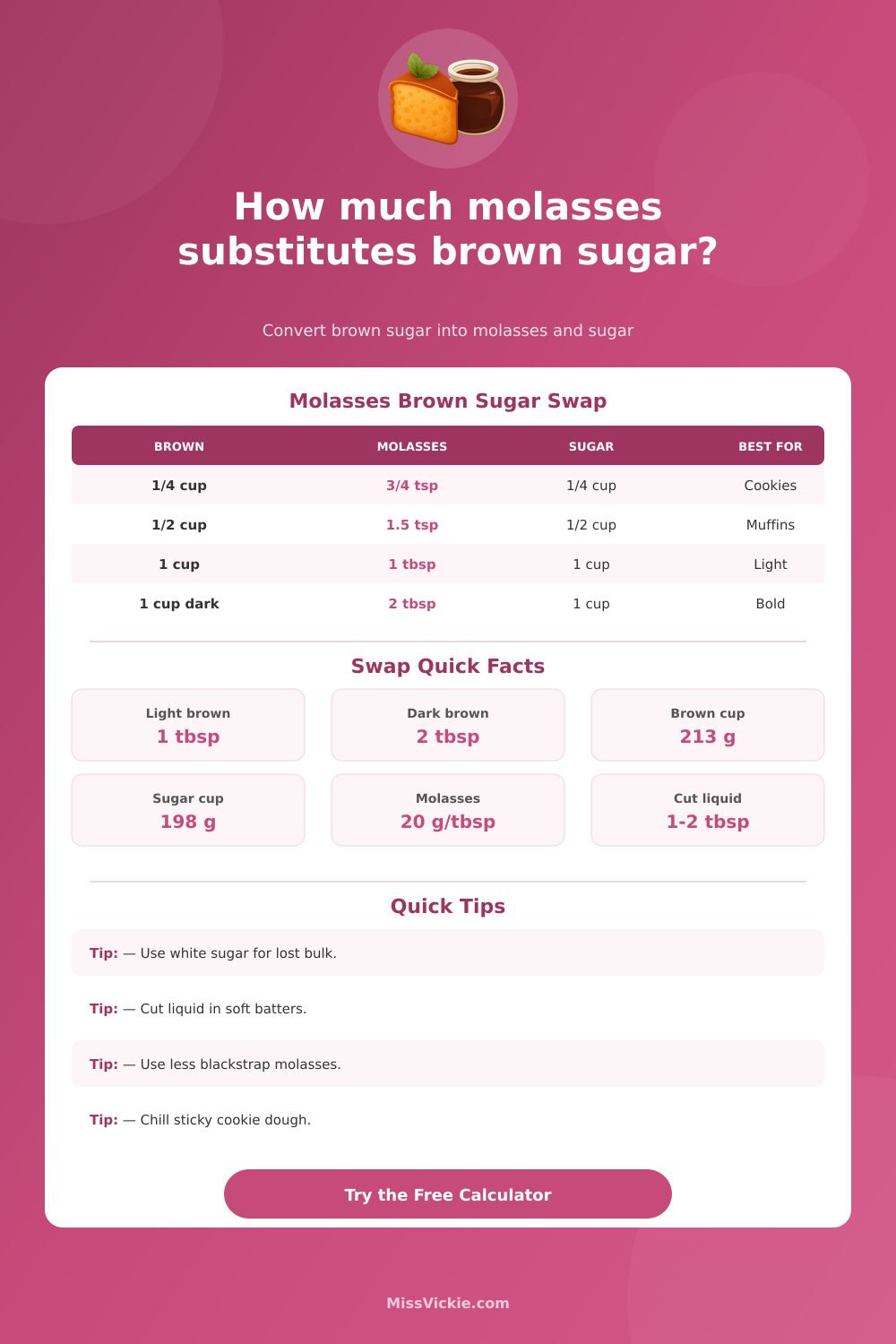
| 1/4 cup light brown sugar | 3/4 teaspoon molasses | 1/4 cup white sugar | Small cookie, crumble, or oatmeal amount |
| 1/2 cup light brown sugar | 1 1/2 teaspoons molasses | 1/2 cup white sugar | Muffins, small loaf, or bar batch |
| 1 cup light brown sugar | 1 tablespoon molasses | 1 cup white sugar | Classic everyday brown sugar replacement |
| 1 cup medium brown sugar | 1 1/2 tablespoons molasses | 1 cup white sugar | Richer cookies, spice cakes, and sauces |
| 1 cup dark brown sugar | 2 tablespoons molasses | 1 cup white sugar | Gingerbread, baked beans, barbecue glazes |
| Recipe Type | Liquid Reduction | Dry Buffer | Best Handling Note |
|---|---|---|---|
| Cookies or bars | Reduce about half the molasses volume if possible | Chill first; add very little flour only if dough is loose | Expect darker edges and softer chew |
| Quick bread or muffins | Reduce milk, coffee, or water before changing eggs | Use flour or oats only for wet batter | Lower oven by 10 to 15 F if browning fast |
| Cake or soft loaf | Reduce free liquid gently | Add a small dry buffer if crumb turns gummy | Mix molasses into sugar before creaming |
| Sauce or glaze | Reduction can happen in the pan | Usually none | Simmer until glossy and balanced |
| Dry rub blend | Avoid extra liquid | Use extra sugar, spice, or salt base | Rub may clump if molasses is too high |
| Beans or braises | Little reduction needed | Usually none | Add in stages and taste near the end |
| Molasses Type | Use Versus Standard Ratio | Flavor Impact | Best Match |
|---|---|---|---|
| Unsulfured baking molasses | Use standard amount | Classic brown sugar flavor | Most cookies, cakes, and sauces |
| Mild or fancy molasses | Use slightly more | Gentle caramel with less bitterness | Light brown sugar replacement |
| Robust full-flavor molasses | Use a little less | Deep color and strong aroma | Dark brown sugar replacement |
| Blackstrap molasses | Use much less | Bitter, mineral, and intense | Small accents, savory braises, bold sauces |
| Dark treacle | Use slightly less | Sticky and dark with a cooked finish | Puddings, ginger cakes, and glazes |
| Sorghum syrup | Use slightly more | Earthy sweetness, less dark color | Breakfast bakes, beans, and rustic breads |
| Recipe Amount | Light Brown Substitute | Dark Brown Substitute | Useful For |
|---|---|---|---|
| 2 tablespoons brown sugar | 2 tbsp sugar plus 1/8 tsp molasses | 2 tbsp sugar plus 1/4 tsp molasses | Single sauce or drink adjustment |
| 1/3 cup brown sugar | 1/3 cup sugar plus 1 tsp molasses | 1/3 cup sugar plus 2 tsp molasses | Small muffins or oatmeal bars |
| 3/4 cup brown sugar | 3/4 cup sugar plus 2 1/4 tsp molasses | 3/4 cup sugar plus 1 1/2 tbsp molasses | Cookies and banana bread |
| 1 1/2 cups brown sugar | 1 1/2 cups sugar plus 1 1/2 tbsp molasses | 1 1/2 cups sugar plus 3 tbsp molasses | Large cookie or cake batch |
| 500 grams brown sugar | About 465 g sugar plus 44 g molasses | About 426 g sugar plus 85 g molasses | Metric baking batch |
Brown sugar is an type of sugar that consists of white sugar that has been coated in molasses. Since brown sugar consist of white sugar and molasses, it is possible to recreate brown sugar by combining white sugar and molasses. Many peoples may have white sugar and molasses in there pantry, but they may not have brown sugar.
However, using white sugar and molasses as a substitute for brown sugar require consideration of the recipe that is being use to make the product. The type of molasses that is used will impact the flavor and color of the resulting product. Light brown sugar contains less molasses than dark brown sugar.
Use White Sugar and Molasses Instead of Brown Sugar
Consequently, light brown sugar has a lighter flavor to it than dark brown sugar. If using unsulfured baking molasses, the flavor will be neutral. If using robust molasses, the flavor will be stronger and there will be a more stronger aroma to the product.
Blackstrap molasses has a very intense flavor that is slight bitter. It is important to use blackstrap molasses sparingly in the recipe. Another consideration in using white sugar and molasses as a substitute for brown sugar is the moisture content of the recipe.
Since molasses is a liquid ingredient, adding it to a recipe will add moisture to the recipe. Adding too much molasses to a recipe can make the dough too wet. Using too much molasses could lead to the dough becoming gummy when cooked.
To adjust for this, you can reduce the other liquids in the recipe, or add dry ingredients to the recipe. The amount of liquid that need to be removed from the recipe will depend on the type of product that is being made. For instance, cookie dough may require reducing the amount of liquid in the recipe compared to recipe for barbecue sauce that simmers on the stove.
The type of product that is being made will impact the way in which the substitution of white sugar and molasses for brown sugar is to be made. For instance, cookies require that the bulk of the sugar is maintain in the recipe and that the baker adjust the amount of molasses to provide flavor to the cookies. Quick breads and muffins can take in more moisture.
Therefore, the amount of milk or coffee can be reduced instead of add dry ingredients to the recipe. Sauces and glazes generaly do not mind the extra moisture from the addition of molasses. However, dry rubs would not take the added moisture, as the dry rub could clump on the meat if it is too wet.
The type of molasses that is used will also impact the amount of white sugar and molasses that is used in the recipe. Since mild molasses have a very light flavor, the baker will need more of the mild molasses to provide the flavor to the recipe that uses the sugar and molasses replacement. Blackstrap molasses is much more concentrated in flavor so less of this type of ingredient will be needed.
Considering the strength of the type of molasses that will be used is important to ensure the final product isnt too sweet or too bitter. The other ingredients in the recipe that must also be considered is if other liquid are already in the recipe. For instance, recipes that contain honey and maple syrup already have a significant amount of liquid in the recipe.
Adding molasses to a recipe that also has honey and maple syrup will significantly increases the amount of liquid in the recipe. For recipes that are lean in the amount of liquid and that rely on the moisture from the brown sugar, it is important to ensure that the bulk of the sugar is replaced with white sugar. Otherwise, the product may end up dry and crumble.
Finally, the temperature and time that the product is baked must also be considered. Since molasses brown faster than white sugar, the edges of the baked good will brown faster than the center of the good. To compensate, the baker should of lowered the oven temperature by ten or fifteen degrees.
In recipes like cookies, it may also be beneficial to chill the dough after mixing the white sugar and molasses together. This will ensure the cookies dont spread too much during baking. The success of using white sugar and molasses instead of brown sugar in a recipe depend on the bakers understanding of the bulk, moisture, and color of the recipe.