Pan film, ingredient load, batch count, and smoke point margin
How Much Oil For Stir Fry Calculator
Calculate stir-fry oil from pan size, cooking surface, ingredient weight, vegetable moisture, protein share, sauce amount, heat level, oil type, coating, and batch plan.
Choose a real stir-fry situation, then adjust the pan, food weight, moisture, and oil smoke point for your stove.
Oil Breakdown
Best for dry broccoli, peppers, onions, and quick side-dish portions in a skillet.
Good starting point for one 12-inch pan batch with meat and mixed vegetables.
Starch-coated chicken or beef releases better with a slightly fuller oil film.
Rice grains need more surface lubrication than sliced vegetables or lean protein.
Oil helps separated noodles toss cleanly before sauce tightens on the surface.
Use modest oil and higher batch count so moisture evaporates quickly.
Lower heat and slick coating need less oil, but browning is usually gentler.
Early seasoning often benefits from a wider oil film until the pan gets slicker.
| Oil Type | Approx Smoke Point | Best Stir-Fry Use | Calculator Logic |
|---|---|---|---|
| Refined avocado oil | About 500°F / 260°C | Very hot wok burner and dry searing | Largest smoke margin for aggressive heat |
| Rice bran oil | About 450°F / 232°C | High heat wok cooking with neutral flavor | Strong choice for most stir-fries |
| Peanut oil | About 450°F / 232°C | Classic high-heat meat and vegetable stir fry | Default baseline oil in this calculator |
| Light olive oil | About 465°F / 241°C | High heat if refined and light, not extra virgin | Works when the label says light or refined |
| Grapeseed oil | About 420°F / 216°C | Medium-high stir fry and moderate wok use | Watch smoke margin on very hot burners |
| Canola or vegetable oil | About 400°F / 204°C | Home skillet stir fry at controlled heat | Better for medium-high than extreme wok heat |
| Toasted sesame oil | About 350°F / 177°C | Finishing flavor after cooking | Calculator warns when used as main high-heat oil |
| Pan Or Wok | Hot Contact Area | Light Film | Classic Film |
|---|---|---|---|
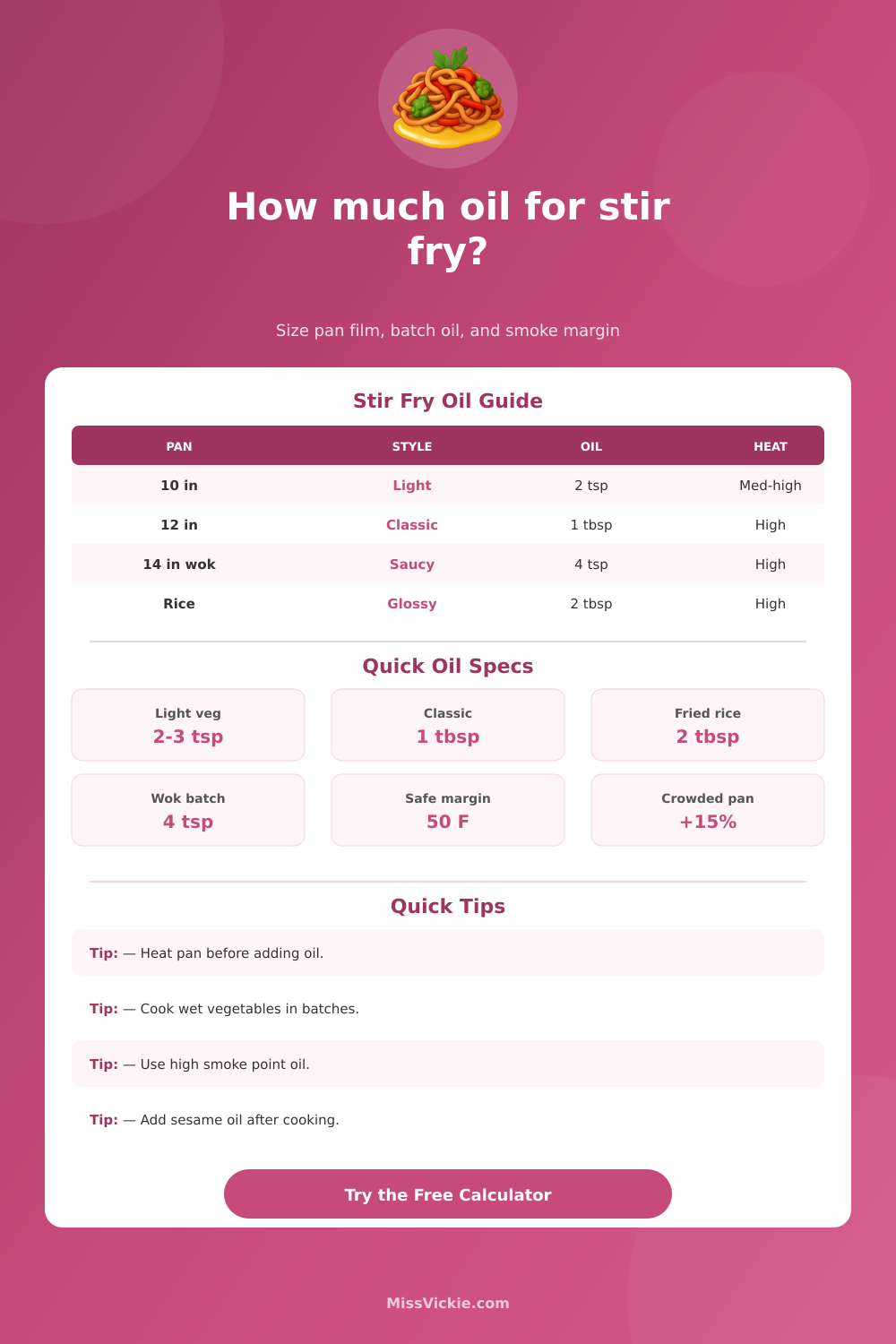
| 10-inch skillet | About 64 sq in | 2 tsp / 10 ml | 1 tbsp / 15 ml |
| 12-inch skillet | About 95 sq in | 1 tbsp / 15 ml | 4 tsp / 20 ml |
| 14-inch flat-bottom wok | About 110 sq in hot surface | 4 tsp / 20 ml | 5 tsp / 25 ml |
| 14-inch round wok | About 80 sq in active base | 2 1/2 tsp / 12 ml | 1 tbsp / 15 ml |
| Large nonstick skillet | About 95 sq in | 2 tsp / 10 ml | 1 tbsp / 15 ml |
| Cast iron skillet | About 80 sq in | 1 tbsp / 15 ml | 4 tsp / 20 ml |
| Ingredient Situation | Oil Adjustment | Why It Changes | Best Handling Move |
|---|---|---|---|
| Dry sliced vegetables | Baseline or minus 5% | Surfaces sear cleanly and release quickly | Keep pieces even and pan hot |
| Wet mushrooms or leafy greens | Plus 10% to 15% | Water cools the pan and breaks the oil film | Cook in smaller batches |
| Velveted chicken or beef | Plus 15% to 20% | Starch coating grabs oil before it sets | Let protein sear before tossing |
| Tofu cubes | Plus 10% to 18% | Porous surfaces absorb oil and stick early | Pat dry and pre-sear if possible |
| Cooked rice | Plus 20% to 30% | Many grains need a lubricating film | Use cold dry rice and break clumps |
| Noodles | Plus 10% to 20% | Starch surfaces cling before sauce coats them | Toss with a small amount first |
| Meal Goal | Typical Food Weight | Pan Plan | Oil Range |
|---|---|---|---|
| Side vegetables for 2 | 300 to 450 g | 10-inch skillet, 1 batch | 2 to 3 tsp total |
| Dinner stir fry for 4 | 800 to 1000 g | 12-inch skillet or wok, 2 batches | 1 1/2 to 2 tbsp total |
| Protein-heavy dinner for 6 | 1300 to 1600 g | Large wok, 3 batches | 2 1/2 to 3 1/2 tbsp total |
| Fried rice for 4 | 900 to 1200 g | Large wok, 2 batches | 2 to 3 tbsp total |
| Noodle stir fry for 6 | 1500 to 1900 g | Wok, 3 batches | 3 to 4 tbsp total |
| Party wok station for 12 | 3000 to 3800 g | Cook 5 to 6 batches | 6 to 8 tbsp total |
Using the correct amount of oil in a stir fry is important, because the amount of oil will determine how the food cook in the pan. Oil has two specific function in a stir fry; it carry heat to the food, and it prevents the proteins and vegetables from sticking to the pan. Using too little oil will cause the food to stick to the pan or steam itself in its own moisture.
Too much oil will make the food sit in a greasy puddle in the pan. Many people guess the amount of oil they need to use in there stir fry. However, using the incorrect amount of oil results from the fact that the amount of oil required to cook stir fry depends on the size of the pan, the moisture content of the stir fry ingredient, and the heat setting of the burner.
How Much Oil to Use in a Stir Fry
The behavior of the oil within the pan is a primary variable in stir fry cooking because the oil perform differently in the pan based on the distribution of the oil. A thin film of oil spread across the pan’s surface behave differently from a pool of oil in the center of the pan. The calculator plans for the amount of oil that is required to perform a stir fry by taking into account the size of the pan, the weight of the ingredient, the moisture content of the ingredients, and the heat setting of the stove burner.
The calculator calculates the amount of oil that is necessary to create a pan film to cook the stir fry and the amount of oil necessary for tossing the ingredients in the pan, as well as the safety margin for the oil before it reaches its smoke point. The pans surface area is another variable that impact the amount of oil that should be used in a stir fry. A 12-inch skillet will have a different cooking surface area than a 14-inch wok.
The difference in these two variables will impact how the heat is distributed to the food being stir fried. The calculator takes into account the surface area of the pan when it determine the amount of oil necessary to maintain a cooking film that spreads evenly over the active cooking area of the pan. The amount of oil necessary to even out the heat distributed to the pan can be calculated once the area of the pan are establish.
Another variable that impacts the amount of oil that should be used when stir frying is the type of ingredients that will be stir fried. For example, dry vegetable like broccoli and peppers will allow the oil to remain in place on the pans cooking surface. However, vegetables that contain more moisture, like mushrooms and leafy greens, will release the moisture when stir fried, which will cool the pan and thin the film of oil on the pans cooking surface.
Therefore, the oil calculator will increase the amount of oil recommended if the moisture content of the stir fry ingredients is high. If the vegetable are dry, the amount of oil will be less than if wet vegetables are to be stir fried. Additionally, the protein ingredients will also affect the amount of oil required for stir frying.
Ingredients like marinated beef or chicken that have absorbed liquid into their coatings will require the stir fry cook to use a small amount of oil to compensate for the oil that the protein ingredients absorb. The heat level at which the pan will be cooked is another variable that will impact the amount of oil necessary for stir frying. Oil has a smoke point, which is the temperature at which it begins to break down.
The oil calculator reports a smoke point margin, which is the difference between the temperature of the pan where the food will be cooked and the smoke point of the oil. A large smoke point margin allows the user to cook at high heat setting without the oil becoming bitter tasting and smoking. A small smoke point margin will require the cook to either cook the food quickly or to choose a different type of oil.
Using the correct oil will prevent the user from making the mistake of using a delicate oil for cook settings that require high heat. Another variable in determining the amount of oil necessary for stir frying is the number of batch that are to be prepared. Cooking too many batches at once will quickly lower the cooking temperature of the pan, and the excess moisture from cooking too many batch at once will turn the cooking process into a braise.
To prepare multiple batches, the calculator will increase the amount of oil necessary to heat the pan to account for cooking multiple batch, but the amount of oil that will be used for each batch will decrease due to the oil that will be in the pan after preparing each batch. The type of oil that is used in stir frying will impact the safety margin for the cooking process. If oils with a high smoke point are used, such as peanut oil or rice bran oil, the safety margin for the oil will be high, allowing for the oil to be heated to very high temperature.
Avocado oil also provides a high safety margin for stir frying. Canola oil and vegetable oil can be used for stir frying at standard heat level. However, care must be taken not to heat these oils too high with the stir fry.
The oil calculator will alert the cook if the type of oil that is chosen has a smoke point that will not provide enough of a safety margin at the heat setting that is chosen. There are some habit that can be followed to ensure that oil is used correctly during the stir frying process. One habit is to heat the pan without any oil before adding the ingredients to the pan.
Once the pan is heated, oil should be added to the pan to such an amount that the pans cooking surface begins to shine. Additionally, the pan should be allowed to heat further with the oil added until the oil begins to move freely in the pan before any food is added to the pan. If the pan does not sizzle when the food is added, the cook should prepare the next batch with a smaller load of food.
Additionally, if sauce is added late in the cooking process, this sauce will act as a lubrication agent for the food, so there will be less need for oil to finish the stir fry. Another habit is to wipe the pan between batches so that the oil film can be re-created between batches. Finally, the oil calculator will remove the uncertainty of the amount of oil to use in the stir fry, allowing the cook to focus on the pan and the batches of stir fry food to prepare.