Whipped cream stabilizer, bloom water, piping strength, and hold time
How Much Gelatin To Stabilize Whipped Cream?
Calculate unflavored gelatin for stabilized whipped cream by cream amount, finished yield, serving plan, room temperature, hold time, piping style, bloom strength, sugar level, and batch allowance.
Choose a real serving situation, then adjust the cream volume, target stability, bloom ratio, sugar, temperature, and hold time.
Whipped Cream Stabilizer Breakdown
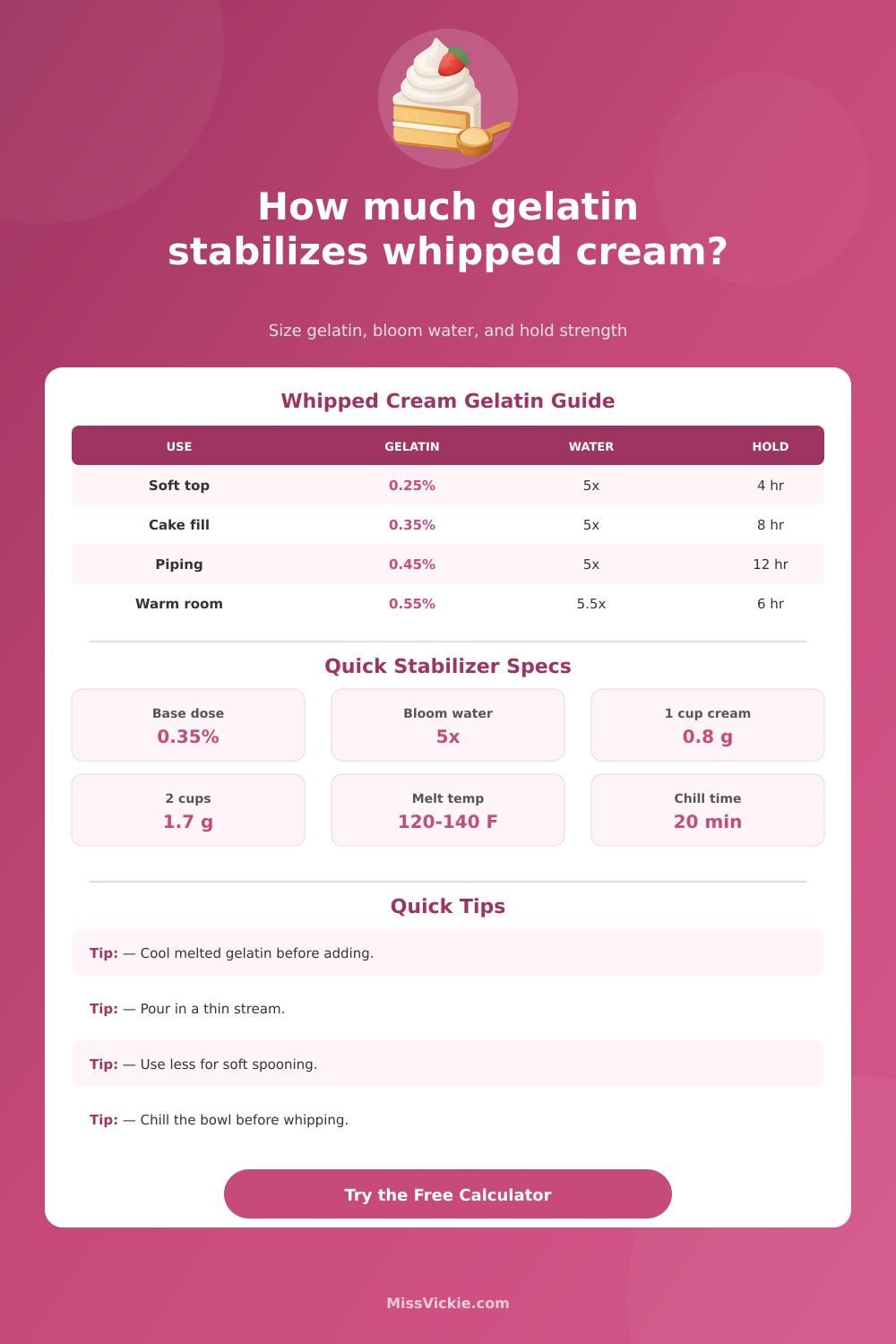
| Whipped Cream Use | Gelatin Percent | Powder per 1 Cup Cream | Texture Goal |
|---|---|---|---|
| Soft pie topping or cocoa dollops | 0.20 to 0.28 percent | 0.5 to 0.7 g | Soft peaks that last several hours in the refrigerator |
| Cake filling, trifle, and parfait layers | 0.30 to 0.40 percent | 0.7 to 1.0 g | Clean spoonfuls with less weeping overnight |
| Piped borders, rosettes, cupcakes | 0.40 to 0.50 percent | 1.0 to 1.2 g | Sharper ridges that keep shape after chilling |
| Warm-room buffet or tall layer cake | 0.50 to 0.65 percent | 1.2 to 1.5 g | Firm hold, but a higher risk of bouncy texture |
| Cream Type | Typical Fat | Adjustment | Kitchen Note |
|---|---|---|---|
| Whipping cream | 30 to 35 percent | Add 8 percent gelatin | Lower fat foams are lighter but need more support for piping. |
| Heavy cream | About 36 percent | Use base dose | The most predictable choice for stabilized whipped cream. |
| Ultra-pasteurized heavy cream | 36 percent or more | Add 4 percent gelatin | Can whip a little slower and benefits from extra chilling. |
| Mascarpone blended cream | Rich mixed fat | Reduce 12 percent gelatin | Mascarpone adds body, so too much gelatin can feel rubbery. |
| Batch Size | Heavy Cream | Standard Gelatin | Bloom Water at 5x |
|---|---|---|---|
| Small topping bowl | 1 cup / 240 ml | 0.8 g / about 1/4 tsp | 4 g / about 1 tsp |
| One layer cake | 2 cups / 475 ml | 1.7 g / about 1/2 tsp | 8 g / about 1 1/2 tsp |
| Dessert bar bowl | 4 cups / 950 ml | 3.3 g / about 1 tsp | 17 g / about 1 tbsp |
| Large party batch | 8 cups / 1.9 L | 6.7 g / about 2 tsp | 33 g / about 2 tbsp |
| Step | Temperature | Timing | What To Watch |
|---|---|---|---|
| Bloom gelatin | Cold water | 5 to 10 minutes | Every grain should look hydrated before melting. |
| Melt bloom | 120 to 140 F | Short gentle heat | Do not boil; overheating weakens the setting power. |
| Temper into cream | Fluid but not hot | After soft foam forms | Stream slowly while the mixer runs to avoid strings. |
| Finish whipping | Chilled bowl | To medium or firm peaks | Stop before grainy butter flecks appear. |
Best for piping, cake filling, and long chilled holding when used sparingly.
Easy and subtle, but it mostly helps sweetness and moisture, not structure.
Adds body and dairy flavor; reduce gelatin if mascarpone is also in the bowl.
Fast and sturdy, though the starch flavor and color can show in delicate desserts.
Stabilized whipped cream is made of cream and a stabilizing agent. This type of whipped cream is used to create textures that are both light and sturdy. People may desire to use stabilized whipped cream to ensure that the whipped cream will hold its shape on a cake or dessert table for several hour.
One method of creating stabilized whipped cream is to add unflavored gelatin to the cream; the unflavored gelatin will provide structure to the whipped cream. If you add too little of this unflavored gelatin, however, the whipped cream will lose its structure over time. If you add too much unflavored gelatin to the cream, the whipped cream will end up being rubberily.
How to Use Gelatin to Stabilize Whipped Cream
The amount of unflavored gelatin that you use will depend upon the needs of the specific dessert that you are creating. For instance, a dessert that requires the whipped cream to be a soft topping will require less unflavored gelatin than a dessert that include piped borders with the whipped cream. You should calculate the amount of unflavored gelatin that you use according to the original weight of the cream that you use before you begin whipping it.
Cream that contain a lower fat content will require more unflavored gelatin to provide the same level of structure as creams that have higher fat content. Additionally, creams that contain more sugar will require less unflavored gelatin, as the sugar will provide some of the body to the whipped cream. The temperature at which you keep the stabilized whipped cream will also affect the amount of unflavored gelatin that you use.
If you keep the cream in a cool room, the unflavored gelatin will remain firm. If, however, you place the cream in an area that is warm to the touch or is exposed to warm lights, the unflavored gelatin will soften. Consequently, you will have to add more unflavored gelatin to creams that will be exposed to these warm area.
Additionally, the length of time that the stabilized whipped cream must hold its shape will also affect the amount of unflavored gelatin; the longer that the cream must maintain its structure, the more unflavored gelatin that you will need to incorporate into the cream. The flavors of the stabilized whipped cream may also impact the function of the unflavored gelatin. Vanilla and chocolate flavors are generally safe to incorporate into creams with unflavored gelatin.
Acids, such as those from citrus or berry flavored desserts, may weaken the unflavored gelatin over time. Some fruits, such as pineapple, kiwi, and papaya, contain enzymes that will break down the proteins of the unflavored gelatin; these should be cooked prior to incorporate into the cream. If these enzymes remain in the fruit prior to adding it to the cream, they will prevent the unflavored gelatin from setting the cream properly.
In order to prepare the unflavored gelatin properly, there are certain step that must be followed in order to ensure the success of the whipping process. First, you must bloom the unflavored gelatin in cold water until it is fully hydrated. Second, you must melt the bloomed unflavored gelatin gently; the unflavored gelatin should not be boiled.
If you boil the unflavored gelatin, it will weaken the setting power of the unflavored gelatin. Third, after melting the unflavored gelatin, it must be allowed to cool until it is fluid but not hot. If the unflavored gelatin is too hot when it is added to the cream, it will create streaks within the cream.
If it is too cold, however, it will create rubbery bits within the cream. Some people may use an alternative to unflavored gelatin, such as powdered sugar or mascarpone. Powdered sugar will add sweetness to the dessert; however, it will not provide the same level of structural stability to the whipping cream as the unflavored gelatin.
Mascarpone will add richness to the whipping cream; however, it will also alter the flavor of the cream. Consequently, unflavored gelatin will generally be the best choice for creating stabilized whipped cream; it is flavorless and will allow the chef to retain the most control over the structure of the whipped cream. In addition to unflavored gelatin, other forms of gelatin can also be used in the whipping cream; powdered, sheet, or fish gelatin can all be used.
Powdered and sheet gelatin will behave in similar manner to unflavored gelatin. Fish gelatin will behave similarly to pork or beef gelatin, but will have a milder flavor. Regardless of the type of unflavored gelatin that is chosen, the bloom strength of the gelatin must be accounted for in order to achieve the desired structure in the whipped cream.
Many errors in creating stabilized whipped cream result from individuals guessing at the amount of unflavored gelatin that should be used. For example, if you add too little unflavored gelatin, the whipped cream will hold its structure initially, but it may slump over time. If you add too much unflavored gelatin, the cream may have a rubbery texture when tasted.
Therefore, before beginning the whipping process, individuals must determine how much cream they need, for how long the cream will need to hold, and what temperature the cream may face. By considering these factors in advance, individuals will be able to create stabilized whipped cream that is reliable and successful in its intended purpose.