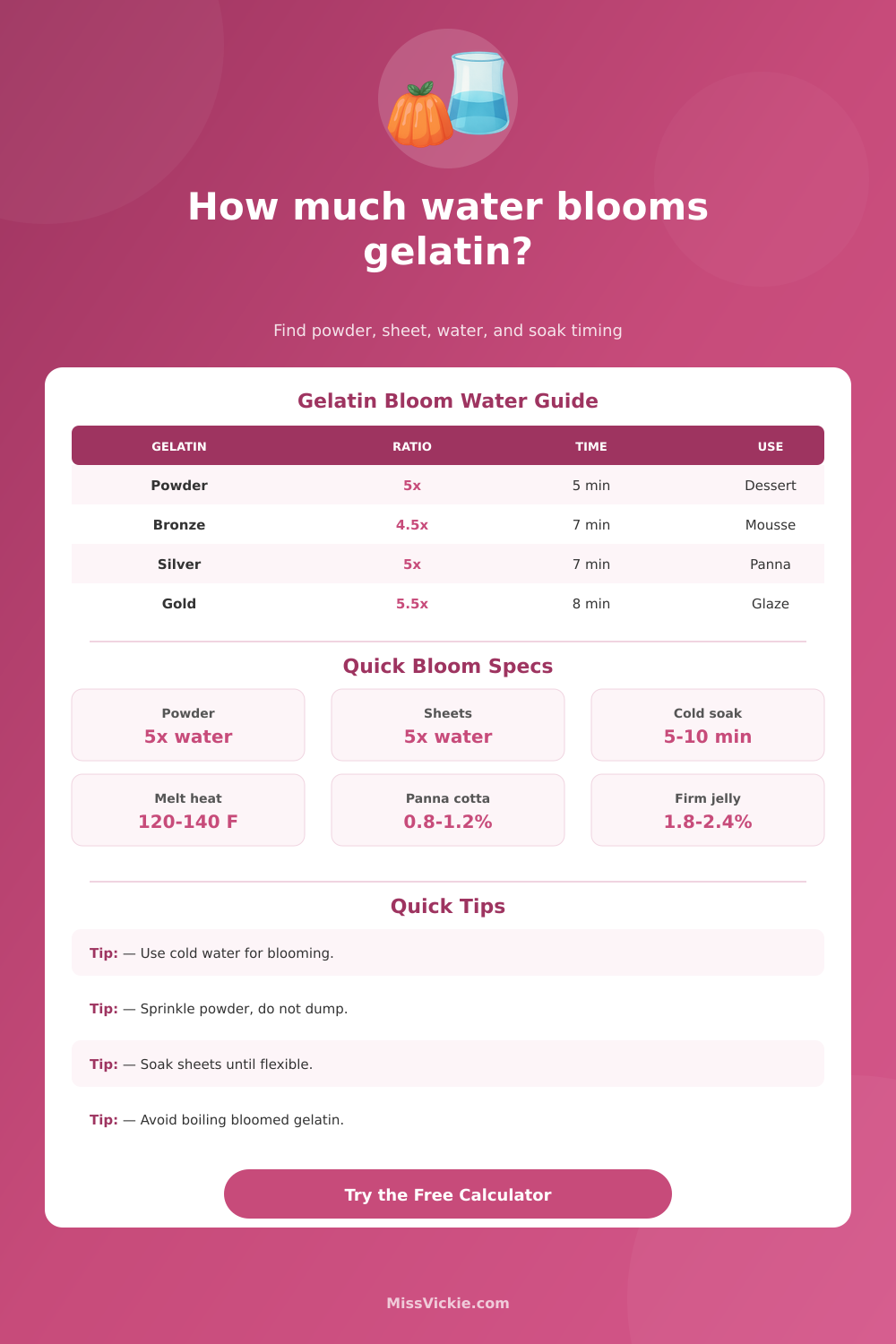
Powder, sheets, bloom strength, water ratio, and soak timing
How Much Water To Bloom Gelatin Calculator
Calculate the cold water needed to bloom powdered gelatin or gelatin sheets, then compare the slurry weight, soak time, melting range, and final set level for desserts, glazes, mousse, panna cotta, gummies, and savory aspics.
Choose a kitchen scenario, then adjust the gelatin form, batch size, target set, bloom ratio, sugar level, acidity, and liquid temperature.
Bloom Breakdown
Best when sprinkled over cold water in a wide bowl so every granule hydrates evenly.
Best when submerged in plenty of cold water, squeezed, then melted into warm liquid.
Gold and platinum sheets need fewer grams than bronze sheets for a similar final set.
Strong acid and fresh enzyme fruits can weaken gelatin unless heated or adjusted.
| Gelatin form | Typical bloom ratio | Soak time | Best method |
|---|---|---|---|
| Powdered gelatin | 4 to 6 times gelatin weight | 5 to 10 minutes | Sprinkle evenly over cold water and var it swell before heating. |
| Bronze gelatin sheets | About 4.5 to 5 times weight | 7 to 10 minutes | Soak until flexible, squeeze, then melt into warm liquid. |
| Silver gelatin sheets | About 5 times weight | 6 to 8 minutes | Use for panna cotta, mousse, and custards with moderate firmness. |
| Gold or platinum sheets | About 5 to 5.5 times weight | 5 to 8 minutes | Use fewer grams because the higher bloom strength sets more firmly. |
| Final use | Gelatin percent | Texture target | Kitchen note |
|---|---|---|---|
| Soft spoon dessert | 0.5% to 0.8% | Tender wobble | Good for creams served in cups, not unmolded slices. |
| Panna cotta | 0.8% to 1.2% | Clean wobble | Chill fully so the texture sets without turning rubbery. |
| Sliceable filling | 1.2% to 1.8% | Neat slices | Useful for cakes, entremets, cheesecake layers, and mousse inserts. |
| Firm jelly or gummy | 1.8% to 3.0% | Firm chew | High sugar and low water formulas may need recipe testing. |
| Temperature stage | Approx range | Effect on bloom | What to do |
|---|---|---|---|
| Cold blooming water | Below 70 F / 21 C | Hydrates granules or sheets evenly | Use cold water, milk, juice, or a recipe liquid reserved from the batch. |
| Warm melting liquid | 120 to 140 F / 49 to 60 C | Melts bloomed gelatin gently | Stir until fully dissolved before combining with cold ingredients. |
| Hot liquid | 150 to 180 F / 66 to 82 C | Dissolves fast but can thin delicate foams | Temper into creams, mousses, and whipped bases gradually. |
| Boiling liquid | 212 F / 100 C | Can weaken setting power | Remove from heat before adding bloomed gelatin whenever possible. |
| Ingredient condition | Set impact | Adjustment idea | Examples |
|---|---|---|---|
| Moderate sugar | Usually stable | Use normal ratio | Panna cotta, mousse, custard, cheesecake. |
| High sugar syrup | Can feel firmer after chilling | Test a small batch before scaling | Mirror glaze, gummies, marshmallows. |
| Acidic fruit | Can soften the gel | Add a little more gelatin or reduce acid | Lemon, passion fruit, wine, berry puree. |
| Protease enzymes | May prevent setting | Use canned fruit or heat the puree first | Fresh pineapple, kiwi, papaya, guava. |
Blooming gelatin requires using the correct amounts of water and allowing the gelatin to sit for the correct amount of times. If too little water are used or if you dont allow the gelatin to sit for long enough, the texture of the final dessert may be uneven or it may rubbery. The blooming process is when the gelatin absorbs the water, and it is during this stage that the bloomed gelatin becomes usable in a recipe.
Gelatin can come in two primary form: powdered or sheet gelatin. Powdered gelatin use water to hydrate from the outside of the granule to the inside, while sheet forms of gelatin must soak in water to become flexible. Water is added to the gelatin during the blooming stage.
How to Bloom Gelatin
The water isnt a major component of the final recipe, but it is required for the gelatin to properly hydrate. Once the gelatin has hydrated, you must melt it into a warm liquid to ensure that it is evenly distributed throughout the other ingredients in the recipe. The bloom number measures the strength of the gelatin.
Gelatin with a higher bloom number has a higher gelling power and requires less of the ingredient to be used in the recipe. If the bloom number of the gelatin is lower, then it has a lower gelling power and more of the ingredient will be require. The temperature of the water used to bloom the gelatin is important to ensure that the gelatin does not stick to itself.
If warm or hot water is used, a layer of skin may form on the outside of the bloomed gelatin while the interior remain dry. These dry spots will result in chewy bits in the final dessert. Other ingredients in the recipe can also play a role in the texture of the final product.
If the recipe contains sugar, the texture of the bloomed gelatin can be affected. Using very high amounts of sugar may result in a firmer texture from the gelatin. Acid can impact the texture of the bloomed gelatin.
If the recipe contains acid, the set of the gelatin will be softer. For example, recipes that use lemon or passion fruit require more gelatin because the acid in these ingredient will soften the set of the gelatin. Some fruits, such as pineapple, kiwi, or papaya, contain enzyme that will break down the protein in the gelatin.
In order to avoid this reaction, you must cook these fruits prior to use in a recipe that also contains gelatin. The calculator that is provided on this page will allow you to calculate the amount of gelatin and water that will be required for your recipe. You will need to enter the type of gelatin that you are using, the weight of the liquid in your recipe, and the type of texture that you would like to set.
The calculator will automatically account for the bloom strength of the type of gelatin you are using, as well as the fact that some of the gelatin will be lost if you pour it into a spoon or bowl. The calculator will notify you of the amount of cold water that will be required to bloom your gelatin, as well as for how long the bloomed gelatin will need to sit. Additionally, you can see an estimated percentage of how much the set will be effective with the calculator.
Common errors in the blooming of gelatin may include adding the powdered gelatin to a warm liquid. If you add powdered gelatin to a warm liquid, the gelatin may clumps. Another common mistake is placing the sheets of gelatin in the recipe and adding too much gelatin to too little water.
This can cause the set of the dessert to not firm up properly. Additionally, another error that can be made is using boiling liquid to melt the bloomed gelatin. If the liquid is too hot, the protein in the gelatin may lose its gelling ability.
When melting the bloomed gelatin, the temperature of the liquid should be maintained between 120 and 140 degrees. The size of the batch of the dessert that you are preparing may also have an impact on the amount of gelatin to use. If you are preparing a small batch of your dessert, it may be easier to adjust the amount of gelatin that is used.
If you are preparing a large batch, any error in the amount of gelatin added to the liquid will be much more impactful on the final dessert. Therefore, the batch size multiplier can be used to adjust for larger batches of your recipe. Once the bloomed gelatin is prepared, you should stir it into a small portion of warm liquid prior to being mixed into the remainder of the recipe.
Stirring the bloomed gelatin into a portion of warm liquid first will ensure that the gelatin becomes fully dissolved and that there are no streak of gelatin in the final dessert. The tables listed on this page contain the information that is often used to determine how much gelatin to use in a recipe. These tables include the ratio of the type of gelatin that is to be used and the time required for the blooming of the gelatin.
Additionally, the tables contain information regarding how the temperature of the blooming liquid impacts the set of the protein. The calculator is informed of these ratios to provide the numbers for your specific recipe. The amount of water that is used will impact the blooming of the gelatin.
Using too little water will prevent the bloomed gelatin from swelling enough to properly set, while using too much water will dilute the set of the final dessert. Using the correct amount of water, the correct amount of bloomed gelatin, and the correct amount of time will result in a smooth and reliable set of your gelatin dessert.