How Much Pie Filling for a Pie Calculator
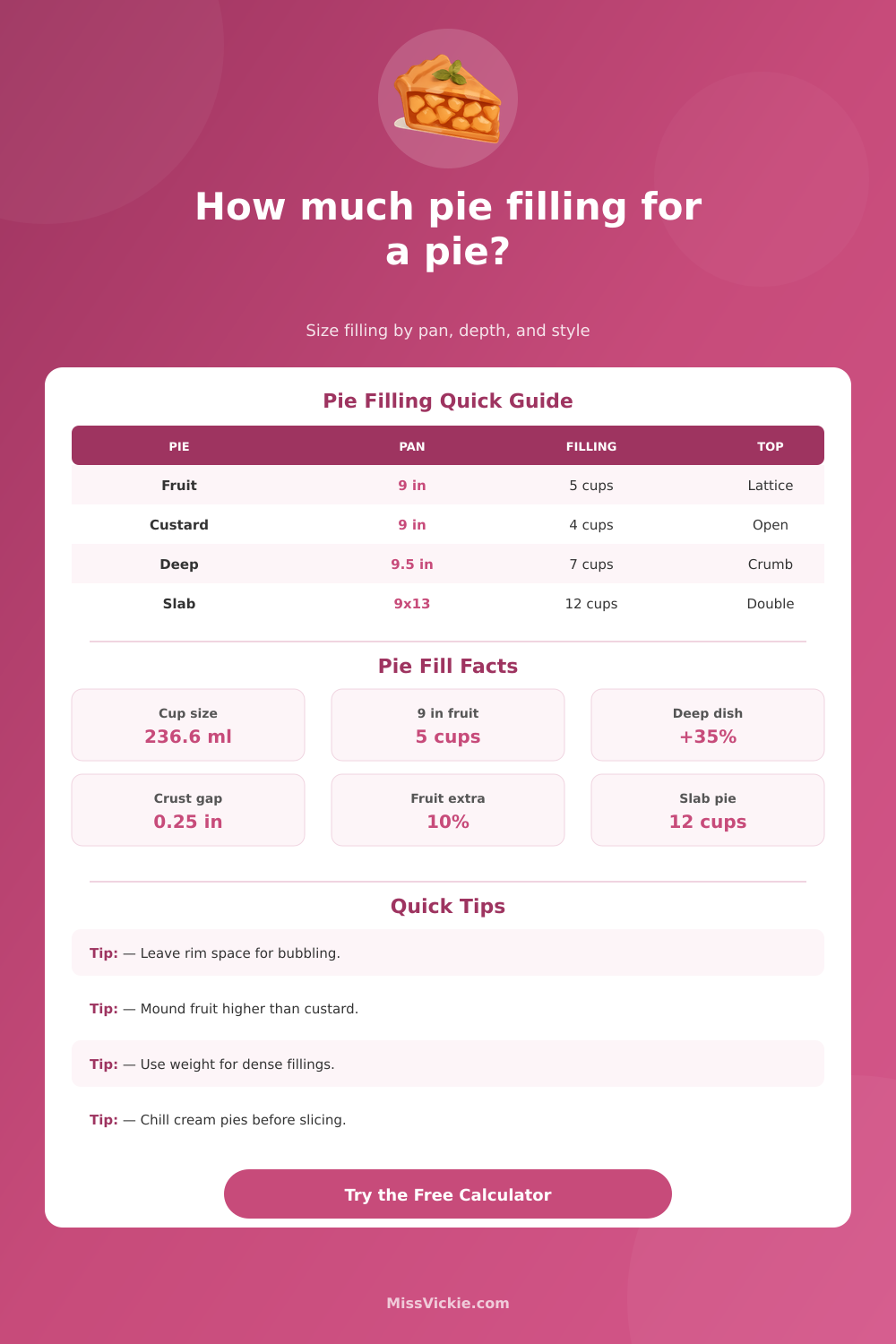
Estimate fruit, custard, cream, nut, or savory pie filling from pan shape, measured depth, crust clearance, topping style, and practical overage.
Choose a common pie setup, then adjust the pan and filling details to match your dish.
Pie Filling Breakdown
| Pie Style | Typical Pan | Filling Cups | Best Fill Level |
|---|---|---|---|
| Classic apple, peach, or mixed fruit | 9 inch round, 1.25 inch fill depth | 4.5 to 5.5 cups | Mounded above rim before baking |
| Berry or cherry lattice pie | 9 inch round, shallow to standard plate | 4 to 5 cups | Standard fill with bubbling room |
| Pumpkin or sweet potato custard | 9 inch round, blind or par-baked shell | 3.5 to 4.25 cups | Below crimp line for clean set |
| Pecan or nut syrup pie | 9 inch round, open top | 3.25 to 4 cups | Low fill because syrup expands |
| Deep dish fruit pie | 9.5 inch round, 1.75 inch fill depth | 6 to 7.5 cups | Full fill with sturdy rim |
| Rectangular slab pie | 9x13 inch pan, 1.25 inch fill depth | 10 to 13 cups | Even layer for square slices |
| Filling Type | Approx Weight per Cup | One Quart Equals | Planning Note |
|---|---|---|---|
| Sliced apple filling | 155 g / 5.5 oz | 4 cups or 620 g | Settles as slices soften, so extra helps. |
| Berry or cherry filling | 170 g / 6 oz | 4 cups or 680 g | Juicy fruit needs rim clearance. |
| Pumpkin custard | 245 g / 8.6 oz | 4 cups or 980 g | Pour below crimp to prevent cracking. |
| Cream filling | 230 g / 8.1 oz | 4 cups or 920 g | Chilled fillings slice best when level. |
| Pecan syrup filling | 270 g / 9.5 oz | 4 cups or 1080 g | Dense syrup expands while baking. |
| Savory pot pie filling | 215 g / 7.6 oz | 4 cups or 860 g | Chunks need enough sauce to bind. |
| Pan Size | 1.0 in Usable Depth | 1.25 in Usable Depth | 1.5 in Usable Depth |
|---|---|---|---|
| 8 inch round | 3.5 cups | 4.4 cups | 5.2 cups |
| 9 inch round | 4.4 cups | 5.5 cups | 6.6 cups |
| 9.5 inch round | 4.9 cups | 6.2 cups | 7.4 cups |
| 10 inch round | 5.4 cups | 6.8 cups | 8.2 cups |
| 8 inch square | 4.4 cups | 5.5 cups | 6.6 cups |
| 9x13 rectangle | 8.1 cups | 10.1 cups | 12.2 cups |
Fruit fillings can mound above the rim because slices soften and settle during baking.
Custard pies need measured clearance so the center can set without sloshing or cracking.
Nut syrup fillings weigh more per cup, so weight estimates matter when scaling recipes.
Rectangular pans give predictable servings and make filling depth easier to control.
Calculating the correct amounts of filling is important because the amount of filling will determine whether the pie appears to have a generous amount of filling or if the pie appears to be skimpily in it’s distribution of the sweet filling. Many people think about the recipe for the pie, but they often does not consider the volume of the pan that will be used for the recipe. This is, in part, due to the fact that the type of crust and the type of filling that is use in the pan will change the volume of the pan.
In order to determine the correct amount of filling for the pie, it is first necessary to understand how the different types of filling will behave when baked. The volume of a pan is not the same as the volume of filling that the pie should contain. For instance, a nine-inch pie plate may appear to have alot of volume for the filling, but the amount of volume that is actualy available for the filling is less than the total volume of the pan due to the bottom crust and the rim of the pan.
How to Calculate the Right Amount of Pie Filling
Additionally, the type of filling will impact the amount of headroom that will be required for that pan. For instance, fruit filling will tend to rise off of the pan and then settle, but custard fillings will require headroom in the pan so that the custard does not crack as it sets. Because of these differences in the need for headroom, different amounts of filling will be required in the same pan based on the type of filling that will be used in the pie.
Another factor that will impact the amount of filling that should be used is the density of that filling. For instance, fillings that use apple slices packed with sugar will be less dense than a pumpkin custard filling. This difference in density can impact how much the filling will press against the crust covering the pie.
To account for these differences in density, a filling calculator can be used to determine the amount of filling that is needed for the pie based on the type of filling and the size of the pan. Along with calculating the amount of filling that is needed, it is also important to ensure that there is enough clearance for the filling to avoid sticking to the oven floor. For instance, it is important to leave a quarter inch of clearance for the pie below the rim of the pan to prevent the juices from the pie from sticking to the oven floor.
Additionally, double crust pie will require more of this clearance than open top pies because the steam will build up under the second crust. However, the filling calculator will account for these differences in topping styles so that the amount of filling that is required will account for these variable. The shape of the pan will also impact the amount of filling that is required for that pan.
For instance, a rectangular slab pan can hold more filling than a round pie pan of the same size due to the fact that the corners of the slab pan do not taper. Additionally, if the pan contain a number of tartlets, the number of tartlets will impact the total amount of filling that will be required for that pan. The filling calculator takes into account these variables in that it asks for the number of individual pies that will be made with the tart pans so that it can provide the proper calculation for each tartlet.
The depth of the pan is one more variable to consider when calculating the amount of filling that should be used in the pie. For instance, the total depth of the pan is not the same as the depth of the pan that is available for the pie filling. The depth of the pan is occupied both by the bottom crust for the pie and the top crust for the pie.
Thus, the depth of the pan is measured from the inside bottom of the pan to the inside rim of the pan. The amount of filling calculator accounts for these variables in that it will subtract the depth of the crust and the depth of the required clearance from the total depth to calculate the amount of filling that will be needed for the pan. It is also important to account for the fact that some fillings will require an extra margin of that filling.
For instance, fruit fillings will settle as the fruit is cooked so an extra margin of that type of filling is required. Custard fillings will not require an extra margin because the custard will hold its shape when chilled. The amount of filling calculator asks for the type of extra margin that is required so that the filling calculator can properly calculate the amount of filling for the pie.
Calculating the amount of filling that will be produced by the pie also allows for the pie to be portioned into portions according to the number of servings that will be produced by the pie. The total volume of the pie can be divided by the number of servings that will be produced by the pie to determine how many servings will contain the same amount of each pies filling. Calculating the number of servings that will contain the filling allows the baker to make certain that each portion will be a generous size of the pie.
Additionally, the tables that are provided on the calculator will allow the baker to verify that the amount of filling that was calculated is within the expected range for that type of pie. For instance, one of the tables may indicate the range of amounts of filling for pies with specific types of fillings and crusts. If the amount of filling that is calculated is outside of the range that is specified in the table, then the inputs for the type of pie will need to be reviewed.
These tables are useful in that they indicate the different amounts of filling for deep dish and slab pies as compared to the amount of filling that is needed for standard pies. Finally, the variables that will have the most impact on the amount of filling that is used will exist in the real world. For instance, the tightness with which the fruit is packed will impact the amount of headroom that will be required in the pan.
These variables will impact the final amount of filling that is used in the pie, but the amount of filling that is calculated will help the baker to adjust the amount of filling that is used during the baking process. Additionally, watching how the filling reacts to heat in the first few minutes of baking will allow the baker to understand how the amount of filling should be adjusted in the future for baking pies.