Pizza dough flour, hydration, yeast, and baker percentages
How Much Flour For Pizza Dough Calculator
Calculate total flour from pizza count, dough-ball weight, hydration, preferment, salt, oil, sugar, yeast, flour type, and bench flour allowance.
Choose a realistic dough setup, then adjust ball weight, hydration, preferment, and baker percentages for your oven and flour.
Baker Percentage Breakdown
Small dough balls, little or no oil, high-heat oven, puffy rim.
Larger balls, strong flour, sliceable crust, often a little oil or sugar.
High hydration, oil in the pan, thick airy crumb, crisp fried edges.
Sheet-pan dough with enough strength to hold sauce and toppings.
Very extensible dough, folds, long proofing, light open structure.
Lower water, firm handling, crisp bite, short dough balls.
Starter flour and water must be counted in the baker math.
Often batter-like because starches and binders absorb water slowly.
| Pizza Size Or Pan | Typical Dough Weight | Common Hydration | Approx Flour Per Pizza |
|---|---|---|---|
| 10 inch personal Neapolitan | 190 to 220 g | 58% to 63% | 116 to 136 g flour |
| 12 inch Neapolitan round | 240 to 270 g | 60% to 65% | 145 to 165 g flour |
| 14 inch New York pizza | 330 to 380 g | 60% to 64% | 199 to 229 g flour |
| 16 inch New York pizza | 410 to 470 g | 61% to 65% | 246 to 281 g flour |
| 10 by 14 inch Detroit pan | 520 to 650 g | 68% to 75% | 288 to 360 g flour |
| 13 by 18 inch Sicilian sheet | 850 to 1050 g | 66% to 72% | 478 to 590 g flour |
| Roman tray pizza | 900 to 1200 g | 75% to 85% | 480 to 640 g flour |
| Flour Type | Useful Pizza Styles | Hydration Adjustment | Handling Cue |
|---|---|---|---|
| Tipo 00 flour | Neapolitan, same-day rounds | Baseline or reduce 1 to 2 points | Soft, extensible, easy to over-wet |
| Bread flour | Home oven pizza, pan pizza | Add 1 to 3 points | Stronger chew and better browning |
| High-gluten flour | New York, long cold proof | Add 3 to 5 points | Elastic dough that tolerates tossing |
| All-purpose flour | Thin crust, quick dough | Keep moderate | Less chew, easier for shorter ferments |
| Whole wheat blend | Nutty crust, mixed flour dough | Add 5 to 8 points | Rest before judging stickiness |
| Semolina blend | Roman, Sicilian, sturdy pan crust | Add 1 to 4 points | Grainy at first, smoother after rest |
| Gluten-free pizza blend | Gluten-free crusts | Add 25 to 40 points | Often spreads like thick batter |
| Ingredient | Common Baker % | What It Does | Adjustment Note |
|---|---|---|---|
| Flour | 100% | The base for every dough calculation | All other ingredients are measured against flour |
| Water | 48% to 105% | Controls extensibility, puff, crispness, and stickiness | Change by 2 points when testing a flour |
| Salt | 2% to 3% | Flavor, gluten strength, and fermentation control | Lower slightly for salty toppings |
| Oil | 0% to 6% | Tenderness, pan fry, and slower drying | Pan pizza usually uses more than round pizza |
| Sugar or malt | 0% to 3% | Browning and mild tenderness | Helpful in home ovens below wood-fired heat |
| Instant yeast | 0.03% to 1% | Proofing speed | Use very little for cold fermentation |
| Prefermented flour | 5% to 30% | Flavor and fermentation momentum | Count its flour and water inside the total formula |
| Batch Goal | Dough Target | Typical Total Flour | Good Starting Style |
|---|---|---|---|
| Two 12 inch pizzas | 500 g dough | 300 to 310 g flour | Neapolitan or home-oven round |
| Four 12 inch pizzas | 1000 g dough | 600 to 620 g flour | Party dough balls |
| Two 16 inch pizzas | 880 g dough | 525 to 535 g flour | New York style |
| One Detroit pan | 580 g dough | 315 to 330 g flour | High hydration pan |
| One Sicilian sheet | 900 g dough | 505 to 520 g flour | Thick sheet-pan crust |
| Two Roman trays | 2000 g dough | 1050 to 1120 g flour | Wet tray pizza |
Getting the correct amount of flours for pizza dough is important due to the way that the amount of flour will determine the doughs behavior. Using too little flour will create dough that is tight and difficult to stretch. Using too much flour will create dough that is stickier and difficult to handle on the counter.
The amount of flour that is used must be balanced with the other ingredient that interact with the flour (water, salt, oil, and yeast). While many may attempt to use measuring cup to measure the flour for their pizza dough, measuring flour by volume often create inaccuracies in the amount of flour that is added to the dough. Different types of pizza require different weight of flour for their doughs, and each style of pizza requires different level of hydration.
Get the Right Amount of Flour and Water for Pizza Dough
For instance, Neapolitan pizza dough has a lower mass than New York style pizza dough. Detroit pan pizza dough, for instance, requires a specific amount of flour to provide the dough with the structure necessary to rise within an oily pan. Because the different styles of pizza require different amounts of flour for their doughs, it is essential to understand the relationship between the type of pizza that will be made and the amount of flour that are necessary.
The pizza dough calculator allows for the number of pizzas that are to be made to be entered, as well as the size of each dough ball that will be formed. Additionally, the calculator can enter the hydration level of the dough that is desire. The calculator uses baker percentages to calculate the amount of flour that is required for the pizza dough recipe.
Many people desire to first select the weight of the finished dough balls, and then to use that information to calculate the amount of flour that is required. However, this method often create dough that is too wet or too dry. Hydration is the percentage of water that is present in the dough in relation to the weight of the flour.
Doughs with 62 percent hydration are easy to manage on a counter top, but doughs with 75 percent hydration may feel as if they are like a thick batter. The calculator can display the impact of changing the amount of flour on the amount of water that is required to achieve the desired hydration. A preferment, such as a sourdough starter or poolish, contains both flour and water.
The dough calculator allows for the water and flour that are contained within the preferment to be separated from the flour and water that will be used in the main mix of the pizza dough. If the flour that is contained in the preferment isnt accounted for in the calculation of the flour for the pizza dough, the resulting pizza dough will contain twice as much flour as is accounted for, resulting in dough that is too strong and difficult to stretch. The type of flour that is used can impact the hydration of the pizza dough.
Tipo 00 flour contains less water than bread flour, and flour that contains whole wheat require more hydration than bread flour. Gluten-free flours have different hydration level than wheat flour. The dough calculator includes a field for indicating the type of flour that is to be used, and displays the impact of changing the flour on the hydration levels of the pizza dough.
Bench flour is the flour that is used to dust the hands and counter top. This flour is added during the pizza dough process, so the amount of bench flour should be accounted for in the calculation of the total amount of flour that is required for the pizza dough recipe. The amount of bench flour can be determined through the dough calculator, and is helpful in allowing the pizza maker to reach the desired weight of the pizza dough balls.
Cold fermentation can impact the amount of yeast that is required for the pizza dough. Pizza dough that is made on the same day that it is to be baked may require 0.6 percent of instant yeast, but pizza dough that is fermented in a refrigerator for three days may only require 0.05 percent of instant yeast. The dough calculator allows for these difference to be accounted for.
While using less yeast than would normally be used for room-temperature fermented dough will result in pizza dough with improved flavor, it does require planning of the baking schedule in advance. Oil and sugar are two ingredients that are included in the baker percentage. Oil is an ingredient that can be added to the pizza dough to tenderize the crumb and promote browning of the pizza in the oven at home.
Sugar is another ingredient that can be added to promote browning of the pizza, but if used in excess can have the effect of making the pizza dough slack. Because these ingredients are included in the baker percentage, they are included in the calculations used in the pizza dough calculator. The tables located on this page include examples of the weights and hydration percentages levels of various types of pizza doughs.
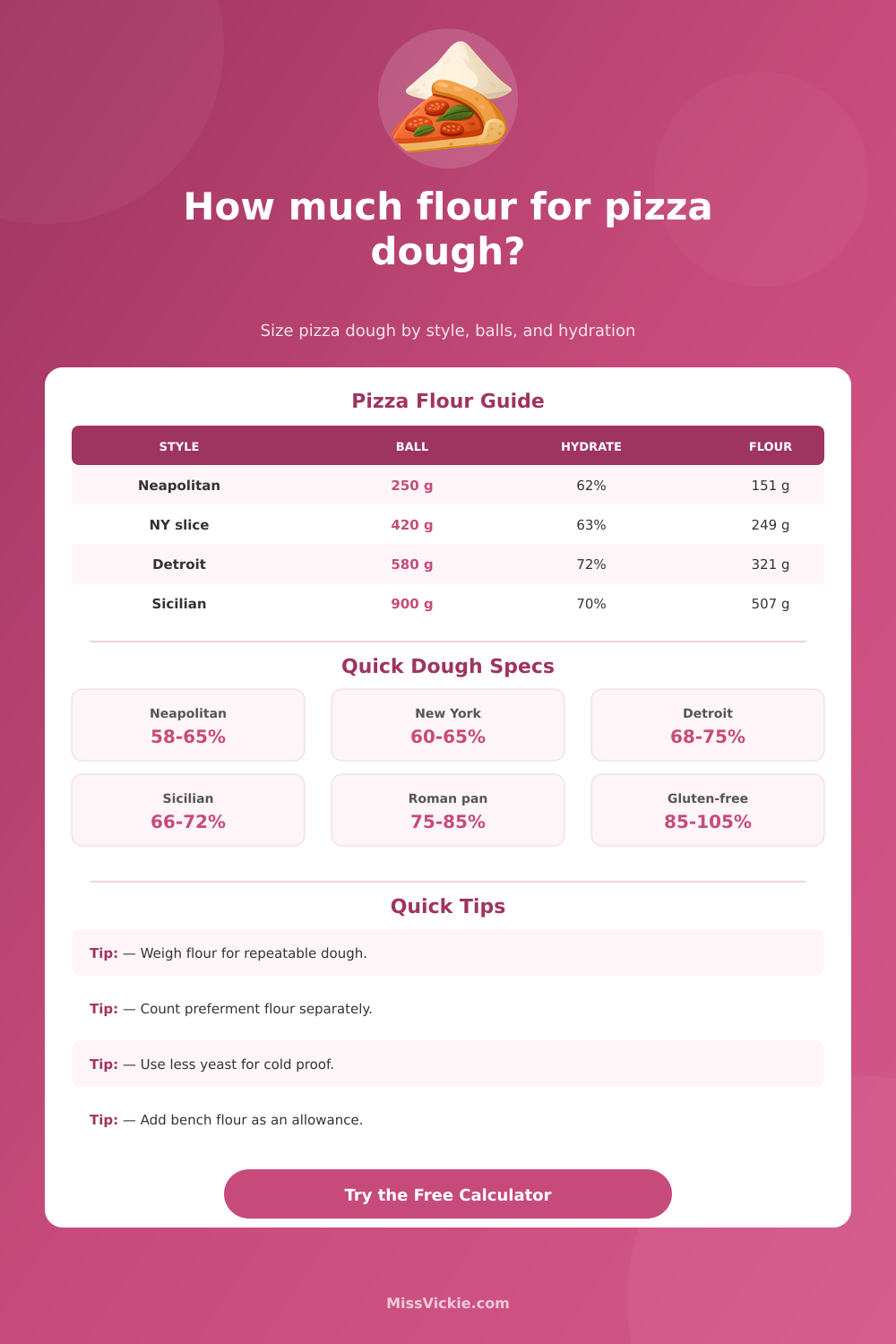
These tables provide starting points for pizza makers to decide on the weights and hydration percentages of their pizza dough. For instance, a 12-inch Neapolitan style pizza will have a different weight and hydration percentage than a 16-inch New York style pizza. These tables allow for pizza makers to understand the differences between various types of pizza and the hydration percentages of their doughs.
Common mistakes in incorporating flour into the pizza dough can occur if an individual treats the amount of flour as a fixed number for a given recipe. For instance, many individuals may choose a flour measurement in cups, and then find that their pizza dough balls are incorrect when they change the hydration or add oil to the dough. The pizza dough calculator is setup in the opposite of this process; first deciding the weight and percentages of the pizza dough, and using that information to calculate the amount of flour that is required.
Once individuals understand the relationship between each of these variables, they can use the calculator to adjust the recipe for any number of pizzas, as well as for any type of flour.