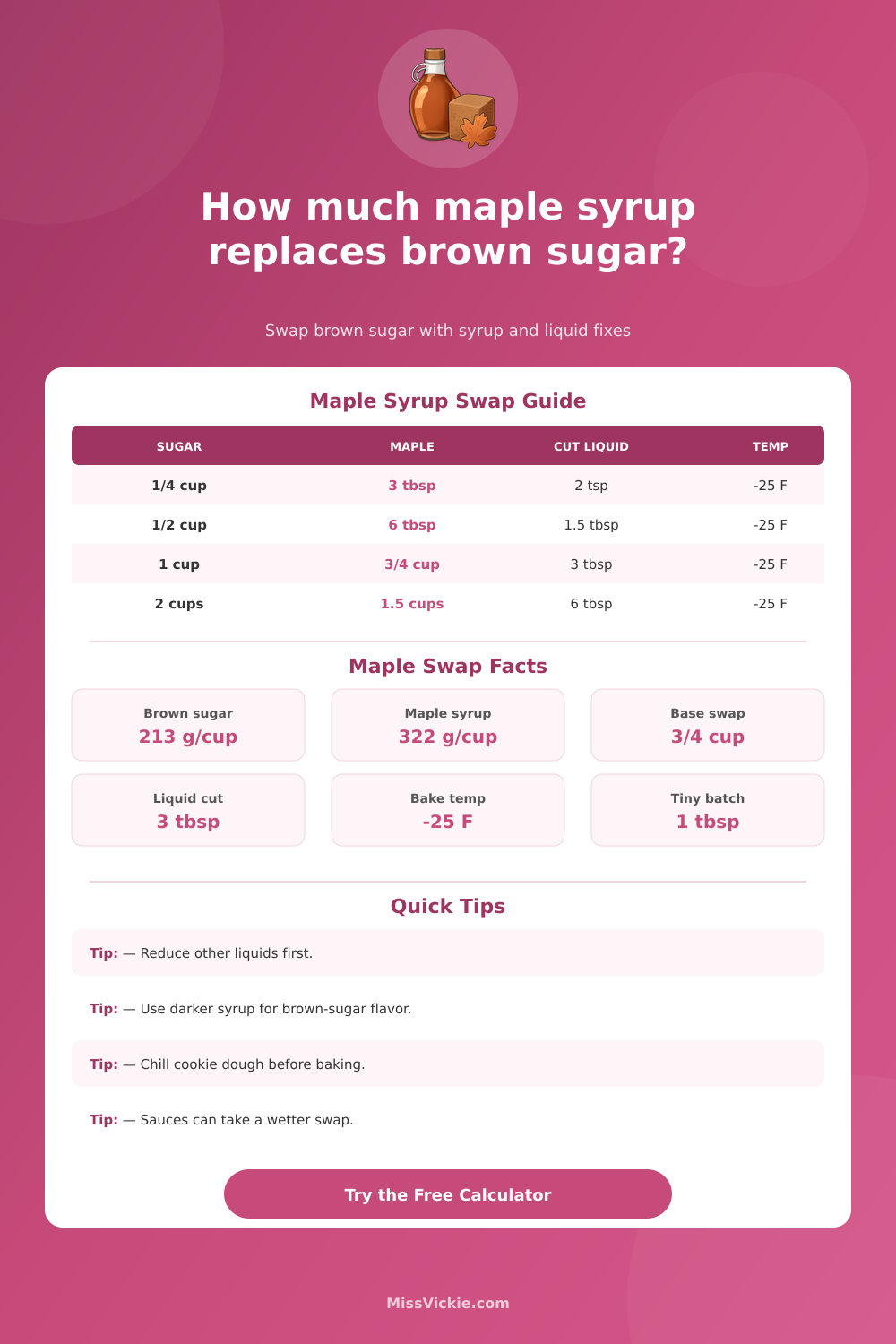
How Much Maple Syrup to Replace Brown Sugar Calculator
Convert packed brown sugar into maple syrup, then adjust liquid, oven temperature, sweetness, and structure for cookies, cakes, sauces, marinades, breakfast bakes, and glazes.
Pick a real kitchen scenario to load the brown sugar amount, recipe style, syrup grade, sweetness target, and moisture setting before fine-tuning.
Full Swap Breakdown
| Brown Sugar | Approx Weight | Maple Syrup | Metric Syrup | Liquid to Reduce |
|---|---|---|---|---|
| 1 tablespoon packed | 13 g | 2 1/4 teaspoons | 11 ml | 3/4 teaspoon |
| 1/4 cup packed | 53 g | 3 tablespoons | 44 ml | 2 1/4 teaspoons |
| 1/3 cup packed | 71 g | 1/4 cup | 59 ml | 1 tablespoon |
| 1/2 cup packed | 107 g | 6 tablespoons | 89 ml | 1 1/2 tablespoons |
| 2/3 cup packed | 142 g | 1/2 cup | 118 ml | 2 tablespoons |
| 3/4 cup packed | 160 g | 9 tablespoons | 133 ml | 2 1/4 tablespoons |
| 1 cup packed | 213 g | 3/4 cup | 177 ml | 3 tablespoons |
| 2 cups packed | 426 g | 1 1/2 cups | 355 ml | 6 tablespoons |
The table uses the practical baking swap of 3/4 cup maple syrup for each packed cup of brown sugar, with liquid reduction scaled from the syrup added.
| Recipe Type | Maple Ratio | Liquid Strategy | Texture Note | Best Syrup |
|---|---|---|---|---|
| Cookies or bars | 70% to 75% | Cut liquid fully or add dry base | Softer, more spread | Dark robust |
| Quick breads | 75% to 80% | Cut milk or water by 3 tbsp per cup sugar | Moister crumb | Amber rich |
| Cakes | 72% to 78% | Reduce thin liquid, not eggs or fat | Browns faster | Amber rich |
| Pies or custards | 80% to 85% | Reduce other syrup or cream slightly | Softer set | Dark robust |
| Sauces or compotes | 85% to 95% | Usually simmer longer instead | Glossy finish | Very dark |
| Glazes or BBQ sauce | 85% to 100% | Cook down to target thickness | Shiny and sticky | Very dark |
| Granola | 75% to 85% | Cut oil or water only if wet | Crisps as it cools | Amber rich |
| Marinades | 90% to 100% | Balance with salt and acid | Fast browning | Dark robust |
Maple syrup tastes slightly less sweet than packed brown sugar by volume, but its aroma can make the swap feel richer.
Maple syrup adds water, so batters need liquid reduction, extra dry base, chilling, or longer simmering.
Liquid sugars brown readily; baked recipes often work better with the oven lowered by about 25 F.
Dark or very dark syrup gives the closest deep flavor when a recipe originally depends on brown sugar and molasses notes.
| Ingredient | 1 Cup Weight | 1 Tbsp Weight | Kitchen Role | Swap Behavior |
|---|---|---|---|---|
| Packed light brown sugar | 213 g | 13 g | Sweetness, moisture, molasses | Original baseline |
| Packed dark brown sugar | 213 g | 13 g | Stronger molasses flavor | Use dark syrup if replacing |
| Pure maple syrup | 322 g | 20 g | Sweetness, water, maple aroma | Use 3/4 cup per cup sugar |
| All-purpose flour | 120 g | 8 g | Structure and absorption | Add only when liquid cannot be reduced |
| Rolled oats | 89 g | 6 g | Absorption in granola and bakes | Good dry fallback |
| Milk or water | 237 g | 15 g | Hydration | Reduce before changing eggs or fat |
| Original Temp | Maple Temp | Metric Temp | Watch For | Texture Fix |
|---|---|---|---|---|
| 325 F | 300 F | 150 C | Slow browning | Add a few minutes if center is wet |
| 350 F | 325 F | 165 C | Golden edges | Chill dough for cookies |
| 375 F | 350 F | 175 C | Fast surface color | Tent loaf tops if dark |
| 400 F | 375 F | 190 C | Glaze scorching | Brush later in cooking |
| Stovetop sauce | No temp cut | Simmer low | Thin texture | Reduce until glossy |
| Marinade | No temp cut | Cook gently | Quick charring | Wipe excess before searing |
Replacing brown sugar with maple syrup can cause changes to the texture and an appearance of the baked goods due to the difference in the compositions of these two ingredient. Brown sugar is a dry ingredient that contains sucrose and molasses. In contrast, maple syrup is a liquid ingredient that contains sucrose and water.
Using maple syrup in place of brown sugar will introduce more water into the baking recipe. This additional water can make the dough too loose, or the edges of the baked goods can brown too quick in the oven. To avoid ruining the recipe, the baker has to make adjustments to the amount of liquid ingredients and the oven temperature that is used to bake the goods.
Using Maple Syrup Instead of Brown Sugar
The composition of maple syrup is different than that of brown sugar. Maple syrup contains mostly sucrose and water. Brown sugar, on the other hand, is sucrose that is coated in molasses.
Maple syrup contains a high amount of water. When a baker uses maple syrup in place of brown sugar in the same amount, the recipe will contain approximately thirty percent more liquid than the recipe state. This excess liquid change the way that the flour hydrates with the other ingredients in the recipe.
Furthermore, excess liquid changes the way that fat coat the dough. To even consider using maple syrup in place of brown sugar, the baker will need to reduce the amount of other liquids in the recipe. The type of baked good that will be prepared determines how much adjustment is made to the recipe.
For instance, cookie dough contain very little water. Using maple syrup in place of brown sugar in cookie dough can make the cookie dough too thin. Quick breads can typically handle more moisture from maple syrup.
However, adjustments will still have to be made. For marinades or glazes that contain sugar, there is no need to make any adjustments to the recipe when using maple syrup in place of brown sugar. In these instances, a calculator will allow bakers to determine the amount of liquids to reduce in the recipe that is being prepared.
The sweetness of the recipe and the grade of the maple syrup that is used are two factors that will impact the baking recipe. Maple syrup is slightly less sweet than brown sugar when measured by the volume of the ingredients. However, the aroma of maple syrup can make a person feel as if the recipe containing maple syrup is much sweeter than the recipe actual is.
If the original recipe for the baked goods is very sweet, a lighter grade of maple syrup should be used in the recipe, and the sweetness setting should be adjusted accordingly. Darker grades of maple syrup contain more of a molasses flavor to the syrup. For recipes that require the same flavor of brown sugar as the original recipe, using a darker grade of maple syrup is the better replacement for brown sugar.
The moisture goal for the baked good will determine how the recipe should be adjusted. For example, if the baked good is supposed to have crisp edges, such as in cookies or granola, the baker should reduce the liquid in the recipe, and a dry ingredient should be added. For items like banana bread, the moisture content should be maintained, and there is no need to make adjustments to the recipe to accommodate the liquid in the maple syrup.
The moisture goal for the recipe will not change the amount of maple syrup to be used, but it will change the reaction to the water content of the maple syrup. If maple syrup is used in place of brown sugar, the oven temperature should also be adjusted. Maple syrup will cause the baked goods to brown faster in the oven than if brown sugar was used.
The sugars in maple syrup are already in liquid solution in the syrup. These sugars will react more quickly to the heat of the oven than the sugars in brown sugar. In order to accommodate for this, the oven temperature should be lowered by approximately twenty-five degrees.
No adjustment to the oven temperature is needed for stovetop glazes, as these glazes will not be baked in the oven. There are two different measurements of the same ingredients that must be understood when using maple syrup in place of brown sugar. One cup of packed brown sugar weighs approximately two hundred thirteen grams.
One cup of maple syrup, however, weighs three hundred twenty-two grams. These difference in weight show that adjustments need to be made to the recipe based on the weight of each ingredient. Using a scale to measure both the brown sugar and the maple syrup will allow bakers to make more accurate adjustments to the recipe.
Those who are replacing brown sugar with maple syrup make some common mistakes but fail to follow the adjustment steps necessary to do so. One mistake is to use the wrong liquid to reduce. For instance, reducing the amount of milk in a recipe instead of butter will not fix the problems created by using maple syrup for brown sugar.
Another mistake is to fail to reduce any liquid at all. This can lead to baked goods whose center is too gummy. These mistakes can be avoided by using a calculator that determines the amount of liquid to reduce and the oven temperature to use in the baking recipe.
Using a calculator will allow bakers to change their vague feelings about maple syrup to a specific decision regarding the amount of maple syrup to use and the temperature to set the oven to.