How Much Baking Powder for Cornbread?
Calculate baking powder for skillet cornbread, pan cornbread, muffins, or casserole-style batter using cornmeal ratio, flour, dairy acidity, add-ins, sugar style, and altitude.
Pick a common cornbread situation, then adjust the meal, flour, dairy, add-ins, and altitude before baking.
Full Leavening Breakdown
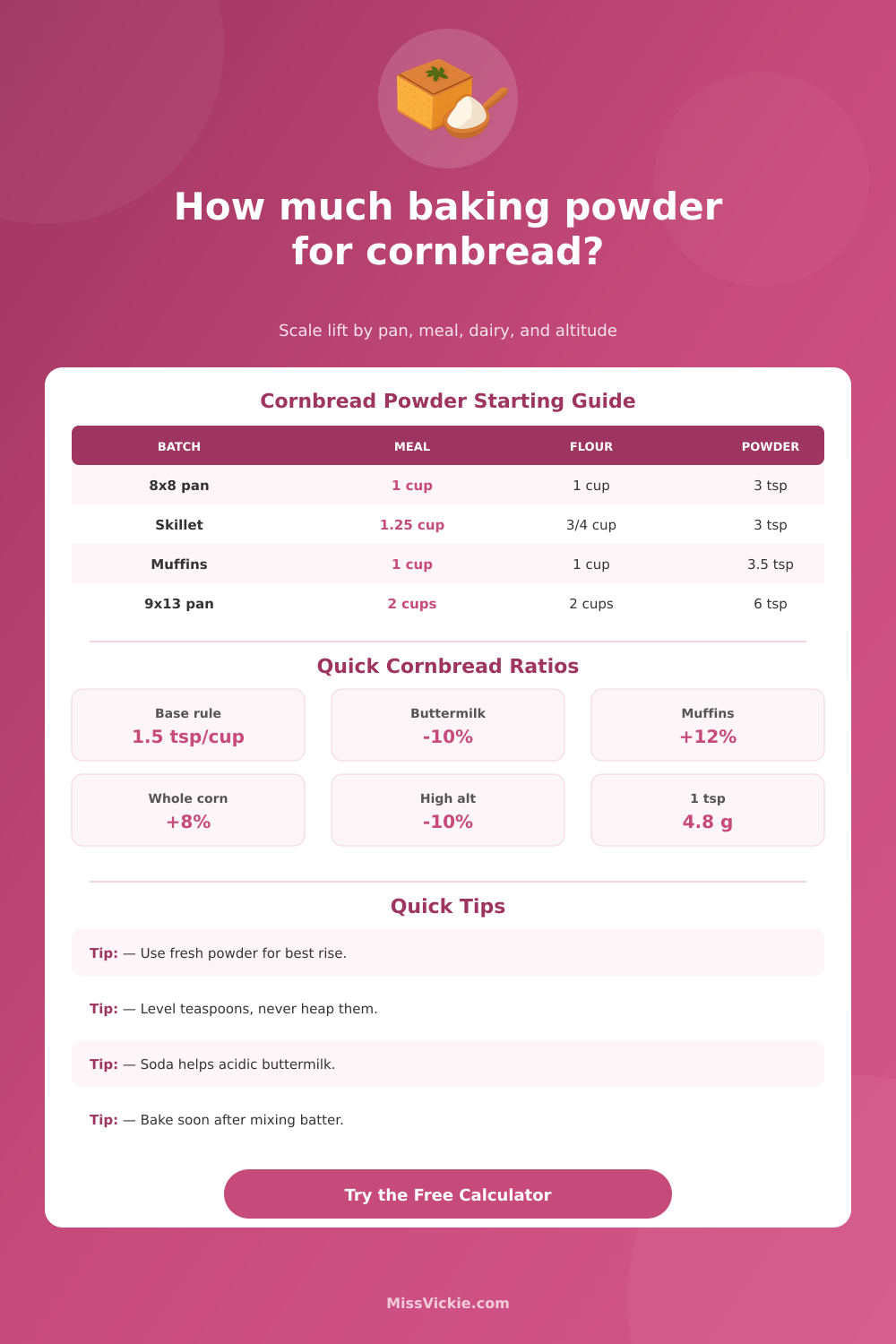
| Batch Style | Cornmeal and Flour | Starting Baking Powder | Best Use |
|---|---|---|---|
| 8 x 8 inch pan | 1 cup cornmeal plus 1 cup flour | 3 teaspoons / 14 g | Everyday square slices |
| 10 inch skillet | 1 1/4 cups cornmeal plus 3/4 cup flour | 3 teaspoons / 14 g | Crusty cast-iron cornbread |
| 12 muffins | 1 cup cornmeal plus 1 cup flour | 3 1/2 teaspoons / 17 g | Taller muffin domes |
| 9 x 13 inch pan | 2 cups cornmeal plus 2 cups flour | 6 teaspoons / 29 g | Potluck or holiday pan |
| Gluten-free pan | 1 cup cornmeal plus 1 cup GF blend | 3 1/4 teaspoons / 16 g | Extra starch support |
| Ingredient Situation | What It Changes | Powder Adjustment | Soda Note |
|---|---|---|---|
| Sweet milk batter | Neutral pH needs full powder lift | Use the base amount | Soda is optional |
| Buttermilk batter | Acid helps soda release gas | Reduce powder about 10% | Use 1/4 tsp soda per pan |
| Sour cream batter | Thicker and acidic batter | Reduce powder 8% to 12% | Use 1/4 to 1/2 tsp soda |
| Coarse stone-ground meal | Heavier texture and slower hydration | Add 6% to 10% | Rest batter briefly |
| Corn kernels or cheese | Extra weight in the crumb | Add 5% to 12% | Fold in gently |
| Altitude | Powder Change | Liquid Change | Practical Cue |
|---|---|---|---|
| 0 to 2,999 ft | No change | Follow the recipe | Standard rise |
| 3,000 to 4,999 ft | Reduce about 5% | Add 1 tablespoon liquid | Watch browning |
| 5,000 to 6,999 ft | Reduce about 10% | Add 1 to 2 tablespoons liquid | Set crumb faster |
| 7,000 ft and above | Reduce about 15% | Add 2 tablespoons liquid | Check early |
| Measurement | Equivalent | When to Use | Rounding Note |
|---|---|---|---|
| 1 teaspoon baking powder | About 4.8 grams | Small batch scaling | Level the spoon |
| 1 tablespoon baking powder | 3 teaspoons / 14.4 grams | Classic 8x8 pan | Common cornbread amount |
| 1/4 teaspoon baking soda | About 1.2 grams | Buttermilk support | Do not overdo it |
| 1 cup cornmeal | About 138 grams | Meal weight estimate | Spoon and level |
| 1 cup flour | About 125 grams | Dry mix estimate | Fluff before measuring |
Best for sweet milk cornbread where no acidic ingredient is driving a soda reaction.
Ideal for buttermilk, yogurt, sour cream, or kefir batters with tangy dairy.
Works for dense Southern-style cornbread, but may bake flatter in a deep pan.
Useful for muffins, coarse meal, or loaded batters, but too much can taste bitter.
The amount of baking powder that are used in a batch of cornbread is an important factor in the recipe. The amount of baking powder that is add will ultimately determine the texture of the cornbread that is produced. If too little baking powder are used, the cornbread will have a dense texture, which may be desirable for some recipes but may indicate that the cornbread is lacking a bit of a treat factor.
However, if too much baking powder is used, the cornbread will have a bitterness to the cornbread, which will remain on the tongue after the cornbread is eaten. Many people understands that a certain amount of baking powder is to be used in cornbread recipes in relation to the other ingredients in the recipe. However, a number of variables related to the recipe can change the amount of baking powder that is require to make the cornbread.
How Much Baking Powder to Use in Cornbread
For instance, the type of cornmeal that is use can change the amount of baking powder that is required for the cornbread to rise properly. Medium yellow cornmeal often produces relatively predictable results with cornbread. However, if stone-ground or coarse cornmeal is used, more baking powder is required, since those types of cornmeal hold more moisture.
The ratio of cornmeal to flour is another of the variable that must be considered. Flour contain proteins that assist in the setting of the cornbread, trapping the gas that is created by the baking powder. Consequently, if the ratio of cornmeal to flour is high in cornmeal and low in flour, more baking powder is required to provide for the additional rising power required by the batter that contain more cornmeal than flour.
The type of dairy that is used in the cornbread is another of the variables that will impact the amount of baking powder required for the cornbread. Sweet milk are neutral in their reaction to baking powder. However, buttermilk, yogurt, and sour cream contain the acidic component that react with baking soda to provide lift to the cornbread.
Consequently, if buttermilk, yogurt, or sour cream is used in the cornbread, ten percent less baking powder should be use. Non-dairy milk products will behave similarly to sweet milk products unless they contain additional acid, in which case a small adjustment in the baking powder will be required. The type of pan in which the cornbread is cooked is another of the variable that impact the amount of baking powder that should be used in the cornbread.
Skillet that are relatively wide and shallow will allow the cornbread to spread thinner, thus allowing the cornbread to rise to the surface of the skillet without having to rise as much. However, deep pans will require more baking powder to allow the cornbread to rise to the pans depth. Muffin pans contain relatively small portions of cornbread, and the edges of the muffins will cook faster than the center of the muffins.
Consequently, the edges of the muffins may trap the remaining batter in the center of the muffins, preventing those portion from rising. Thus, more baking powder is required in muffin pans to allow the center portions of the muffins to rise to the surface. The add-ins that is used in the cornbread are another of the variables to consider in baking powder adjustments.
Corn kernel contain moisture and weight to the cornbread. The additional weight of the corn kernels may weigh down the cornbread if there isnt enough baking powder to provide for the rising of the cornbread. Similarly, ingredients like cheese and bacon add fat and salt that will tenderize the structure of the cornbread.
Jalapenos and scallions is relatively light product to include in the cornbread, but they may interrupt some of the even distribution of the gas bubbles that are created by the baking powder. Though these add-ins are relatively small variables, they can have an impact on the baking process in conjunction with variables like the type of cornmeal to be used in the cornbread. The altitude at which the cornbread is prepared is a variable in itself.
At higher altitudes, the air pressure is lower, which allow the gases to expand within the cornbread batter. The result is that the cornbread may rise to the surface of the pan too quick. To compensate for this, the amount of baking powder should be reduced.
Additionally, because liquids tend to evaporate at higher altitudes, additional liquid may be added to the cornbread to keep it moist. Lastly, the amount of sugar and fat that is included in the cornbread is a variable in relation to the amount baking powder. Cornbread that contains a higher amount of sugar will brown faster.
Additionally, the sugar may tend to soften the structure of the cornbread, requiring an additional amount of baking powder to compensate for the tenderizing effect of the sugar. Cornbread that contains a high amount of melted butter or bacon drippings will produce a soft crumb when cooked. Thus, if such ingredient are used, the batter will contain less error in the amount of baking powder that is used.
The freshness of the baking powder itself is one more of the variable that can impact the amount of baking powder required for the cornbread. If the baking powder is old, it may not react as effective as fresh baking powder would. To test the baking powder for freshness, the baking powder can be mixed into hot water.
If no reaction occur, replacement of the baking powder with fresh baking powder should be made. In each of these variables, the amount of baking powder that is used in the cornbread is not an arbitrarily set number. Instead, the amount of baking powder required to make delicious cornbread with even texture can be calculated after understanding each of these variable.