Red Velvet Food Coloring Calculator
Estimate how much red food coloring to use in red velvet cake from batter volume, dye style, cocoa load, acidity, target shade, and expected bake fade.
Choose a common bake to load realistic batter, cocoa, color, and shade settings, then fine tune the inputs for your own recipe.
Coloring Breakdown
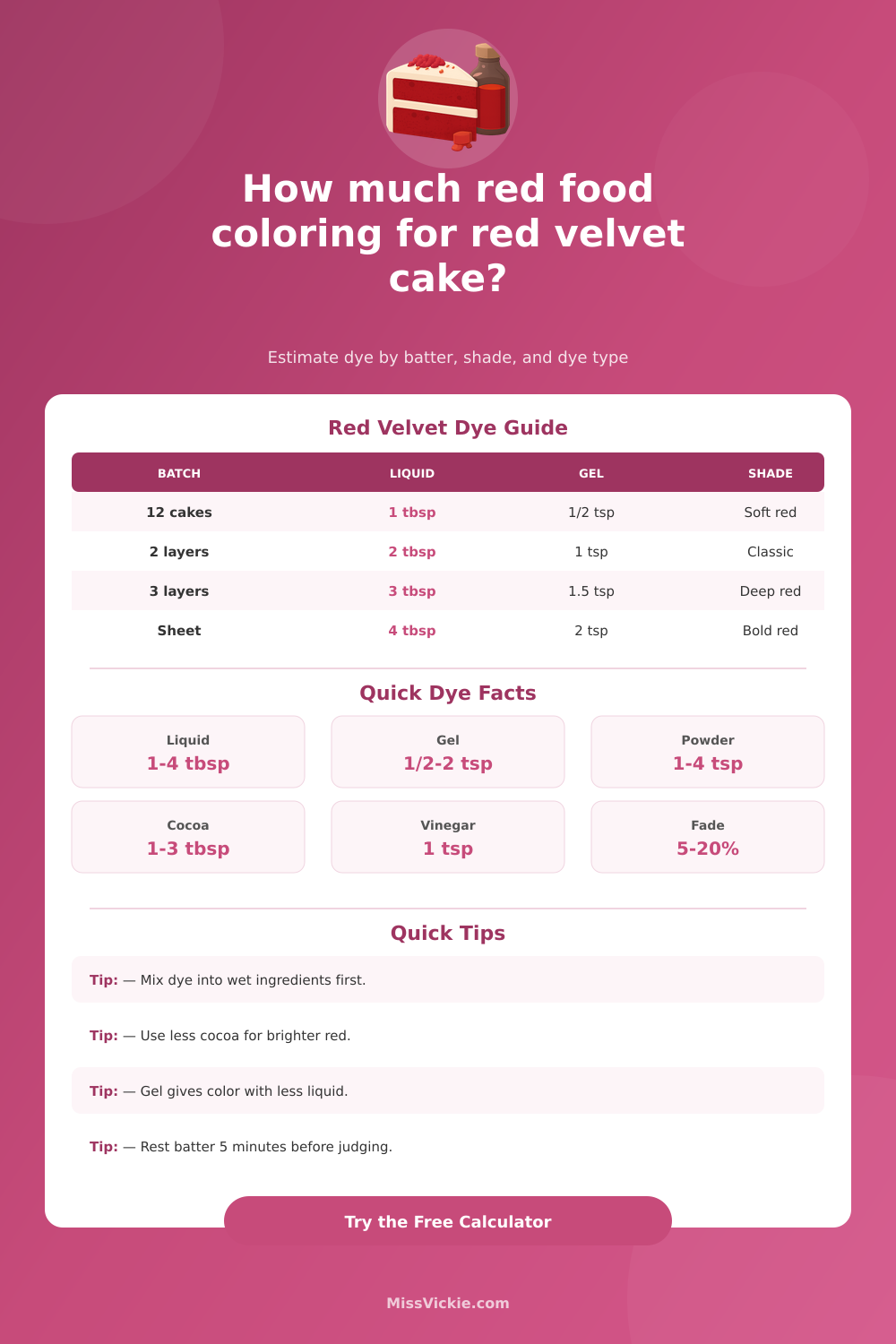
| Coloring type | Starting point per 6 cups batter | Best use | Notes |
|---|---|---|---|
| Liquid red coloring | 2 tablespoons | Classic home red velvet | Adds water, so it is easiest when the recipe already expects liquid coloring. |
| Gel red coloring | 1 teaspoon | Bright color with less liquid | Stir into buttermilk or vinegar first so thick gel does not streak the batter. |
| Powder red coloring | 2 teaspoons | Dry mix control | Whisk with flour or bloom in a spoonful of liquid to avoid specks. |
| Paste color | 3/4 teaspoon | Professional strong color | Use a toothpick or gram scale for tiny changes because it is concentrated. |
| Beet powder | 2 tablespoons | Natural muted red | Expect a softer brick tone after baking, especially with cocoa. |
| Color emulsion | 1 tablespoon | Smooth liquid blending | Often sits between grocery liquid and gel for strength. |
| Red velvet batch | Batter estimate | Liquid color | Gel color |
|---|---|---|---|
| 12 cupcakes | 3 to 4.5 cups | 1 to 1.5 tablespoons | 1/2 teaspoon |
| Two 8 inch layers | 5.5 to 6.5 cups | 2 tablespoons | 1 teaspoon |
| Two 9 inch layers | 7 to 8 cups | 2.5 to 3 tablespoons | 1.25 teaspoons |
| Three 8 inch layers | 8.5 to 10 cups | 3 to 3.5 tablespoons | 1.5 teaspoons |
| 9x13 sheet cake | 10 to 12 cups | 3.5 to 4 tablespoons | 2 teaspoons |
| Tall event tier | 12 to 16 cups | 4 to 5.5 tablespoons | 2 to 3 teaspoons |
| Ingredient variable | Low setting | High setting | Color effect |
|---|---|---|---|
| Cocoa powder | 1 tablespoon | 3 tablespoons or more | More cocoa darkens the cake and pushes red toward mahogany. |
| Buttermilk and vinegar | Milk only | Buttermilk plus vinegar | Acidity helps red stay clearer, especially with natural cocoa. |
| Bake time | Cupcakes | Large dense layers | Longer bakes fade color and may need a small buffer. |
| Dye concentration | Liquid bottle | Paste or professional gel | Concentrated color needs less volume and changes batter texture less. |
| Natural color | Beet powder | Strong synthetic red | Natural reds bake softer and browner, even when the raw batter looks bright. |
Traditional red velvet recipes often call for liquid coloring because the formula balances that extra moisture.
Gel is the easiest way to reach a vivid bakery red without adding several spoonfuls of liquid.
Powder works well when the batter is already loose, but it must be whisked thoroughly to prevent specks.
Beet powder gives a natural look, usually red brown rather than the vivid color of bakery slices.
The color of a finished red velvet cake can be differently from the color of the red velvet cake batter. The red color of the cake change during the baking process. While the amount of red food coloring that is include in the batter is one reason for the change in color, many peoples tend to add too much food coloring to achieve the desired pale appearance of the batter.
Adding too much red food coloring to the batter can alter the flavor of the cake to taste metallic, and can cause the cake to appear brown when finished baking. Thus, besides the amount of red food coloring that is included in the batter, there are many other factor that will influence the final color of the cake. The total volume of the batter will influence the final color of the cake.
Why Red Velvet Cake Changes Color and How to Keep It Red
For example, a small batch of red velvet cake will behave more differently than a large batch of red velvet cake batter. This is because small batch contain less mass than a large batch of red velvet cake batter. Additionally, if you add the same amount of red food coloring to small and large batches of red velvet cake batter, the red color will be less vivid in the larger batch of batter.
Furthermore, the longer that a batch of batter is in the oven, the more the red color of the cake will fade. The amount of cocoa that is include in the batter will also impact the red color of the resulting cake. Baking cookies that contain more cocoa will result in a darker color of the cake than those that contains less cocoa.
Additionally, if you use dutch process cocoa in place of natural cocoa, the color of the cake will fade to a less bright red color. To achieve a bright red color in the finished cake, it may be necessary to use natural cocoa in the recipe. The acidity of the batter will also impact the color of the red velvet cake.
Ingredients like buttermilk and vinegar will increase the acidity of the batter. Increased acidity will help the red color of the cake remain clear. Using regular milk in place of buttermilk will result in a less acidic batter and, therefore, a softer red color in the cake.
To account for the difference in acidity, you can adjust the amount of red food coloring. The type of red food coloring that is used can impact the results of the red velvet cake. Liquid red food coloring is easy to measure but will add water to the batter.
Gel and paste red food colorings are stronger than the liquid red food colorings and allow for less liquid to be used in the batter. Powdered red food coloring is precise but requires thoroughly mixing to avoid leaving specks of red food coloring in the batter. Finally, you can use natural beet powder but will result in a brick red color in the cake instead of the desired vivid crimson color.
Thus, the type of red food coloring that is used will impact the amount of red food coloring necessary for the recipe. The baking process will cause the red color of the cake to fade. If you bake the cake according to the recipe, the red color will fade by ten percent.
Baking the cake for longer period of time, or baking the cake in a convection oven will result in a further fading of the red color. To compensate for the fading of the red color, you can add extra red food coloring to the batter prior to baking. The fading of the red color is most noticeable in the center of thick cake layer.
The longer that the cake remains in the center of the oven, the more the red color will fade. People sometimes make mistake when adding red food coloring to the batter. For example, people may add red food coloring until the batter looks good, but the cake will end up darker then expected.
Conversely, people may add red food coloring to the batter but stop before the cake is finished baking, resulting in a pink cake when it is sliced. In both instances, people should aim for a color that is slightly lighter than the desired final color of the cake. The temperature of the oven and when the cake is baked will also impact the final color of the cake.
For example, removing the cake from the oven at the minimum amount of baking time will allow the cake to retain more of it’s red color than if it was baked for an additional five minute. Additionally, allowing the cake to cool on a rack instead of in the pan will allow for the retention of the red color. Cooling the cake on a rack will reduce the amount of carryover heat in the cake that could fade the red color.
The calculator can calculate the amount of red food coloring necessary for your recipe. To use the calculator, you will need to enter the amount of batter that will be used, the amount of cocoa that will be used, the type of red food coloring that will be used, and the shade of red that you would like to achieve. In addition to the calculator, there are reference tables to assist you in determining the amount of red food coloring that should be used in your recipe.
While the tables provide starting points for the amounts of red food coloring necessary for certain batch size of red velvet cake batter, you are also able to modify the batch size and other variables to determine how the amount of red food coloring necessary for your recipe may change. Achieving the desired amount of red color in the finished red velvet cake is the result of balancing many of these factors. For instance, you should balance the amount of red food coloring that is used with the amount of cocoa that is used in the recipe.
Using too little red food coloring will result in a cake that does not contain enough red color; however, using too much red food coloring will impart an unpleasant flavor to the finished cake. You should of used natural cocoa for the best results. Most people finds that red food coloring is actualy the hardest part of the process.
It’s important to make sure the batters color is correct. Its going to take alot of practice to get it right. The red color dissapears if you are not careful.
This moddern way of baking is better then the old ways. The baker will mix the ingredients carefuly. The cake should of been baked more longer.
Youll need to be more careful with the cocoa amount. If you want a luxurius look, follow these steps. Don’t forget to measure the cocoa amount.
The red velvet cake is a favorit among many. The colors of the cake can looks different depending on the oven. Check the cake’s color.
You cant miss it. Use the recipe’s instructions. The cake will look great.