How Much Heavy Cream for Whipped Cream?
Calculate heavy cream before whipping by finished volume, serving size, dessert style, overrun, cream fat, sweetener, stabilizer, and reserve so the bowl matches the plate.
Load a real dessert situation, then fine tune the number of servings, finished dollop size, cream type, and overrun.
Whipped cream breakdown
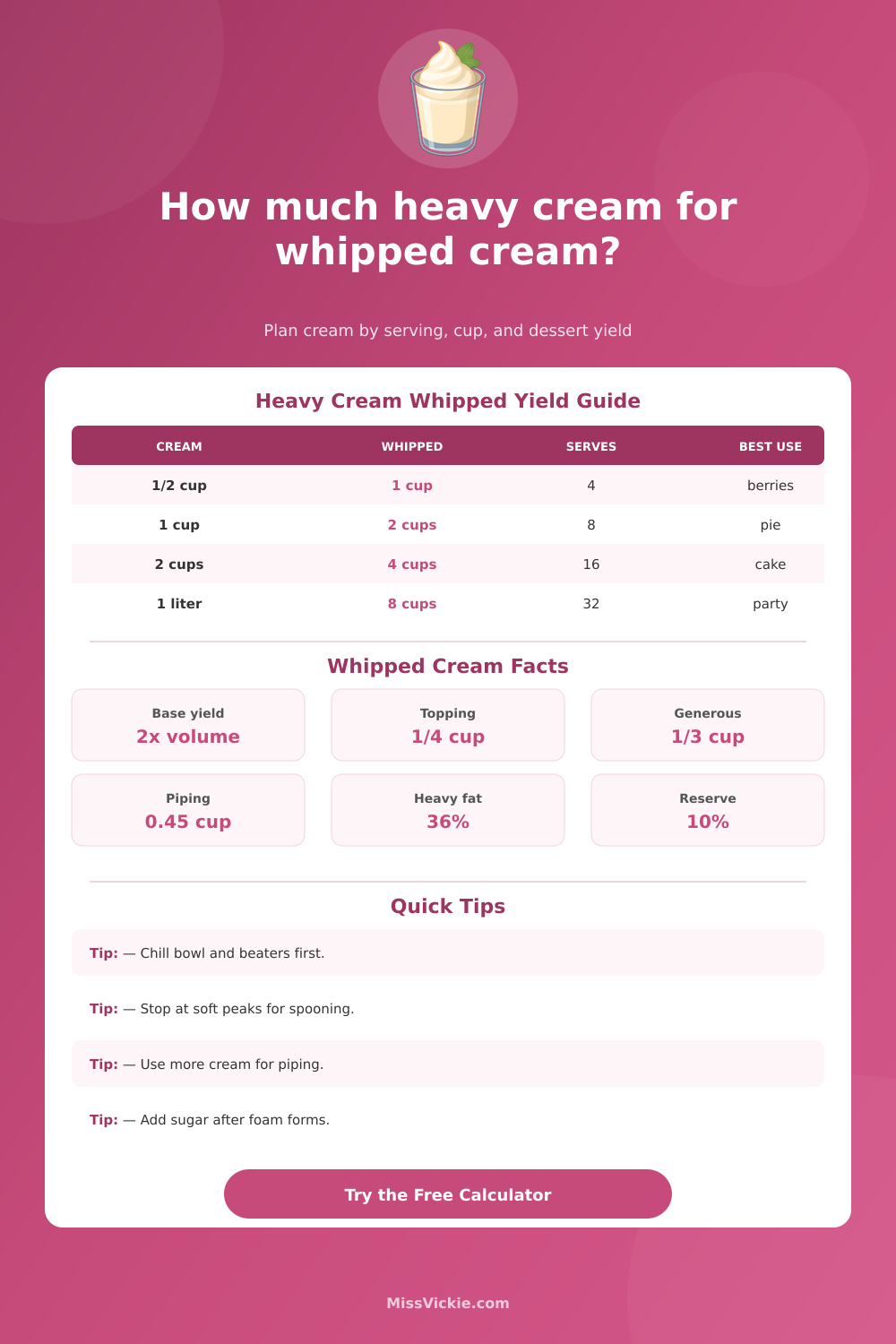
| Heavy cream before whipping | Likely whipped volume | Servings at 1/4 cup | Typical dessert use |
|---|---|---|---|
| 1/2 cup / 120 ml | About 1 cup | 4 modest servings | Berries, cocoa mugs, pancakes |
| 1 cup / 240 ml | About 2 cups | 8 modest servings | One pie, crisp, or small cake |
| 2 cups / 480 ml | About 4 cups | 16 modest servings | Two pies, trifle, dessert bar |
| 1 quart / 950 ml | About 8 cups | 32 modest servings | Party bowl or catering backup |
| Dessert style | Finished portion per serving | Heavy cream per serving | Planning note |
|---|---|---|---|
| Fruit or pie topping | 1/4 cup whipped | 2 tablespoons cream | Good for a spooned dollop. |
| Generous shortcake | 1/3 cup whipped | 2 2/3 tablespoons cream | Better when cream is part of the dessert. |
| Piped border or cupcakes | 0.40 to 0.50 cup whipped | 3 to 4 tablespoons cream | Add reserve because piping bags hold some cream. |
| Trifle or layer filling | 1/2 cup whipped | 1/4 cup cream | Dense folds may expand less than plain topping. |
| Cream type | Typical fat | Expansion behavior | Best handling |
|---|---|---|---|
| Heavy cream | 36 percent | Reliable 1.9x to 2.2x | Best all-purpose choice for topping. |
| Whipping cream | 30 percent | Softer 1.7x to 2.0x | Keep very cold and serve sooner. |
| Ultra-pasteurized heavy cream | 36 percent | Often a little slower to whip | Use medium peaks and avoid overbeating. |
| Double cream | 45 percent plus | Dense, rich, lower airiness | Whip gently and stop early. |
| Batch size | Heavy cream to buy | Finished whipped cream | Powdered sugar, classic |
|---|---|---|---|
| Dinner for 4 | 1/2 cup / 120 ml | 1 cup | 1 tablespoon |
| Pie for 8 | 1 cup / 240 ml | 2 cups | 2 tablespoons |
| Party for 16 | 2 cups / 480 ml | 4 cups | 1/4 cup |
| Event for 32 | 1 quart / 950 ml | 8 cups | 1/2 cup |
Best for spooning over fruit, pancakes, cocoa, and tender desserts.
The default estimate for pie topping, everyday dessert bowls, and most recipes.
Useful for defined dollops, but can turn grainy if pushed too far.
Gelatin, mascarpone, or pudding mix makes the cream denser and more holdable.
When preparing to whip heavy creams for a dessert, it is crucial to calculate the amount of heavy cream that is needed to be purchased and the amount that will be produced. The amount of heavy cream that is use in the recipe is crucial in determining the outcome of the dessert. Using too little heavy cream will result in the dessert having too little topping.
Using too much heavy cream will result in having a surplus of heavy cream that cant be used for the recipe. The amount of expansion that the heavy cream will undergo when whipping air into the heavy cream will depend on several factor. The factors that will impact the expansion of the heavy cream are the fat content of the brand of heavy cream that is used, the temperature of the heavy cream, and the length of time that the heavy cream are whipped.
How Much Whipped Cream Do You Need?
For instance, heavy cream that contain thirty-six percent fat will double in volume when whipped. However, if the recipe is prepared in a warm kitchen or if the heavy cream is only whipped until soft peak are achieved, the heavy cream will not be able to double in volume. A cook can use a calculator to calculate the amount of heavy cream that will be needed for a dessert.
The desired volume of the dessert and the number of serving that are to be prepared can determine the amount of heavy cream needed. The type of dessert will change the amount of heavy cream needed for the recipe. For instance, a dessert that requires only a small dollop of heavy cream will require less heavy cream than a dessert that require piped heavy cream.
A dessert like trifle will require more heavy cream than a dessert that only uses heavy cream in the topping. This is because a trifle require each serving to have a larger portion of heavy cream. Additionally, a percentage of heavy cream is set aside in advance for the recipe to account for the heavy cream that may remain in the mixing bowl or piped bag.
This heavy cream must be accounted for because the bag prevent the heavy cream from being evenly distributed to the dessert. The fat content of the heavy cream will change the behavior that the heavy cream exhibit while whipping. Heavy cream that contains more fat will produce a foam that is more denser and will result in less total volume of heavy cream.
Heavy cream that contains less fat will produce more expansion of the heavy cream when whipping but will lose its structure more quickly during the whipping process. Therefore, you must chose the type of heavy cream that is used for a recipe correctly to ensure that the correct amount of volume of whipped heavy cream is produced. Some of the ingredients that contain stabilizers and sweeteners will also change the behavior of the heavy cream.
Using powdered sugar will provide structure to the heavy cream. Additionally, ingredients like gelatin or mascarpone will also change the amount of air that the heavy cream can hold. Using these ingredients will change the expansion factor of the heavy cream.
These ingredients must be accounted for in the amount of heavy cream that is calculate. Another critical ingredient is the temperature of the heavy cream. The temperature impact the rate at which the heavy cream will whip.
Heavy cream will whip the best when it is cold and when the mixing bowl is also cold. If the heavy cream is warm it may take longer to reach the desired peaks when whipping and may not whip to the same volume as the warm heavy cream. The heavy cream should be kept chilled until it is ready to be whipped to ensure that it remains at a consistent volume.
People make several mistake when whipping heavy cream for dessert. For instance, people assume that the volume will remain the same after it is whipped. People often do not account for the type of dessert being made, the type of stabilizers in the heavy cream, and the portion of heavy cream that will remain in the piping bag.
If these factors are not account for, the amount of whipped heavy cream will not be correct for the recipe. To avoid these mistakes people must use a calculator to calculate the amount of heavy cream that is needed. Using a calculator will allow the cooks to account for the type of dessert being prepared, the type of heavy cream stabilizers, and the reserve amount of heavy cream.