How Much Cocoa Powder for Brownies Calculator
Calculate cocoa powder for brownies by pan area, batch count, brownie texture, cocoa type, chocolate add-ins, flour level, sugar level, and rounding style.
Choose a real brownie scenario to load pan size, texture, cocoa style, fat, sugar, flour, eggs, and add-ins, then fine-tune the formula.
Full Brownie Cocoa Breakdown
| Cocoa Measure | Approx Weight | Brownie Use | Formula Note |
|---|---|---|---|
| 1 tablespoon cocoa | 5 grams / 0.18 oz | Fine adjustment | Useful for darkening a batch |
| 2 tablespoons cocoa | 10 grams / 0.35 oz | Small texture shift | Add a little fat if batter tightens |
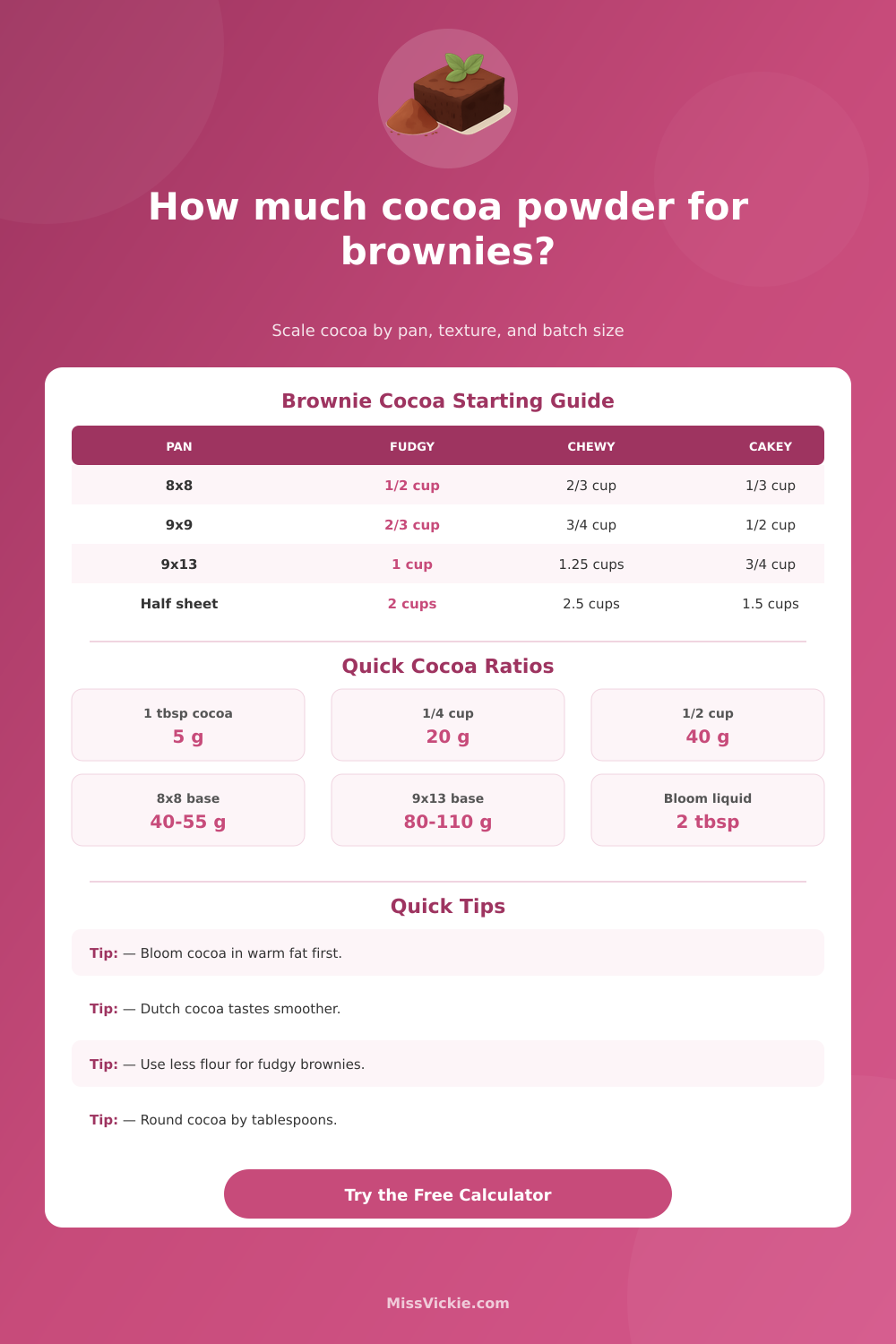
| 1/4 cup cocoa | 20 grams / 0.7 oz | Light 8x8 cocoa base | Works for cakey brownies |
| 1/2 cup cocoa | 40 grams / 1.4 oz | Fudgy 8x8 base | Common cocoa-only brownie amount |
| 2/3 cup cocoa | 53 grams / 1.9 oz | Chewy 8x8 or 9x9 | Needs enough sugar and fat |
| 1 cup cocoa | 80 grams / 2.8 oz | 9x13 classic pan | Good party-pan baseline |
| Pan or Batch | Area Factor | Fudgy Cocoa | Chewy Cocoa |
|---|---|---|---|
| 8 x 8 inch square | 1.00x | 40 g / 1/2 cup | 55 g / 2/3 cup |
| 9 x 9 inch square | 1.27x | 50 g / 5/8 cup | 70 g / 7/8 cup |
| 11 x 7 inch rectangle | 1.20x | 48 g / 0.6 cup | 66 g / 0.8 cup |
| 9 x 13 inch pan | 1.83x | 75 g / scant cup | 100 g / 1.25 cup |
| Half sheet pan | 3.66x | 150 g / 1.9 cups | 200 g / 2.5 cups |
| Two 9 x 13 pans | 3.66x | 150 g / 1.9 cups | 200 g / 2.5 cups |
| Cocoa Type | Calculator Factor | Flavor Result | Brownie Note |
|---|---|---|---|
| Natural unsweetened | 1.00x | Classic and slightly sharp | Good with melted butter |
| Dutch-process | 0.96x | Smoother and darker | Great for dense brownies |
| Black cocoa blend | 0.82x | Deep cookie-like flavor | Best blended, not solo |
| High-fat alkalized | 0.92x | Round and rich | Often needs less added fat |
| Raw cacao powder | 1.10x | Sharper and fruitier | Use balanced sugar |
| Half natural, half Dutch | 0.98x | Balanced dark cocoa | Reliable all-purpose blend |
Lower flour, enough fat, and a moderate cocoa load make the center dense and soft.
More cocoa and sugar build chew, especially with melted butter and a crackly top.
Less cocoa with more flour and egg gives a lighter crumb and gentler chocolate taste.
High cocoa needs strong sweetness, enough fat, and careful mixing to avoid dryness.
| 8x8 Base Style | Cocoa | Sugar Range | Fat and Flour |
|---|---|---|---|
| Fudgy cocoa brownie | 40 to 50 g | 180 to 220 g | 115 g fat, 60 g flour |
| Chewy cocoa brownie | 50 to 60 g | 220 to 260 g | 115 g fat, 75 g flour |
| Cakey brownie | 28 to 38 g | 160 to 210 g | 100 g fat, 95 g flour |
| Ultra dark brownie | 65 to 75 g | 240 to 285 g | 130 g fat, 55 g flour |
| Chocolate chip brownie | 35 to 50 g | 190 to 240 g | Add 85 g chips |
| Gluten-free fudgy | 40 to 55 g | 200 to 250 g | 70 g GF blend |
| Ingredient | Typical Amount | Calories | Primary Impact |
|---|---|---|---|
| Cocoa powder | 40 g per 8x8 | 90 calories | Chocolate flavor and dryness control |
| Butter | 115 g per 8x8 | 810 calories | Fudgy texture and richness |
| Sugar | 220 g per 8x8 | 850 calories | Sweetness, chew, shiny top |
| Flour | 60 to 95 g | 220 to 345 calories | Structure and crumb height |
| Eggs | 2 large eggs | 140 calories | Set, lift, and emulsification |
| Chocolate chips | 85 g per 8x8 | 430 calories | Richer bite and sweetness |
Baking brownie require an understanding of the relationship between cocoa, fat, sugar, and flour. The amount of cocoa you use will determine teh texture of the brownies. Additionally, the amount of cocoa will determine the flavor of the brownies.
If you use alot of cocoa, the brownies may end up being dense. However, if you use lesser cocoa, the brownies will end up being lighter in texture. Cocoa powder is almost pure cocoa solids.
How cocoa, fat, sugar and flour affect brownies
Therefore, it dont contain the same amount of moisture than melted chocolate. To compensate for this, you must add more fat to the brownie mixture when using cocoa powder. The type of cocoa you use will change the flavor of the brownies and create a chemical reaction within the brownies.
If you use natural cocoa, it will be acidic. This acidity will react with the baking soda to help the brownie rise. If you use Dutch-process cocoa, the cocoa will not be acidic because it has been neutralized.
Therefore, it will taste smooth but it will create a different chemical reaction within the brownies. Black cocoa has also been neutralized. It will create a deep flavor and provide a very dark color to the brownies.
Because each type of cocoa contain a different level of strength, you will need to adjust the amount of cocoa that you use in the brownies so that the flavor of the chocolate isnt too strong or too weak. Fat is another ingredient that play a critical role in the recipe. The fat will react with the cocoa to create the texture of the brownies.
If you use butter, it will contain some water and some milk solids that will help to create a thin crust on the top of the brownies. If you use oil, it will be a neutral fat that will help to keep the crumb of the brownies soft. If you use brown butter, the flavor of the brownies will be deeper.
However, brown butter will contain less moisture than butter. Therefore, you may need to add more liquid to the brownie mixture if you use brown butter to avoid dry brownies. Sugar is used in the brownie mixture for flavor and texture.
If you use too little sugar with a high amount of cocoa powder in your brownies, the texture of the brownies may end up being chalky. Additionally, if you use too much sugar, it may mask the flavor of the cocoa within the brownies. To avoid these outcome, you must find the right balance between the amount of sugar and the amount of cocoa powder used in the recipe.
Flour determine the structure of the brownies. If you use a lot of flour in the brownies, the texture of the brownies will be more cake like. However, if you use a low amount of flour, you will end up with fudgy brownies.
Additionally, if you use gluten-free flour, you must adjust the amount of cocoa and fat in the brownie recipe. The size of the pan in which you bake the brownies will also have an impact on how the cocoa and other ingredient bake within the brownie pan. For a larger brownie pan, the brownie mixture will spread thin.
You can use a calculator to ensure that the ratio of cocoa to fat is correct when scaling the brownie recipe for a larger pan. This calculator will help you to manage the amount of cocoa, fat, sugar, and flour that should be used within the brownie recipe. You can add chopped chocolate or chocolate chip to the brownie mixture to change the recipe.
Chocolate contains cocoa butter and sugar. Because of the moisture within chocolate, if you add a lot of chocolate chips to the brownie mixture, you may be able to use less cocoa powder. This is because the chocolate will add moisture to the brownie mixture and provide the flavor of cocoa to the brownies without the need for additional cocoa powder.
Additionally, blooming the cocoa in the fat will help to distribute the flavor of the cocoa even throughout the brownie mixture.