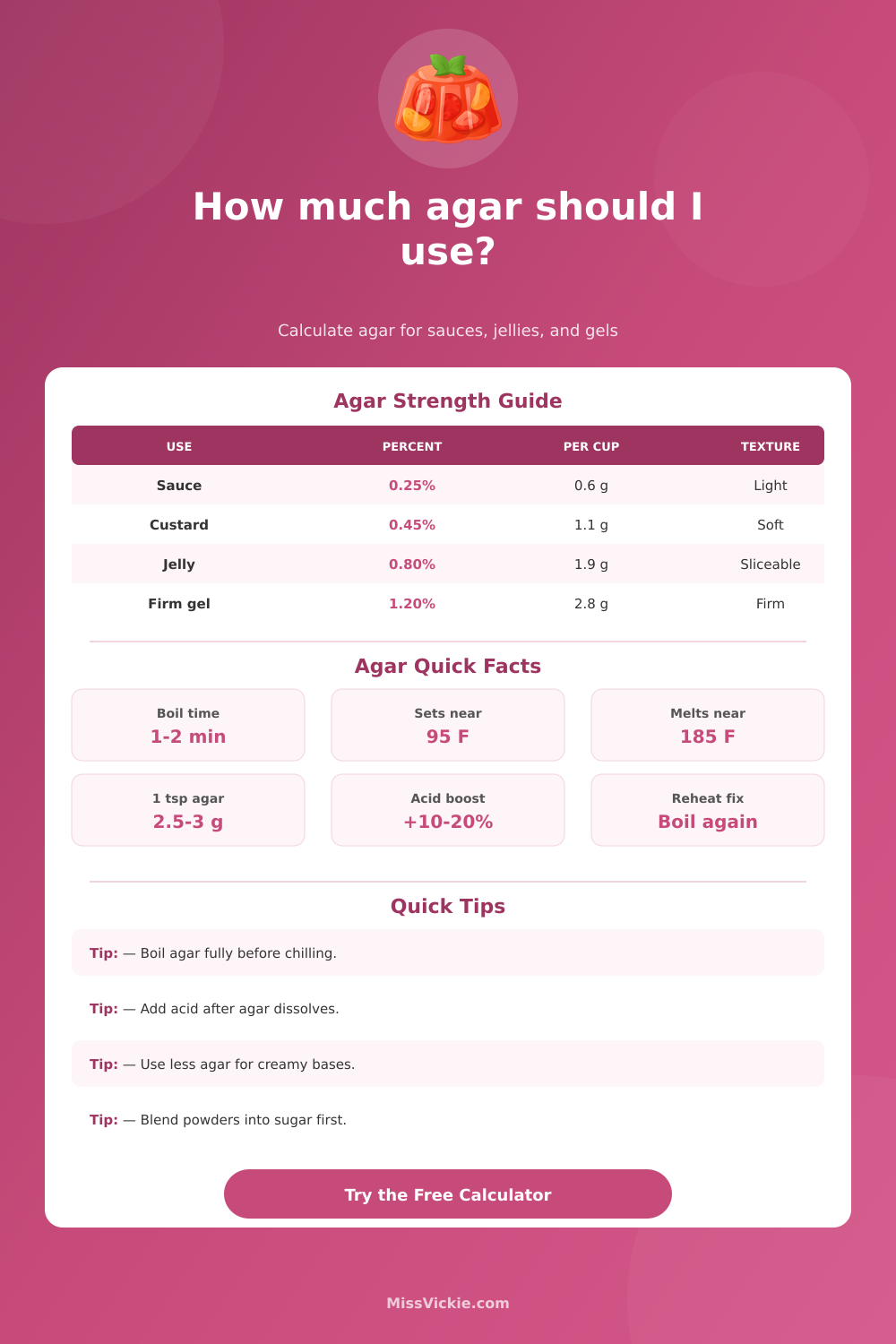
How Much Agar to Use Calculator
Calculate agar powder for sauces, fruit jellies, panna cotta-style desserts, glazes, firm cubes, and vegan set recipes using batch size, texture, acidity, sugar, and alcohol.
Choose a real kitchen scenario, then adjust the texture, liquid, acidity, sugar, or setting margin before you cook the agar.
Full Agar Breakdown
| Texture Goal | Agar Percent | Grams per Cup | Best Uses |
|---|---|---|---|
| Loose sauce set | 0.20-0.30% | 0.5-0.7 g | Fluid gels, plated sauces, light glazes |
| Tender custard | 0.35-0.50% | 0.8-1.2 g | Vegan panna cotta, coconut desserts, soft cream cups |
| Spoonable jelly | 0.60-0.85% | 1.4-2.0 g | Fruit cups, tea jelly, coffee jelly, dessert layers |
| Sliceable jelly | 0.90-1.10% | 2.1-2.6 g | Layered bars, unmolded desserts, clean-cut squares |
| Firm molded gel | 1.15-1.40% | 2.7-3.3 g | Buffet gels, firm cubes, decorative molded shapes |
| Extra firm sheet | 1.50-1.80% | 3.6-4.3 g | Noodles, sheets, very firm savory or pastry inserts |
| Ingredient Factor | When It Applies | Typical Change | Kitchen Note |
|---|---|---|---|
| High acidity | Citrus, tart berry, vinegar, hibiscus | Add 10-25% | Dissolve agar before adding the sharpest acid when possible. |
| Alcohol | Wine, liqueur, cocktail bases | Add 5-20% | Keep final alcohol moderate for the cleanest set. |
| Dense puree | Mango, berry, pumpkin, bean paste | Add 5-12% | Purees can block a neat gel if they are pulpy or fibrous. |
| Fat and cream | Coconut milk, cream, nut milk | Reduce 3-8% | Creamy bases feel firmer at the same agar level. |
| High sugar | Jams, syrups, sweet dessert layers | Reduce 3-6% | Sugar supports structure but can slow hydration if clumped. |
| Travel service | Picnics, buffet, warm room display | Add 10-15% | Use the margin setting when the gel must unmold cleanly. |
| Batch Size | Soft Set 0.45% | Jelly 0.80% | Firm Set 1.20% |
|---|---|---|---|
| 1 cup / 237 ml | 1.1 g | 1.9 g | 2.8 g |
| 2 cups / 473 ml | 2.1 g | 3.8 g | 5.7 g |
| 1 quart / 946 ml | 4.3 g | 7.6 g | 11.4 g |
| 1 liter / 1000 ml | 4.5 g | 8.0 g | 12.0 g |
| 2 liters / 2000 ml | 9.0 g | 16.0 g | 24.0 g |
| 1 gallon / 3.79 L | 17.0 g | 30.3 g | 45.4 g |
| Spoon Measure | Approx Agar Powder | Best For | Accuracy Note |
|---|---|---|---|
| 1/8 teaspoon | 0.35 g | Tiny test batches | Level carefully; powder density varies. |
| 1/4 teaspoon | 0.7 g | Single cup soft set | Good for light sauces and trials. |
| 1/2 teaspoon | 1.4 g | One cup spoon jelly | Close to a medium fruit jelly ratio. |
| 1 teaspoon | 2.8 g | Firm cup or two soft cups | Use grams for exact dessert texture. |
| 1 tablespoon | 8.4 g | Large trays and batches | Whisk into sugar for even dispersal. |
Plant-based gel that sets firm at room temperature and needs a full boil to hydrate.
Animal-based gel with a softer melt; it blooms gently and melts near body temperature.
Fruit gel system that often depends on sugar, acidity, calcium, or a specific pectin type.
Thickens sauces and fillings but gives a paste texture rather than a clean cut gel.
Agar is a thickening agent that requires the use of the correct amount of agar to achieve the desired textures in the dessert. Using too little agar will result in a loose mixture or one that weep after a few hours. Using too much agar will result in a rubbery texture that is difficultly to melt on the tongue.
The amount of agar that are used will determine the texture of the liquid base. Agar is different than both gelatin and starch in that agar require a full boil to hydrate. Agar will set if the mixture is allow to cool.
How Much Agar to Use for Desserts
Agar sets at a temperature around that of the bodys temperature. Because agar sets at such a high temperature, agar desserts will hold there shapes at room temperature and in warm rooms. Agar desserts is useful for those buffet displays or summer parties.
Once agar has set, it will remain set unless the mixture are boiled again. The type of liquid base that you use will also affect agar. Juice bases contain natural acidity to the liquids, and many juice also contain pectin that will help set the agar.
Creamy bases contain fats that will enhance the texture of the agar dessert without adding more agar. A dessert that use heavy cream will be firmer than one that uses water and the same amount of agar. If alcohol or acidity is to be used in the liquid base, more agar will be required.
To calculate how much agar will be needed, agar calculators can be used that will account for the type of liquid base that is used, the batch sizes, the acidity of the liquid base, the sugar level, and the amount of alcohol. The texture that you would like your agar dessert to achieve will determine the amount of agar that will be required. For example, agar desserts can be spoonable and set on a spoon without dripping, or the agar dessert may break when pressed on the spoon.
A sliceable layered bar would require more agar than a spoonable dessert that set on a spoon. A sliceable layered bar would need to be firm enough to unmold from the mold, yet break apart when sliced. Textures like custards, fluid sauces and molded agar cubes require different amount of agar to achieve their textures.
Sugar and acidity levels will interact with agar in specific ways. Moderate levels of sugar will help agar to set. However, if the level of sugar is too high, agar may not hydrate proper.
Acid levels will weaken agar structures. Therefore, agar desserts that contains lemon or vinegar will require more agar. For acidic ingredients, the extra agar needed is between ten and twenty percent of the total agar needed.
If agar is not added to acidic ingredients, the soft set agar may turn into a puddles. One of the most common mistakes in agar recipes is the addition of acid or alcohol before agar has had time to dissolve in the liquid base. Agar must be dissolved in a neutral liquid base over a sustained heat before you can give the liquid the acid or alcohol ingredient.
Another common mistake is in the thought that the more agar that is added, the better the agar will unmold from the mold. While true to a point, if the agar content is more than approximately one and a half percent of the total liquid, the agar will develop a leathery texture to the touch. The portion size and how the agar dessert will be served will affect the amount of agar to be used.
A large portion of agar dessert for a picnic will require more agar than a small batch for one or two people. A large portion will require more agar to account for the distance of the serving and the warmer temperature at which the agar dessert will be served. A small batch of agar dessert does not need to be as strong in its setting because the small number of individuals who will taste the dessert will consume it quick.
Agar can behave differently based off the source of the agar and the way in which the agar is ground. For example, agar powder can be stronger than agar flakes. Therefore, the percentage of agar will have to be adjusted to accommodate the different source of agar.
If the strength of the agar is not certain, it is best to use a conservative setting for the agar powder. If the agar set is too soft, the batch can be reheated with more agar. Agar can be added to a heated batch, and the batch can be boiled to allow the agar to rehydrate.
Using a calculator prior to cooking the agar dessert will eliminate the guesswork in the amount of agar to be used in the recipe.