How Much Baking Powder in Banana Bread?
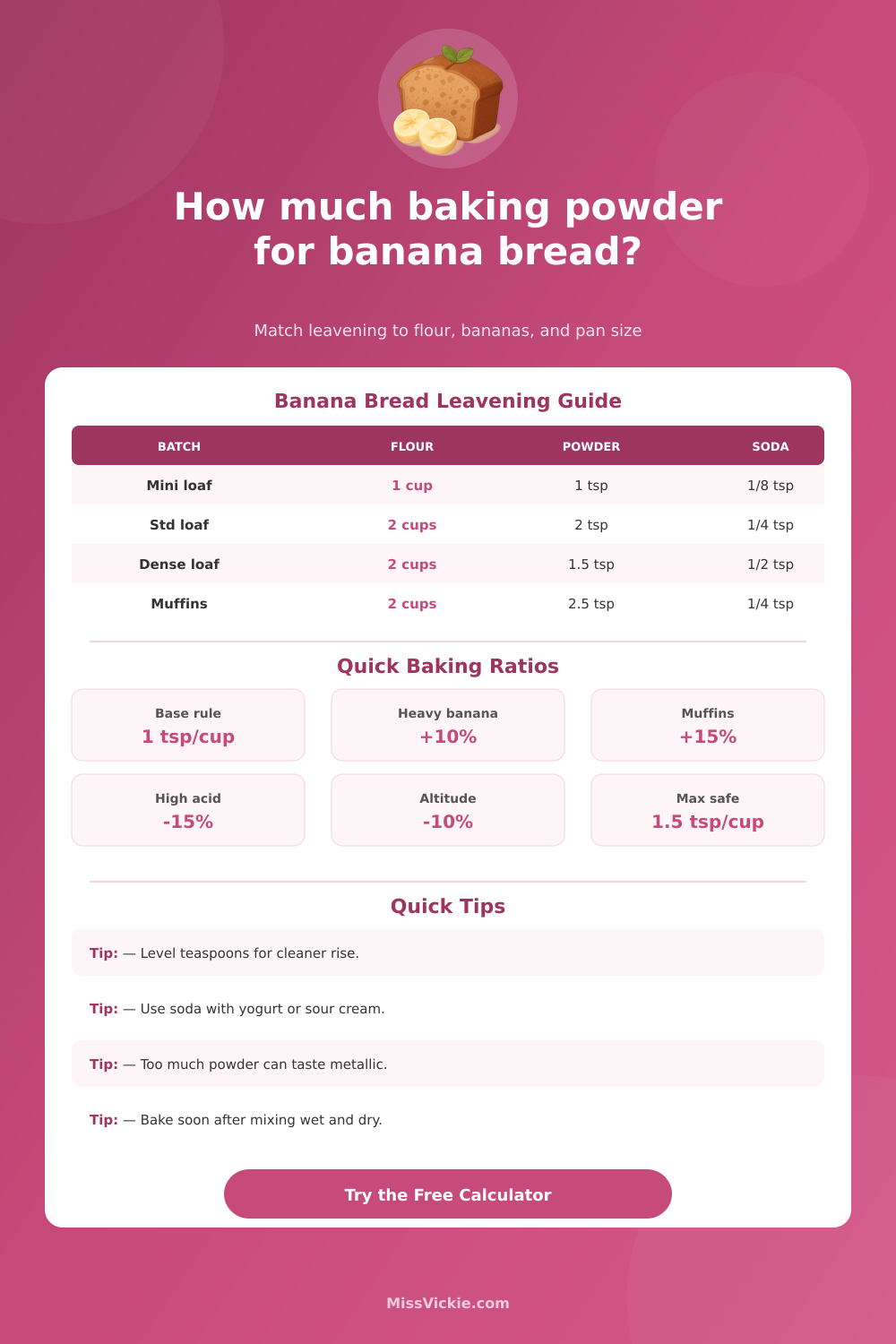
Estimate baking powder for banana bread from flour, banana moisture, pan style, acidity, add-ins, altitude, and whether baking soda is already helping the loaf rise.
Choose a real baking scenario, then adjust the flour, banana, acidity, and add-ins to match your recipe.
Full Leavening Breakdown
| Recipe Size | Flour | Mashed Banana | Starting Powder |
|---|---|---|---|
| Small 8x4 loaf | 1.5 cups / 188 g | 3/4 to 1 cup | 1 1/2 tsp |
| Standard 9x5 loaf | 2 cups / 250 g | 1 to 1 1/2 cups | 2 tsp |
| Two loaves | 4 cups / 500 g | 2 to 3 cups | 4 tsp |
| 12 muffins | 2 cups / 250 g | 1 to 1 1/4 cups | 2 1/4 to 2 1/2 tsp |
| Bundt-style bread | 3 cups / 375 g | 1 1/2 to 2 cups | 3 to 3 1/4 tsp |
| Ingredient Situation | What It Does | Powder Adjustment | Soda Note |
|---|---|---|---|
| Very wet banana mash | Heavier batter needs extra lift | Add 5% to 12% | Keep soda modest |
| Sour cream or yogurt | Acid helps baking soda react | Reduce powder 8% to 15% | Use 1/4 to 1/2 tsp soda |
| Whole wheat flour | Bran weakens rise | Add about 8% | Do not overmix |
| Honey or maple syrup | More moisture and acidity | Usually no big increase | Soda helps browning |
| Heavy nuts or chips | Weighs down the loaf | Add 5% to 10% | Fold in last |
| Altitude | Powder Change | Liquid Change | Practical Cue |
|---|---|---|---|
| 0 to 2,999 ft | No change | Follow recipe | Use standard ratio |
| 3,000 to 4,999 ft | Reduce about 5% | Add 1 to 2 tbsp liquid | Check early |
| 5,000 to 6,999 ft | Reduce about 10% | Add 2 to 3 tbsp liquid | Set structure faster |
| 7,000 ft and above | Reduce about 15% | Add 3 to 4 tbsp liquid | Increase oven slightly |
| Measurement | Equivalent | Use Case | Rounding |
|---|---|---|---|
| 1 teaspoon powder | About 4.6 to 5 g | Per cup flour baseline | Level spoon |
| 1/2 teaspoon powder | About 2.3 to 2.5 g | Small corrections | Use level half spoon |
| 1/4 teaspoon soda | About 1.2 g | Acidic banana bread | Do not heap |
| 1 cup mashed banana | About 225 g | Moisture estimate | Pack lightly |
Good for neutral batters without sour cream, yogurt, or molasses.
Useful for classic banana bread with brown sugar and acidic dairy.
Can brown well, but too much creates soapy flavor and coarse crumb.
Works for very moist loaf style, but risks a flat center.
Baking powder is a leavening agents that helps banana bread rise during the baking process. If you dont use enough baking powder, the center of the banana bread will be heavy and will not rise. If you use too much baking powder the banana bread will have a metallic taste.
The amount baking powder you need will depend upon the amount of flour in your recipe, the moisture level of the bananas, whether your recipe contains baking soda and the altitude at which you are baking your bread. The banana bread calculator can calculate for you the proper amount of baking powder by taking into account several factors. The type of flour that you are using can impact the amount of baking powder that you need because whole wheat and gluten-free flour will require a different amount than all-purpose flour.
How much baking powder to use in banana bread
The moisture content of your bananas can impact the amount of baking powder because more watery bananas will require more baking powder to help the bread rise. If you are using acidic ingredients like yogurt or buttermilk, then the recipe may also contain baking soda which will alter the amount of baking powder that you need. Finally, the altitude at which you are baking can impact the amount of baking powder that you need because baking powder creates bubbles in the banana bread that rise as the bread bakes; at higher altitudes, the air pressure is lower and these bubbles expands at a faster rate.
Many banana bread recipes use a starting point of one teaspoon of baking powder for every one cup of flour in the recipe. Recipes use this starting point because this amount of baking powder will provide enough lift to the banana bread to rise during the baking process without creating a bitter flavor. The calculator may adjust this starting point for factors like the ripeness of your bananas, the type of add-ins that are in the bread, and the altitude at which you are baking.
These adjustments will help you to avoid potential failures in the baking process. The ripeness of the bananas can impact the amount of baking powder that is needed in your banana bread recipe. Bananas that are black and liquid will contain more moisture than bananas that are yellow with fewer spots.
The extra moisture will affect the rise of the banana bread; too much moisture can make it difficult for the banana bread to have a good crumb structure, so more baking powder will be needed if using very ripe bananas. Thawed bananas also contain more liquid and the calculator will account for that liquid so that you dont have to account for it yourself. Baking soda and baking powder are two different leavening agents that can be used in banana bread recipes; however, many recipes use both baking soda and baking powder.
Baking soda reacts with acidic ingredients to create the rise in the banana bread and to make the bread brown; baking powder creates a more even rise to the banana bread. If you use baking soda in your banana bread because you are using sour cream in the recipe, then you can reduce baking powder in the recipe. Using too much baking soda and baking powder will create an aftertaste to the banana bread that tastes soapily and may also result in a coarse crumb structure.
The size of the pan in which you bake your banana bread will impact the way that the baking powder reacts to baking; different pans will require different amounts of baking powder to produce evenly-risen banana bread. For instance, a nine-by-five loaf pan will spread the banana bread thinner than a bundt pan. Finally, muffin pans will require a higher ratio of baking powder than banana bread pans because muffins take longer to cook than banana bread and the muffin domes will set before the centers of the muffins cook.
The add-ins that are included in your banana bread will also impact the amount of baking powder that you should use in your recipe. Any add-ins, like walnuts or chocolate chips, will add weight to the banana bread; too much weight may negatively impact the crumb structure of your banana bread. To counteract the weight of these add-ins, more baking powder will be needed.
Additionally, you should fold these ingredients into the banana bread at the very end of the baking process so that the baking powders air bubbles are not destroyed. Overmixing the banana bread after adding these ingredients will also negatively impact the crumb structure of your banana bread. The altitude at which you are baking will change the way in which the gases created by the baking powder rise in the banana bread.
These rising gases will expand at a faster rate at high altitudes; therefore, less baking powder is needed at high altitudes. Additionally, you should increase the liquid in the banana bread at high altitudes to assist in the setting of the structure of the banana bread before the gases leave the bread. The change in the amount of baking powder needed at high altitudes will be between 5 and 15%.
Though small, this change will help prevent your banana bread from having a deflated middle once it cools. On the page, there are reference tables that list the different start points for various batch sizes and ingredients. These tables is helpful for those who would like to quickly reference the baking powder start point or for those who are baking a recipe that has been baked before.
These numbers are not meant to be a replacement for the tasting of the banana bread and baking adjustments, but they do provide a start to baking banana bread that will rise evenly. You should measure the amount of baking powder after determining if the baking powder is still fresh. If the baking powder has been opened for many months it may not be as strong as new baking powder.
To determine if the baking powder is still strong, place the baking powder into hot water; if there are no strong bubbles in the hot water, then you should replace the baking powder before baking. The amount of baking powder is the one variable in baking banana bread that you should measure precisely before beginning to bake. If you use the proper amount of baking powder for the flour, bananas and baking pan, the banana bread will have a better chance of baking to the desired result.
You’ll find that the most important thing is to follow the instructions exacty. Its better to be careful than to have a ruined loaf. The recipe should of been followed closely to ensure success.
Using more than needed could of caused a bad taste. The baker must be careful with the measurements. If the pan is too small, the bread wont rise correctly.
Most people find that baking is easier than it looks. Use teh proper tools for the best results. Making banana bread is a delicius way to spend an afternoon.
It is a very luxurius treat to share with friends. You can use a lot of ingredients if you want. You should of checked the expiration date first.
The bread’s texture depends on the flour. It is a good idea to check the pan size too. This process is more simple than it seems.
Make sure you use a large bowl. You cant go wrong with chocolate chips. The amount of moisture can vary alot.
Don’t forget the sugar. The recipe is very easy to follow. If you follow it, you will be happy.
This is a great way to bake. One should always be careful with measurements. The pan size matters more then people think.
You should of read the recipe twice. Make sure the oven is preheated. This will help the bread rise.
It is a very common mistake. The flours moisture level is important. You will recieve compliments on your bread.
This is a moddern way to bake.