Crushed strawberries, pectin type, sugar level, lemon juice, firmness, jar yield, and batch safety
How Much Pectin for Strawberry Jam Calculator
Estimate pectin for strawberry jam from crushed berry volume or weight, sugar ratio, pectin style, lemon juice, desired set, jar size, and batch scale.
Load a common strawberry jam batch, then adjust the berries, sugar, pectin style, lemon juice, set firmness, and jar size for your kitchen.
Full Pectin Breakdown
| Pectin style | Common strawberry ratio | Best sugar range | Calculator basis | Watch point |
|---|---|---|---|---|
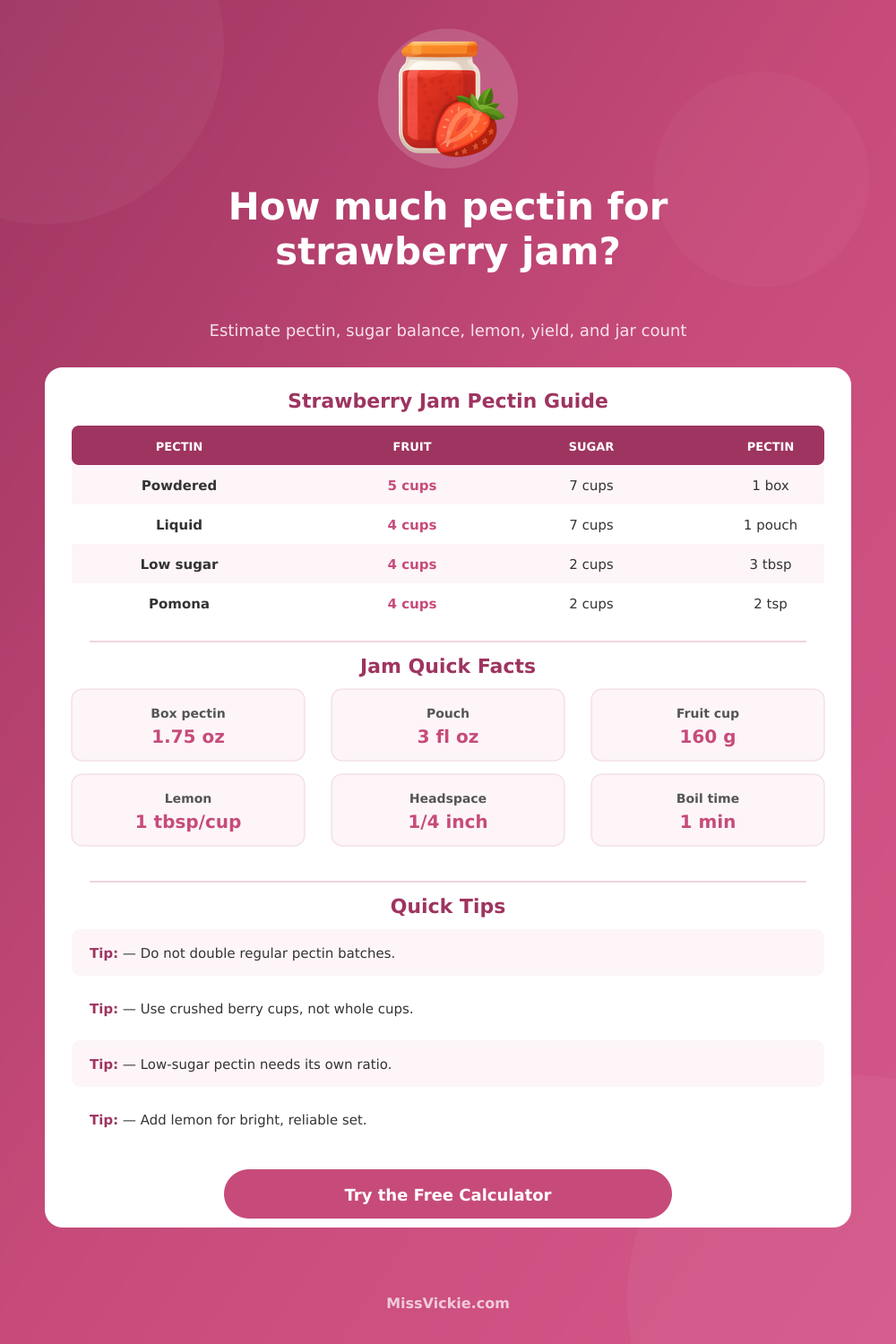
| Regular powdered pectin | 1 box for about 5 cups crushed fruit | Full sugar, often 7 cups | 0.35 oz pectin per fruit cup | Do not casually double the cooked batch. |
| Regular liquid pectin | 1 pouch for about 4 cups crushed fruit | Full sugar, often 7 cups | 0.75 fl oz liquid pectin per fruit cup | Liquid pectin is usually added after sugar boils. |
| Low or no-sugar pectin | About 3 tbsp for 4 cups crushed fruit | Low, flexible, or no sugar | 0.75 tbsp powdered pectin per fruit cup | Use the low-sugar package directions. |
| Pomona-style pectin | 2 tsp pectin plus calcium water for 4 cups fruit | Flexible sweetener level | 0.5 tsp pectin per fruit cup | Calcium water is part of the set system. |
| Bulk high-methoxyl pectin | 0.8% to 1.0% of fruit plus sugar weight | High sugar and proper acid | 0.9% default by mixture weight | Requires scale accuracy and a tested method. |
| Instant freezer jam pectin | Varies by brand and sugar style | Freezer jam method only | 0.55 tbsp per fruit cup estimate | Not a cooked shelf-stable canning pectin. |
This calculator estimates ingredient planning amounts. For shelf-stable canning, follow a tested recipe from the pectin maker or an extension canning source.
| Prepared fruit | Approx weight | Classic sugar | Low-sugar range | Typical cooked yield |
|---|---|---|---|---|
| 2 cups crushed strawberries | 320 g / 11.3 oz | 2.8 cups sugar | 0.5 to 1.5 cups | 3 to 4 half-pints |
| 4 cups crushed strawberries | 640 g / 1.41 lb | 5.6 cups sugar | 1 to 3 cups | 7 to 8 half-pints |
| 5 cups crushed strawberries | 800 g / 1.76 lb | 7 cups sugar | 1.25 to 3.75 cups | 8 to 10 half-pints |
| 8 cups crushed strawberries | 1,280 g / 2.82 lb | 11.2 cups sugar | 2 to 6 cups | 14 to 16 half-pints |
| 10 cups crushed strawberries | 1,600 g / 3.53 lb | 14 cups sugar | 2.5 to 7.5 cups | 17 to 20 half-pints |
| Jar size | Fill volume used | Best use | Approx jars from 5-cup fruit batch | Headspace note |
|---|---|---|---|---|
| 4 oz jelly jar | 3.8 oz jam | Gifts and tasting jars | 18 to 20 jars | Leave 1/4 inch headspace. |
| 8 oz half-pint | 7.7 oz jam | Everyday pantry jam | 8 to 10 jars | Most tested jam recipes use this size. |
| 12 oz jam jar | 11.6 oz jam | Family breakfast jars | 6 to 7 jars | Check processing guidance for jar size. |
| 16 oz pint | 15.5 oz jam | High-use households | 4 to 5 jars | Pints may need recipe-specific processing. |
| 250 ml jar | 242 ml jam | Metric half-pint style | 8 to 9 jars | Similar to an 8 oz jar fill. |
| Condition | What it means | Calculator response | Kitchen adjustment | Best check |
|---|---|---|---|---|
| Very ripe berries | Lower natural pectin, more juice | Adds a modest pectin support factor | Use bottled lemon and avoid overlarge batches | Cold plate or sheet test |
| Underripe mixed in | More natural pectin and firmer fruit | Uses a slight reduction factor | Keep flavor balanced with ripe berries | Look for glossy wrinkle |
| Too little sugar with regular pectin | High-methoxyl pectin may not gel | Shows a sugar balance warning | Switch to low-sugar pectin | Follow pectin package ratio |
| Large doubled batch | Boil-off and heat transfer change | Suggests splitting into single batches | Cook one recipe batch at a time | Rolling boil returns quickly |
| High altitude kitchen | Water boils at a lower temperature | Adds processing-time reminder | Use altitude canning tables | Verified water-bath time |
Pectin is an substance that will enable the strawberry jam to thicken and eventually set into a gel. Because strawberries contains little natural pectin, you must add it to the jam to ensure proper setting. If you dont add the apropriate amount of pectin to the jam, it will remain in a liquid form.
The amount of pectin that should be added to the strawberry jam is dependent upon the amount of strawberry fruit to be used, the ripeness of that fruit, and the desired firmness of the resulting jam. Since the ripeness and volume of the jam can impact the amount of pectin needed, the cook must calculate the jam to ensure proper setting of the jam. There are different type of pectin that may be used in the making of jam, each with different properties.
How to Make Strawberry Jam That Sets
Powdered pectin is used in jams with high amounts of sugar and only need to be boiled for a short period. Liquid pectin is added after the strawberries have boiled. Low sugar pectin is used in jams with less sugar than those with powdered pectin.
Lastly, Pomona style pectin requires the addition of a calcium solution to set the jam. These different types of pectin should not be replaced for one another without adjusting the dosage of the pectin that is to be used in the strawberry jam. The use of one type of pectin for another type of jam without adjusting its dosage will prevent the jam from setting proper.
Sugar is required as an ingredient in the making of jam to both preserve the strawberries and to help the jam to set. The ratio of sugar to strawberries will change depending upon the type of pectin that is used in the jam. Additionally, the ratio will impact the level of sweetness of the strawberry jam.
Using regular high-methoxyl pectin will require more sugar than low-sugar pectin to help the jam set. Therefore, a decision must be made regarding how much sugar is to be used prior to the cooking process. Strawberries contain little natural acid; this acid is provided by the addition of lemon juice.
Bottled lemon juice can be used or fresh lemon juice. The amount of lemon juice that is added to jam will depend upon the volume of strawberries to be used in the jam. Additionally, the addition of lemon juice early in the cooking process will help to extract the color and flavor of the berries.
The size of the batch of jam that is to be produced will impact the jam making process. Jam cooked in a large batch will not reach the proper temperature as quick than jam cooked in a small batch. Additionally, the longer it takes to reach a rolling boil, the softer the jam will be once cooked.
Therefore, if large amount of strawberries are to be processed, it may be better to make two batches of jam instead of one large batch. The altitude at which the jams are being processed will also impact the jam making process. The boiling point of water decreases as the altitude increases.
Therefore, jams prepared to higher altitudes will require the jams to remain in the canner longer to ensure they are properly processed. While altitude will not impact the amount of pectin needed, altitude will impact the amount of time required to process the jars of strawberry jam. Thus, you must account for the altitude at which the jam will be processed in order to ensure the safety of the jam products that are stored on the shelf.
In order to successfully produce strawberry jam, it is necessary to measure the amount of crushed fruit, ensure that the type of pectin is matched to the level of sugar in the jam, and add the apropriate amount of lemon juice. Measuring the crushed fruit will allow for more accurate measurement of ingredients. Additionally, ensuring that the type of pectin is matched to the level of sugar and adding the correct amount of lemon juice will allow for the jam to reach the desired texture.
Following these steps will ensure the jam has the proper color and texture.