How Much Cheese for Pizza Calculator
Estimate shredded mozzarella, fresh mozzarella, provolone blends, cups, grams, and per-pizza coverage from pizza size, shape, crust, toppings, and cheese style.
Choose a common pizza plan, then adjust the cheese, shape, topping load, crust style, and extra allowance to match your actual dough and pan.
Full Cheese Breakdown
Ounces per covered square inch for a visible sauce, thinner melt.
Balanced pizzeria layer for shredded low-moisture mozzarella.
More pull and coverage, best when toppings are not too wet.
Heavy pan, Detroit, or deep dish coverage with edge-to-edge cheese.
| Pizza Size | Covered Area | Classic Cheese | Extra Cheese |
|---|---|---|---|
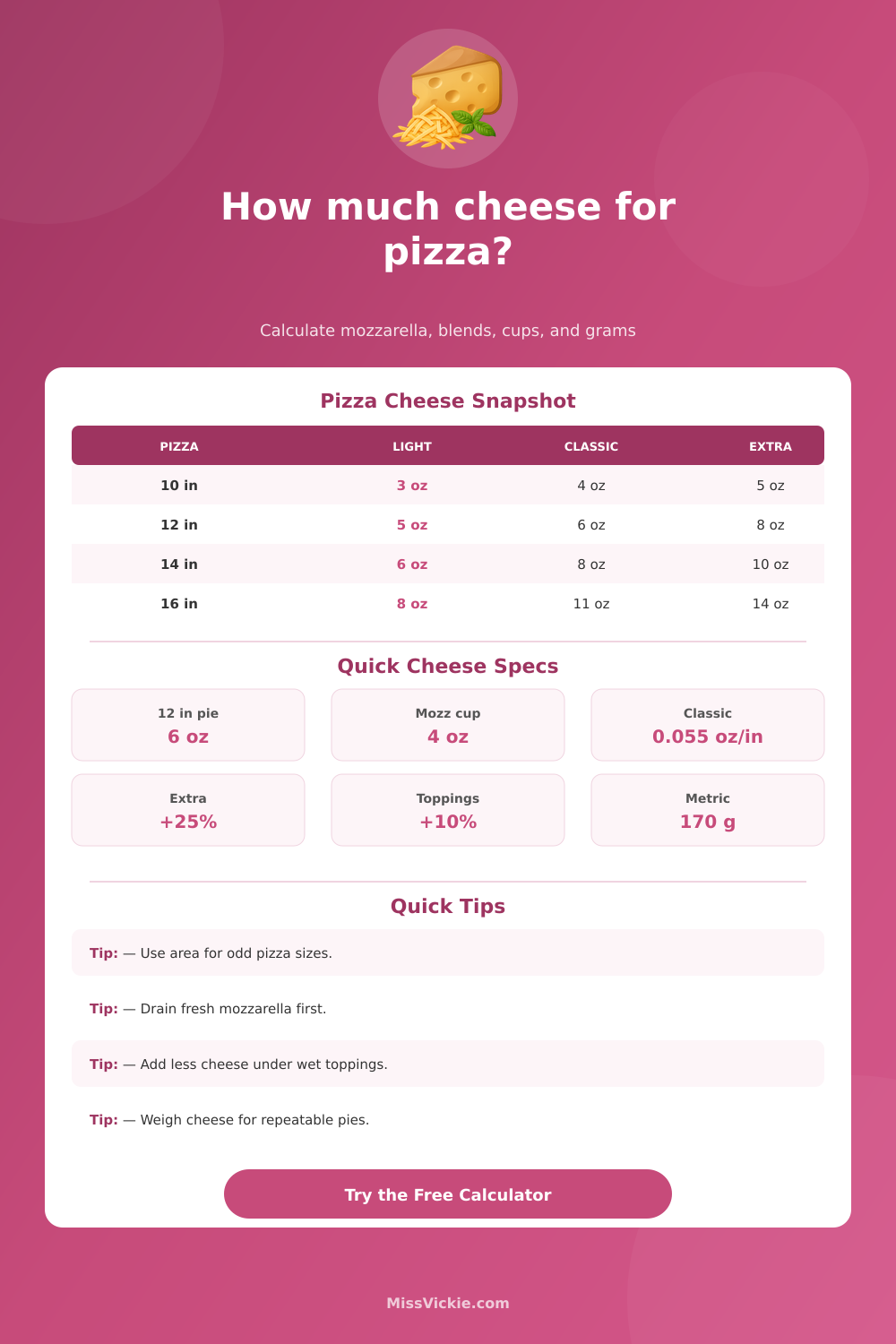
| 10 inch round | About 63 sq in after edge | 3.5 to 4.5 oz | 5 to 6 oz |
| 12 inch round | About 95 sq in after edge | 5.5 to 6.5 oz | 7.5 to 8.5 oz |
| 14 inch round | About 132 sq in after edge | 7.5 to 8.5 oz | 9.5 to 11 oz |
| 16 inch round | About 177 sq in after edge | 10 to 12 oz | 13 to 15 oz |
| 10 x 14 Detroit pan | About 140 sq in | 13 to 16 oz | 17 to 20 oz |
| 12 x 18 sheet pizza | About 216 sq in | 16 to 19 oz | 21 to 25 oz |
| Cheese Type | Approx Weight per Cup | Best Pizza Use | Calculator Adjustment |
|---|---|---|---|
| Low-moisture shredded mozzarella | 4 oz or 113 g | Classic, NY, party pizza | Baseline cup estimate |
| Whole milk mozzarella | 4.2 oz or 119 g | Better melt and browning | Slightly richer coverage |
| Part-skim mozzarella | 4 oz or 113 g | Less oil, steady melt | Baseline coverage |
| Fresh mozzarella slices | 5 oz or 142 g | Margherita, Neapolitan | Less total weight if drained |
| Mozzarella-provolone blend | 4.1 oz or 116 g | Stretch plus sharper flavor | Slight extra density |
| Vegan mozzarella shreds | 3.5 oz or 99 g | Dairy-free pizzas | More cups for same weight |
| Pizza Plan | Light Cheese | Classic Cheese | Extra Cheese |
|---|---|---|---|
| Two 12 inch pizzas | 9 to 10 oz | 12 to 13 oz | 16 to 17 oz |
| Three 14 inch pizzas | 18 to 20 oz | 24 to 26 oz | 31 to 34 oz |
| Four 16 inch pizzas | 33 to 36 oz | 43 to 47 oz | 55 to 60 oz |
| Two 12 x 18 sheet pizzas | 30 to 34 oz | 36 to 40 oz | 46 to 52 oz |
| Six personal 10 inch pizzas | 22 to 25 oz | 27 to 30 oz | 34 to 38 oz |
| 30 party slices from large pies | 38 to 42 oz | 50 to 55 oz | 64 to 70 oz |
| Choice | When to Use | Cheese Effect | Why It Matters |
|---|---|---|---|
| Thin crust | Cracker thin or tavern style | Reduce 8% | A heavy layer can overwhelm the crust. |
| Neapolitan | Hot oven, spotty fresh mozzarella | Reduce 18% | Cheese is placed in islands, not wall-to-wall. |
| Pan pizza | Detroit, grandma, or skillet pizza | Add 18% | Thicker dough and crisp edges support more cheese. |
| Loaded toppings | Many meats or vegetables | Add 8% | More surface gaps need extra cheese coverage. |
| Wet toppings | Tomatoes, mushrooms, spinach | Reduce 6% | Less cheese helps avoid a watery center. |
| Deep dish | Layered or stuffed pizza | Add 38% | The cheese layer is part of the filling. |
The amount of cheeses that is used on a pizza are a critical factor in the outcome of the prepared pizza. The amount of cheese that is used will determine the texture of the cheese and the appearance of the pizza. Using too little cheese will result in the cheese on the pizza being dry and the sauce being exposed through the thin layer of cheese.
Using much much cheese can result in the center of the pizza containing a pool of grease while the edges of the pizza contain less cheese. The amount of cheese that is used will have to account for the type of crust that will be used, the toppings that will be used, and the moisture content of the cheese that will be used on the pizza. Different types of cheese will have different amounts of fat and moisture, which will impact the amount of cheese that should be used on the pizza.
How Much Cheese to Use on a Pizza
Low-moisture mozzarella cheese will release the least amount of moisture of the cheese types and will be the most appropriate for pizza. Using fresh mozzarella cheese, which contains more moisture than low-moisture mozzarella, can lead to a soggy center to the pizza unless you drain the moisture from the fresh mozzarella cheese prior to using the cheese on the pizza. Additionally, using cheese blends that contain provolone and cheddar can change the melting point of the pizza cheese, which will change the amount of that type of cheese that is require.
These variables are accounted for in the cheese calculator that has been create. The type of crust for the pizza will impact the amount of cheese that should be use. Thin crusts have less structural strength for the cheese compared to other crust types.
Using a heavy layer of cheese on a thin crust may lead to undercooked areas in the center of the crust. Pan pizzas and deep-dish crusts has more structural strength for cheese and may be able to support a heavier layer of cheese on the pizza. Additionally, the type of toppings that are used can impact the amount of cheese that is need.
Vegetables that contain water will release moisture during the baking process of the pizza. The steam that is released from wet vegetables may push the cheese away from those toppings. Dry toppings will sit on top of the cheese without interfere with the cheese.
The shape and size of the pizza will impact the total amount of cheese that is required. Round pizzas will have less cheese than square pizzas of the same diameter due to the ring of cheese that cannot be used to cover the edges of the crust. Squares or rectangles of pizza will contain the same amount of cheese over the same area of crust as round pizzas of the same diameter.
Additionally, the calculator allow for the setting of the amount of cheese that should remain free of cheese by the crust edges. The calculator will determine the amount of cheese needed in relation to the diameter of the pizza, the thickness of the crust, and the type of crust. The amount of cheese needed will be provide in weight so that the pizza maker can use a kitchen scale to measure out the cheese.
Many people may prefer to use volume (such as cups) to measure the amount of cheese that will be use on the pizza. However, measuring the cheese by weight is the most accurate way of measuring the amount of cheese. Using volume measurements for cheese can lead to inaccuracies in the amount of cheese measured due to the size of the cheese shreds that are used to measure the cheese.
Using weight measurements will provide the most accurate amount of cheese as the weight will not be impacted by the size of the cheese shreds. The cheese calculator will show the amount of cheese that is needed in ounces or grams so that the pizza chef can use a kitchen scale to measure the cheese. In addition to the factors mentioned in this discussion, there are additional factors that can impact the amount of cheese that should be used on a pizza.
For instance, the humidity in the kitchen may impact the amount of cheese that clump together. The temperature to which the oven is set may impact the rate at which the cheese melts and browns on the pizza. Additionally, some individuals may want the cheese to pool in the center of the pizza while others may want the cheese to be even distributed to the edges of the crust.
While the cheese calculator will provide a reliable amount of cheese to be used on a pizza, the amount of cheese may need to be adjust according to personal preferences of those who will enjoy the pizza. Mistakes in pizza making may be caused by the incorrect amount of cheese being used on the pizza. One of the most common mistakes is using the same amount of cheese that was used on a pizza purchased from a restaurant.
The size of the restaurant’s pizza may not be the same as the size of the pizza that will be prepared at home. Additionally, these restaurants may use a different type of cheese than is used in the preparation of the pizza at home. Other mistakes include the use of fresh mozzarella cheese without first draining the moisture that is contained within the cheese.
Forgetting to drain the moisture from fresh mozzarella cheese will lead to a soggy pizza. Such mistakes can be avoided by drying the cheese or pressing the cheese before placing it on the pizza dough. The single best change that could be made in the pizza making process would be to measure the amount of cheese by weight.
Using a digital kitchen scale to measure the cheese will eliminate the guesswork that can occur when using different sized shreds of cheese. Weighing the cheese will allow for the adjustment of the weight of cheese required for the pizza to be make at later times. The cheese calculator allows for the mathematical calculations to be performed instead of performing the calculations of the area and the weight of the cheese needed.
Planning the amount of cheese that is to be used on the pizza will allow the chef to prepare and cook the pizza in a consistent manner. If many pizzas are to be prepared, the chef should decide the amount of cheese that will be used on the pizzas prior to beginning to cook the pizzas. Using the same amount of cheese will ensure that the baking times for the pizzas are the same.
Additionally, planning the amount of cheese that will be used on the pizzas will make shopping for the cheese easier. Knowing in advance the amount of cheese that will be needed allows for the cheese to be purchased in the correct quantity. The amount of cheese to be used on the pizzas is a variable that can be controlled by the chef.
Using the cheese calculator will allow the chef to reach the same result with every pizza that is made.