Sauce style, pasta shape, servings, coating, and leftovers
How Much Sauce for Pasta Calculator
Estimate the right sauce amount for spaghetti, penne, ravioli, baked pasta, pesto pasta, and party trays using serving size, pasta weight, sauce thickness, add-ins, coating level, and leftover goals.
Start with a real pasta meal, then adjust the sauce style, pasta shape, portions, vegetables, protein, and leftover plan.
Full sauce breakdown
Good all-purpose ratio for spaghetti, penne, shells, and simple tomato pasta.
Richer sauces coat well, so start lower and loosen with pasta water.
Concentrated oil-based sauce works best as a coating, not a pool.
Chunky sauces act like sauce plus topping and need more total weight.
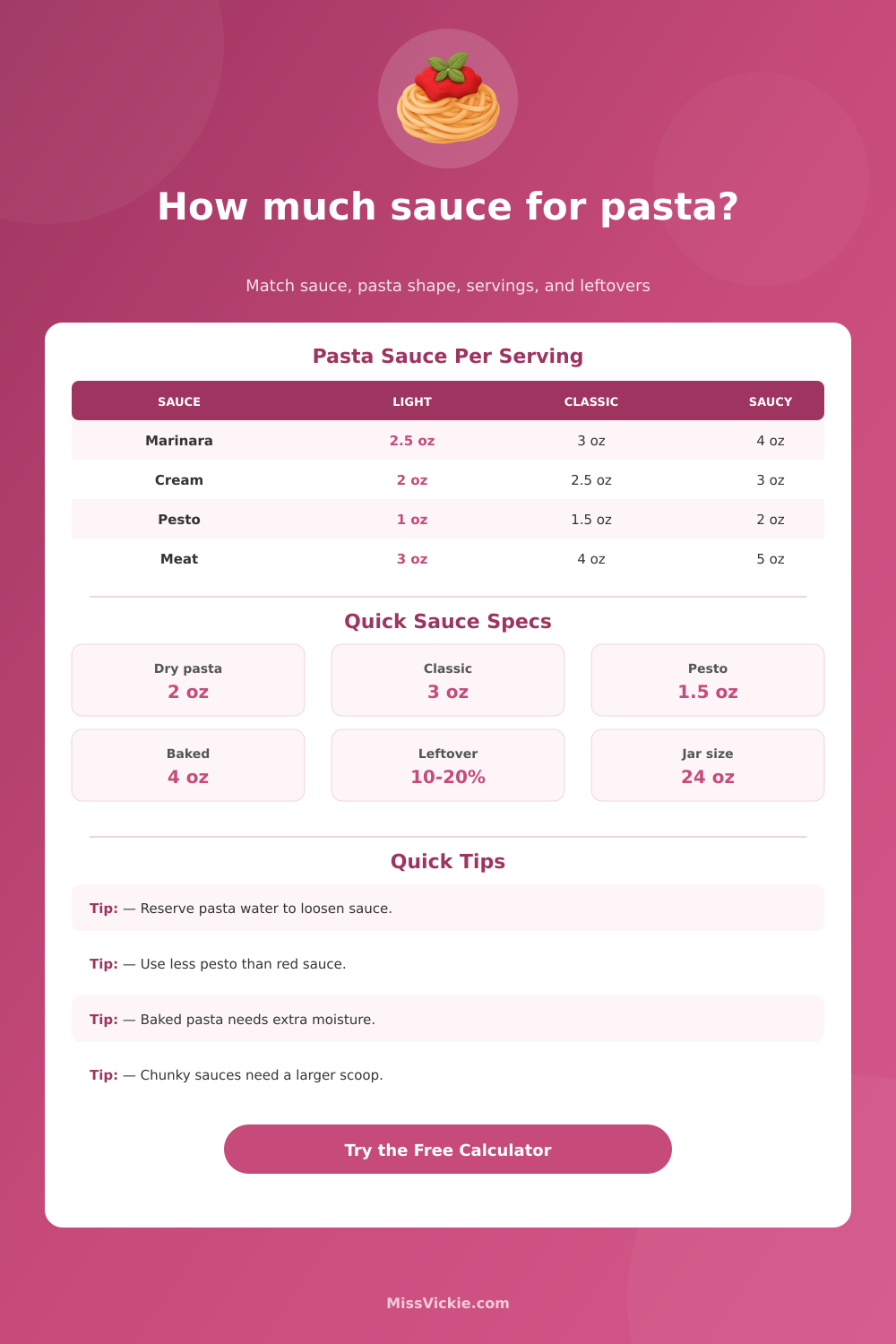
| Pasta style | Light sauce | Classic sauce | Extra saucy |
|---|---|---|---|
| Long strands such as spaghetti or linguine | 2 to 2.5 oz per serving | 3 oz per serving | 3.5 to 4 oz per serving |
| Tubes such as penne, rigatoni, or ziti | 2.5 to 3 oz per serving | 3.25 to 3.75 oz per serving | 4 to 4.75 oz per serving |
| Ridges and spirals such as rotini or cavatappi | 2.75 to 3.25 oz per serving | 3.5 to 4 oz per serving | 4.5 to 5 oz per serving |
| Filled pasta such as ravioli or tortellini | 2 to 2.5 oz per serving | 2.75 to 3.25 oz per serving | 3.5 to 4 oz per serving |
| Baked pasta, lasagna, or casserole trays | 3 to 3.5 oz per serving | 4 to 5 oz per serving | 5 to 6 oz per serving |
| Sauce type | Baseline per 2 oz dry pasta | Best pasta match | Adjustment note |
|---|---|---|---|
| Marinara or tomato basil | 3 oz / 85 g | Spaghetti, penne, shells | Add 10% for chunky tomatoes or family-style serving. |
| Vodka or pink tomato cream | 3.25 oz / 92 g | Rigatoni, penne, shells | Holds well on ridged shapes and baked pasta. |
| Alfredo or cream sauce | 2.5 oz / 71 g | Fettuccine, linguine, gnocchi | Use pasta water to stretch richness without making it heavy. |
| Basil pesto or herb pesto | 1.5 oz / 43 g | Trofie, fusilli, spaghetti | Start lighter because oil, nuts, and cheese are concentrated. |
| Meat sauce or Bolognese | 4 oz / 113 g | Tagliatelle, rigatoni, ziti | Includes meat solids, so weight is higher than smooth sauce. |
| Vegetable ragout | 3.75 oz / 106 g | Short tubes, shells, cavatappi | Chunks need extra sauce to coat pasta and vegetables evenly. |
| Seafood tomato sauce | 3.5 oz / 99 g | Linguine, spaghetti, shells | Keep a moderate coating so seafood stays the focus. |
| Baked pasta sauce | 4.5 oz / 128 g | Ziti, lasagna, manicotti | Extra moisture offsets oven absorption and cheese thickening. |
| Servings | Classic marinara | Cream sauce | Meat or baked sauce |
|---|---|---|---|
| 2 servings | 6 oz / 3/4 cup | 5 oz / 2/3 cup | 8 to 9 oz / about 1 cup |
| 4 servings | 12 oz / 1 1/2 cups | 10 oz / 1 1/4 cups | 16 to 18 oz / about 2 cups |
| 6 servings | 18 oz / 2 1/4 cups | 15 oz / about 2 cups | 24 to 27 oz / 3 cups plus |
| 8 servings | 24 oz / 3 cups | 20 oz / 2 1/2 cups | 32 to 36 oz / 4 cups plus |
| 12 servings | 36 oz / 4 1/2 cups | 30 oz / 3 3/4 cups | 48 to 54 oz / 6 cups plus |
| 25 servings | 75 oz / about 9 cups | 63 oz / about 8 cups | 100 to 113 oz / 3 to 4 jars |
| Kitchen measure | Fluid ounces | Metric estimate | How to use it |
|---|---|---|---|
| 1/4 cup sauce | 2 fl oz | 60 ml / about 57 g | Light coating for one small side serving. |
| 1/3 cup sauce | 2.7 fl oz | 80 ml / about 76 g | Moderate cream sauce or light tomato sauce. |
| 1/2 cup sauce | 4 fl oz | 120 ml / about 113 g | Saucy red sauce or meat sauce serving. |
| 1 cup sauce | 8 fl oz | 240 ml / about 227 g | Enough classic sauce for about 2 to 3 servings. |
| 24 oz jar | 3 cups | 680 g / 710 ml | Covers about 6 to 8 classic servings. |
| 1 lb dry pasta | 16 oz dry | 454 g dry | Makes about 8 main servings and 9 to 10 cups cooked. |
Determine an amount of sauce needed to prepare a pasta meal. The amount of sauce that you use will affect the textures of your pasta meal. If you use to little sauce, the pasta will be dry.
However, if you use too much sauce, the pasta will be submersed in sauce, and the flavor will be diluted. People often guess at the amount of sauce needing to cook the pasta. However, guessing can cause error in the amount of sauce to the pasta.
How Much Sauce to Use for Pasta
To determine the sauce amount needed for the pasta, use a sauce calculator that takes into consideration the following factor. The pasta shape will affect the amount of sauce that the pasta can hold. For example, spaghetti has a flat surface that allows it to hold less sauce than other shape of pasta.
Pasta shapes that have grooves in them, such as tube and ridged pasta, will hold more sauce than pasta with flat surface. Additionally, filled pasta, such as ravioli, will hold less sauce because the pasta is fill with another ingredient. The sauce calculator will ask for the pasta shape, and this will affect the amount of sauce calculating for the pasta.
Another factor that will affect the amount of sauce needed is the type of sauce. For example, marinara sauce is thin and will coat the pasta well. Cream sauces are thick and will efficient coat the pasta with less volume of sauce than thinner sauces.
Additionally, pesto sauce is oily and will require less of the sauce to coat the pasta than other sauce. Meat and vegetable sauce contain solid ingredients that must be balanced in the sauce, so more sauce will be required. The sauce calculator will ask for the sauce type for the sauce to be calculate correctly.
The type of meal that will be prepared and the level of sauce that will coat the pasta are two additional factor to consider when calculating the amount of sauce needed for the pasta dish. For example, if the meal is to be a light lunch, less sauce will be needed than for a large dinner. Additionally, if the meal will be bake, the pasta will absorb some of the sauce, so extra sauce will be needed at the start of the cooking process for the pasta.
If a large amount of pasta is to be cooked, some of the sauce will evaporate, so more sauce will be needed at the start of the cooking process. The number of add-in for the pasta will also affect the amount of sauce needed. For example, if the sauce will contain mushrooms or sausage, the sauce will need to cover the pasta and the add-ins.
The sauce calculator will ask for the number of add-ins for the sauce calculation to reflect the amount of sauce needed to cover the add-ins as well as the pasta. The thickness of the sauce and the consideration of any leftover for the pasta will be asked of in the sauce calculator. The thickness of the sauce will determine how much sauce is needed.
A thin sauce can coat a large amount of pasta, while a thick sauce will remain in a small area of the plate. If you will be making leftovers for future meals, the percentage of leftovers will be increase in the sauce calculator to account for the sauce in the leftover portion of the meal. The sauce calculator will ask for the amount of sauce needed, the amount of sauce per serving, the number of sauce jar needed, and the amount of cooked pasta that will be produced.
These parameter will allow a person to determine if they have enough sauce before beginning to cook the pasta. The calculator will also ask for the amount of pasta water to be used in the sauce cooking to help the sauce emulsify with the pasta. Additionally, the cook should taste the sauce at the end of cooking to ensure that the amount of sauce is balanced with the pasta.
Common mistake occur with the sauce amount for pasta. Using one jar of sauce for one pasta recipe is a common mistake because it does not consider the amount of sauce that the different pasta shape hold. Additionally, sauce amount calculation are not often considered when preparing a recipe.
However, using the sauce calculator and selecting the proper input for sauce amount will ensure that the sauce is of the correct volume for the pasta meal.