How Much Cream of Tartar for Meringue?
Calculate cream of tartar by egg white count, measured egg weight, meringue style, sugar ratio, humidity, acid substitute, and hold time for pies, cookies, pavlova, and frostings.
Load a real baking scenario, then adjust the egg whites, sugar, acid, humidity, or serving goal to match your bowl.
Full Breakdown
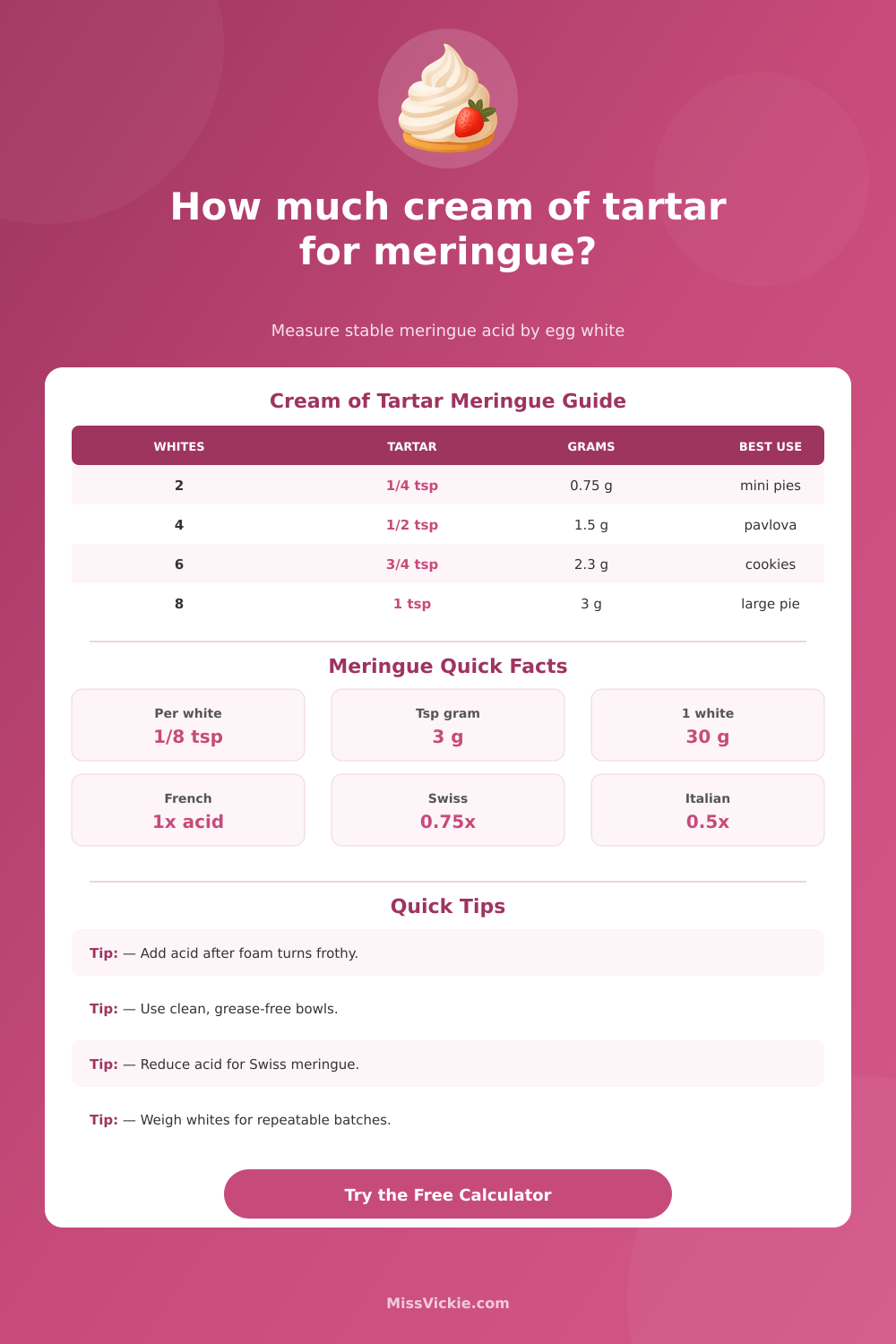
| Egg Whites | Cream of Tartar | Approx Grams | Common Batch |
|---|---|---|---|
| 1 white | 1/8 teaspoon | 0.38 g | Small garnish, tester batch, or single ramekin topping |
| 2 whites | 1/4 teaspoon | 0.75 g | Mini pies, small tartlets, or a light baked topping |
| 3 whites | 3/8 teaspoon | 1.13 g | One standard pie topping with moderate height |
| 4 whites | 1/2 teaspoon | 1.5 g | Pavlova shell, tall pie topping, or small cookie batch |
| 6 whites | 3/4 teaspoon | 2.25 g | Meringue cookies, roulade foam, or family dessert batch |
| 8 whites | 1 teaspoon | 3 g | Large pie topping, party pavlova, or angel food support |
| Style | Acid Factor | Sugar Pattern | Why It Changes |
|---|---|---|---|
| French meringue | 1.00x | Added gradually while whipping | Raw whites rely heavily on acid to stabilize foam bubbles before baking. |
| Swiss meringue | 0.75x | Dissolved over heat | Heat and dissolved sugar improve structure, so slightly less acid is usually enough. |
| Italian meringue | 0.50x | Hot syrup cooked separately | Hot syrup sets the foam, and too much acid can make the texture tighter than needed. |
| Pavlova | 1.15x | Higher sugar, often starch | A crisp outside and marshmallow center benefit from a little extra acid support. |
| Macaron base | 0.85x | Fine sugar, almond flour folded in | Enough acid helps the whip, but excess can make shells stubborn or dry. |
| Angel food cake | 1.10x | Fine sugar folded with flour | The foam must lift batter, so stability matters before the cake sets in the oven. |
| Acid Option | Use Instead Of | Batch Example | Flavor Note |
|---|---|---|---|
| Cream of tartar | 1/8 teaspoon per white | 4 whites need 1/2 teaspoon | Neutral flavor with reliable dry measurement. |
| Lemon juice | 1/2 teaspoon per white | 4 whites need 2 teaspoons | Bright flavor; useful in lemon pie, less invisible in vanilla desserts. |
| White vinegar | 1/2 teaspoon per white | 4 whites need 2 teaspoons | Mild when baked, but measure carefully to avoid sharpness. |
| No added acid | Use only with very fresh whites | Expect softer foam and shorter hold | Best for immediate serving or recipes already containing acid. |
| Dessert | Egg Whites | Cream of Tartar | Sugar Range |
|---|---|---|---|
| 9-inch lemon pie | 3 to 4 whites | 3/8 to 1/2 teaspoon | 150 to 240 g depending on height |
| Small pavlova | 4 whites | 1/2 to 5/8 teaspoon | 220 to 260 g for crisp shell |
| Meringue cookies | 4 to 6 whites | 1/2 to 3/4 teaspoon | 240 to 450 g for dry cookies |
| Swiss buttercream | 5 whites | About 1/2 teaspoon | 250 to 300 g before butter |
| Angel food cake | 10 to 12 whites | 1 1/4 to 1 5/8 teaspoons | 250 to 350 g with flour folded in |
Best place to use the full 1/8 teaspoon per white rule because raw foam needs steady support.
Heat dissolves sugar first, so use slightly less acid for a glossy, flexible meringue.
Hot syrup sets the foam quickly; half-strength tartar is usually enough for structure.
A tiny boost helps the shell bake crisp while keeping the center tender and stable.
Cream of tartar are an acid that is used in the preparation of meringue. Cream of tartar is used to stabilize the egg white in the meringue because cream of tartar help the proteins in the egg whites to form a strong structure. Egg whites contain mostly water and protein.
When whipping the egg whites, the air get trapped within the protein structure. If there is no acid such as cream of tartar in the egg whites, the air within the protein structure will cause the liquid portion in the egg whites to drain out of the protein structure. The cream of tartar will lower the pH of the egg whites.
How to use cream of tartar in meringue
Lowering the pH of the egg whites will allow the proteins in the egg whites to unwind and bind to the air that was trapped within the egg white proteins. If too little cream of tartar are added to the egg whites, the meringue that is formed will have a soft texture. If too much cream of tartar is added to the egg whites, the meringue will have a metallic taste and may crack while bake.
The amount of cream of tartar that will be added to the meringue preparation will depend on the type of meringue to be prepared. For french meringue, the cook will whirl the egg whites raw, thus requiring more cream of tartar to assist in the formation of the protein structure in the egg whites. For Swiss meringue, the cook will dissolve the sugar over heat prior to being added to the egg whites.
The heat will help in the formation of the protein structure, thus requiring less cream of tartar. For Italian meringue, the cook will pour the hot sugar syrup into the egg whites. Thus, Italian meringue will require the least amount of cream of tartar.
Finally, pavlova meringue has a crisp shell with a soft center when sliced horizontally and thus require a balance of cream of tartar. The humidity in the area where the meringue is prepared can affect the amount of cream of tartar that should be added. On dry days, the standard amount of cream of tartar will work for the formation of the meringue protein structure.
On humid days, the moisture in the air will make it harder for the meringue to dry. More cream of tartar will work to assist in the protein structure in the egg whites to maintain it’s shape. If the meringue is to be served immediately, less cream of tartar can be used.
If the meringue is to be left to rest until later in the day, more cream of tartar should be used to enable the meringue to maintain its structure. The amount of sugar that will be used in preparing the meringue will also affect the amount of cream of tartar that will be needed. Using more sugar will create a foam that is denser than meringue with less sugar.
A denser foam will be able to hold its structure with less cream of tartar. If less sugar is used, a lighter foam will be created, requiring more cream of tartar to assist in the creation of the protein structure within the egg whites. Using a lower ratio of cream of tartar will result in softer meringue peaks.
A higher ratio will result in more dryer and crisp meringue peaks. The time at which the cream of tartar is added into the egg whites also matters for the preparation of successful meringue. Adding the cream of tartar at the very beginning along with the egg whites may cause the protein structure to become too tight.
This can prevent the formation of meringue peaks. Adding the cream of tartar after the egg whites have become glossy may prevent the cream of tartar from perform its function. Thus, the cream of tartar should be added when the egg whites first become opaque.
If cream of tartar is not available when preparing meringue, lemon juice and white vinegar can be used as substitutes due to there acidic properties. Since lemon juice has the flavor of lemon, it can be used if the dessert to be prepared also contains lemon flavoring. White vinegar has a less prominent flavor then lemon juice but may leave a sharp taste in the mouth if incorporated into a dessert that contains no sharp flavored ingredients.
Since vinegar and lemon juice are much stronger in acid than cream of tartar, they cannot be used in the same ratio as cream of tartar. Adjustments in the measurement will have to be made when using these ingredient as substitutes. Every batch of meringue is different due to the different sizes of the egg whites and the changes in the weather.
The amount of cream of tartar suggested in the recipe may have to be changed for each batch of meringue. If the meringue peaks are too soft, more cream of tartar can be added in the next batch of meringue. If the meringue contains a sharp taste or the meringue cracked while baking, the amount of cream of tartar should be reduce in the next batch of meringue to be prepared.
Using the proper amount of cream of tartar in the preparation of the meringue will ensure that it maintains its texture and does not crack while baking.