How Much Baking Powder for Baking Soda?
Convert baking soda to baking powder with recipe-specific acid, batch size, altitude, and sodium adjustments so cakes, cookies, muffins, and quick breads still rise cleanly.
Choose a real kitchen scenario to load the soda amount, recipe acidity, batch size, and adjustment style automatically.
Full Baking Swap Breakdown
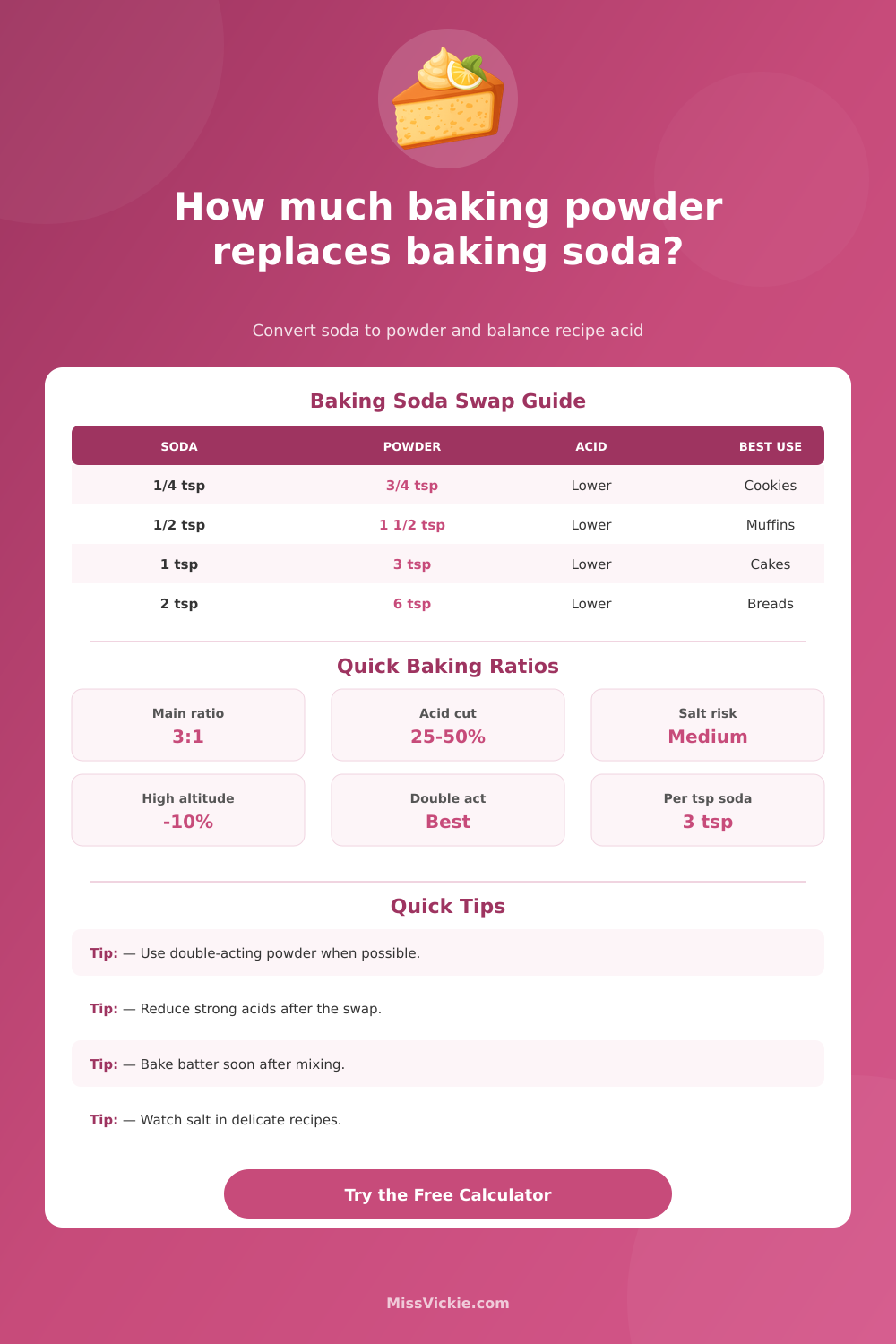
| Baking Soda in Recipe | Baking Powder Substitute | Approx Powder Weight | Acid Note |
|---|---|---|---|
| 1/8 teaspoon baking soda | 3/8 teaspoon baking powder | 1.7 grams | Usually no acid change needed for sturdy cookies. |
| 1/4 teaspoon baking soda | 3/4 teaspoon baking powder | 3.5 grams | Reduce a splash of lemon, vinegar, or buttermilk if flavor is sharp. |
| 1/2 teaspoon baking soda | 1 1/2 teaspoons baking powder | 6.9 grams | Cut a moderate acid by about one quarter for cakes and muffins. |
| 1 teaspoon baking soda | 1 tablespoon baking powder | 13.8 grams | Expect a milder tang and a little more salt in the finished bake. |
| 2 teaspoons baking soda | 2 tablespoons baking powder | 27.6 grams | Large swaps are risky in delicate recipes; consider buying soda if possible. |
| Main Acid Ingredient | Typical Role With Soda | When Using Powder | Flavor Watch |
|---|---|---|---|
| Buttermilk | Activates soda and tenderizes crumb | Reduce by 15% to 35%, replacing liquid with milk | Too much left in can taste tangy. |
| Yogurt or sour cream | Adds acid, fat, and moisture | Reduce modestly only if batter is very sour | Keep enough for moisture. |
| Molasses or dark brown sugar | Provides acid and browning | Do not remove all; reduce only for strong molasses recipes | Flavor depends on it. |
| Natural cocoa | Needs soda for color and rise | Powder works, but crumb may be lighter and less dark | Dutch cocoa behaves differently. |
| Lemon juice or vinegar | Fast acid reaction and bright flavor | Reduce by 25% to 50% when it is mostly for leavening | Keep some for taste. |
| Recipe Type | Swap Reliability | Texture Change | Best Adjustment |
|---|---|---|---|
| Cookies and bars | Medium to good | Less browning, less spread, cakier texture | Use standard powder, keep some brown sugar or molasses. |
| Muffins and quick breads | Good | Usually close, sometimes slightly less tangy | Reduce strong acids by about one quarter. |
| Pancakes and waffles | Very good | Reliable lift, tender crumb | Cook batter soon after mixing for best bubbles. |
| Layer cakes | Good if formula is simple | Crumb may be finer and a bit lighter | Avoid overdoing powder in delicate vanilla cakes. |
| Gingerbread and molasses bakes | Medium | Less deep browning and milder spice backdrop | Keep molasses; reduce only extra acidic liquid. |
| Condition | Powder Adjustment | Liquid or Flour Cue | Why It Matters |
|---|---|---|---|
| Sea level to 2,999 ft | No change | Follow recipe batter texture | Standard 3:1 conversion is the baseline. |
| 3,000 to 4,999 ft | Use about 95% | Add a small splash of liquid if batter is stiff | Leavening expands faster as pressure drops. |
| 5,000 to 6,999 ft | Use about 90% | Strengthen structure with a little flour if needed | Too much lift can collapse cakes. |
| 7,000 ft or higher | Use about 85% | Watch bake time and pan fill carefully | High-altitude swaps need conservative leavening. |
Needs acid in the batter, browns well, and reacts quickly when wet.
Contains soda plus acid, so it can lift recipes without extra acidic ingredients.
Releases gas when mixed and again in the oven, making it best for substitutions.
Already contains leavener and salt, so it is not a direct soda replacement.
Baking swap can occur when a person is low on one ingredient and the recipe require a different ingredient. The question of how much baking powder to add as a replacement for baking soda is often asked. Baking soda and baking powder both act as leavening agent in baked goods, but each of these ingredients behaves different when added to the liquid portion of the recipe and baked goods are heated.
Baking soda requires the addition of an acidic ingredient to activate the leavening properties of the ingredient; baking soda reacts with the acid in the recipe to form carbon dioxide gas. The gas bubble that are formed allow the baked good to rise. Baking soda also contributes to the browning of the baked good.
How to Use Baking Powder Instead of Baking Soda
Baking powder already contain the acid required to react with the baking soda to form the carbon dioxide gas that make baked goods rise. Baking powder can make baked goods rise even when there is no buttermilk or lemon juice ingredients in the recipe. Because baking soda and baking powder have different properties, it isnt as simple as simply swapping ingredient.
The baking swap calculator can help to determine the proper amount of baking powder to use in baked goods by taking into account the type of recipe that is to be made and the amount of acid in that recipe. The amount of baking soda and baking powder that is required in a baked good can be changed according to whether more of the recipe is to be cooked or whether the recipe is to be prepared at a high altitude. Recipes that contain ingredients like molasses will react different to baking soda than vanilla cakes.
If the batch size for the recipe is doubled, then more baking soda is required since baking soda can affect the flavor of the food. The baking swap calculator also allows for adjustment for the sensitivity of the recipe to salt and the altitude at which the baking will take place. These factor will help the calculator ensure that the baked good will be similar to the original recipe.
The three-to-one ratio of baking soda to baking powder is often used as a starting point for baking swap. This ratio states that one teaspoon of baking soda require three teaspoons of baking powder in order to react with the ingredients of the recipe to form the carbon dioxide gas that makes baked goods rise. However, this ratio does not account for the amount of acid in the recipe.
If the recipe uses ingredients that contain acid, such as buttermilk or brown sugar, then less baking powder will be required since the acid will react with the baking soda to form the carbon dioxide gas. Using the three-to-one ratio could lead to the baked good having a tangy taste since there would be an excess of baking soda. The baking swap calculator accounts for the amount of acid in the recipe so that the baked good will not taste too tangy.
When baking soda is used in place of baking powder, the texture of the baked good may change. Baking soda encourage baked goods to spread and brown deeply. Baking powder creates a texture that is softer to the touch with a lighter color due to baking powder’s lack of the alkaline properties of baking soda.
If the baked good that is being made use ingredients like molasses, baking powder can replace baking soda. However, the texture of the baked good may differ from the texture of the original recipe. It is important to know how texture can change with baking soda and baking powder so that bakers can decide if the change in texture is acceptable for the purpose for which the baked good is to be used.
The altitude at which baked goods are prepared can impact the chemical reaction that take place with baking powder. At high altitudes, the air pressure is lower which causes the carbon dioxide gas created by baking powder to emerge from the baked good more quickly. An amount of baking powder that works for a recipe that is prepared at sea level may cause the baked good to rise quickly at high altitudes and then collapse.
The baking swap calculator accounts for the altitude at which the baked good will be prepared so that the chemical reaction with baking powder will occur at a proper rate to enable the baked good to maintain its structural integrity. Similarly, the batch size of the recipe can also impact the chemical reaction of baking powder. If the batch size of the recipe is doubled, then the amount of baking powder would usually double as well.
However, doubling the amount of baking powder could cause the baked good to taste too salty because baking powder contains sodium. Thus, the baking swap calculator accounts for batch size so that the baked good will not taste too salty. When baking soda is used in place of baking powder the chemical reaction begin almost immediately upon mixing of the dry and wet ingredients.
Baking powder continues to release the gas that creates the rise in the baking soda recipe while the baking goods are in the oven. Thus, double-acting baking powder is the best type of baking powder to use in place of baking soda. Baking powder that reacts to both hot and cold ingredients allow bakers to have more time between the mixing of the ingredients and baking the goods.
If the recipe takes sit in warm or hot locations for long periods of time, the gas will emerge from the baking soda replacement ingredient creating baked goods that are denser than those that are baked under proper conditions. Therefore, portioning and baking the batter soon after mixing the dry ingredients and the wet ingredients will help prevent the drop in the rise of the baked goods. Another factor that should of been considered is the sensitivity of the recipe to salt content.
Baking powder contains salt, so using too much baking powder will intensify the salt content of the recipe. If the recipe contains salt, cheese or nut, the amount of baking powder should be reduced. The baking swap calculator includes a setting for the sensitivity of the recipe to salt so that bakers can account for the amount of salt in the recipe.
The conditions of the kitchens may differ from the test kitchens where the recipes were tested. The acidity of the ingredients may be slightly different. The ovens may be hotter or colder than indicated in the recipe.
The humidity in the kitchen could impact the rise of the baking soda or baking powder recipe. While the baking swap calculator provides a suggestion for the amount of baking powder to use instead of baking soda the bakers should also take note of the condition of the batter that is to be baked. If the batter is too thick or too thin, additional liquid or flour can be added to balance out the condition of the batter before baking the goods.