How Much Baking Powder Per Cup of Flour?
Calculate baking powder for flour by recipe style, flour weight, acidic ingredients, altitude, and desired crumb so cakes, muffins, biscuits, pancakes, and quick breads rise cleanly.
Choose a common baking scenario to fill flour amount, recipe style, flour type, acid level, altitude, texture, and rounding in one click.
Full Breakdown
Best for cookies, bars, and formulas that need less puff.
Classic cake starting point for each cup of all-purpose flour.
Common for muffins, quick breads, and heavier batters.
Pancakes and waffles need quick lift before structure fully sets.
| Recipe Style | Typical Baking Powder | Best Flour Range | Use When |
|---|---|---|---|
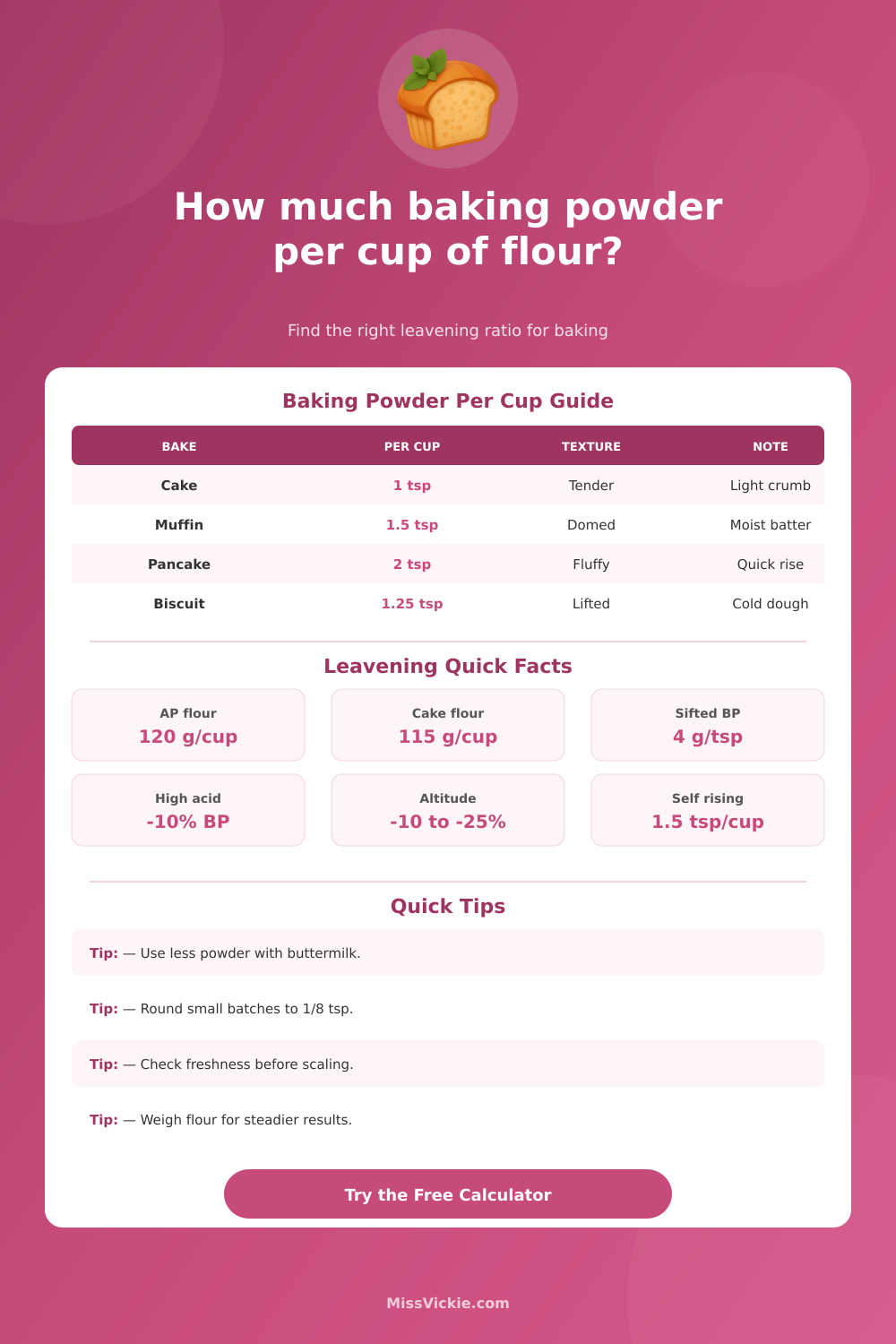
| Cakes and cupcakes | 1 teaspoon per cup flour | 1 to 4 cups | You want an even, fine crumb without a bitter finish. |
| Muffins | 1 1/2 teaspoons per cup flour | 1 1/2 to 3 cups | The batter has fruit, bran, nuts, or more liquid than cake batter. |
| Pancakes and waffles | 2 teaspoons per cup flour | 1 to 3 cups | The batter cooks quickly and needs early lift on a hot surface. |
| Biscuits and scones | 1 1/4 teaspoons per cup flour | 2 to 4 cups | The dough is cold, cut with fat, and depends on oven spring. |
| Quick breads | 1 1/4 teaspoons per cup flour | 1 1/2 to 3 cups | The loaf is moist and heavy with banana, pumpkin, or zucchini. |
| Soft cookies and bars | 3/4 teaspoon per cup flour | 1 to 3 cups | You want spread control and a little softness, not cake height. |
| Flour Type | Approx Grams per Cup | Calculator Effect | Leavening Note |
|---|---|---|---|
| All-purpose flour | 120 g | Baseline cup conversion | Works with most standard baking powder ratios. |
| Cake flour | 115 g | Lower cup weight | Often stays near 1 teaspoon per cup for delicate cakes. |
| Pastry flour | 110 g | Lower cup weight | Good for tender biscuits and scones with moderate lift. |
| Bread flour | 125 g | Higher cup weight | Use cautiously because extra protein can make quick bakes tough. |
| Whole wheat flour | 113 g | Adds small lift factor | Bran weakens structure, so slightly more powder can help. |
| Gluten-free blend | 140 g | Adds moderate lift factor | Heavier blends often need a little more help to rise. |
| Condition | Adjustment | Why It Matters | Kitchen Cue |
|---|---|---|---|
| No notable acid | No reduction | Double-acting baking powder supplies enough acid and base. | Milk, water, or neutral puree in the batter. |
| Light acid | Reduce 5% | Fruit, cocoa, or brown sugar adds mild acidity. | Keep the recipe mostly powder-based. |
| Yogurt or sour cream | Reduce 10% | Acid may be balanced with a little baking soda. | Watch for tangy dairy in the liquid mix. |
| Buttermilk or molasses | Reduce 15% | Strong acid can make full powder amounts taste sharp. | Many classic formulas add soda here. |
| 3,000 to 4,999 ft | Reduce 10% | Batters rise faster as air pressure drops. | Start with a small reduction. |
| 7,000 ft and above | Reduce 25% | Too much gas can collapse before the crumb sets. | Pair with stronger batter structure. |
| Flour Amount | Cake Ratio | Muffin Ratio | Pancake Ratio |
|---|---|---|---|
| 1 cup flour | 1 tsp powder | 1 1/2 tsp powder | 2 tsp powder |
| 1 1/2 cups flour | 1 1/2 tsp powder | 2 1/4 tsp powder | 1 tbsp powder |
| 2 cups flour | 2 tsp powder | 1 tbsp powder | 1 tbsp plus 1 tsp |
| 2 1/2 cups flour | 2 1/2 tsp powder | 3 3/4 tsp powder | 1 tbsp plus 2 tsp |
| 3 cups flour | 1 tbsp powder | 1 tbsp plus 1 1/2 tsp | 2 tbsp powder |
Baking powder are a leavening agent that releases carbon dioxide gas when baking powder meet both liquid and heat. Baking powder help baked goods to rise, and the amount of baking powder that is use will determine the texture of the baked good. The amount of baking powder that is required for a recipe can change based off several different variables.
For instance, the type of flour that is used can change the amount of baking powder that should be use in the recipe. Additionally, the amount of acid that the recipe contains will impact the amount of baking powder that should be used. Finally, the altitude at which the baking good is being prepared can play a crucial role in determine how much baking powder should be used in the recipe.
How Much Baking Powder to Use
Using too much baking powder can result in the baked good have a metallic taste. Using too little baking powder can result in the baked good being too densly. The amount of baking powder that is required for a recipe can vary depending upon the type of baked good that is to be prepared.
For instance, cakes often contain one teaspoon of baking powder for every one cup of flour that is used in the recipe. This amount of baking powder allow the cakes to have a fine crumb. In contrast, muffins often contain more baking powder than cakes because muffins has a sturdier structure and baking powder helps to form the domed top of a muffin.
Pancake recipes often contain a high amount of baking powder because the batter will meet the hot surface of the pan and the baking powder will help the pancakes to rise before the protein in the batter begin to set. Recipes for biscuits and scones typically contain a moderate amount of baking powder because these baked goods contain cold fat that will help to form the layers of the biscuits and scones. The type of flour that is used in a baked good can alter the amount of baking powder that should be used.
For instance, cake flour is often less heavier than other types of flour and therefore less baking powder may be required if cake flour is used. Additionally, recipes that use whole wheat flour may need to contain more baking powder than recipes that use white flour because the bran in whole wheat flour has the potential to weaken the structure of the baked good. Finally, baked goods that use gluten free flour may require more baking powder than recipes that use wheat flour because gluten free baking mixes tend to be denser than wheat flour.
The amount of acid that is contained in a recipe will impact the amount of baking powder that should be used because baking powder itself contains an acidic component. Baked goods that contain acidic ingredients, such as buttermilk, yogurt, molasses, or cocoa powder, contain a high amount of acid. Because of the high amount of acid in these products, the recipe can reduce the amount of baking powder to avoid creating a sharp taste to the baked good.
Additionally, baking powder need to be reduced in recipes with a high amount of acid to avoid introducing a metallic taste to the baked good. Furthermore, the acidity in the recipe need to be balanced with the amount of baking powder that is add. Altitude will impact the amount of baking powder that is required for baked goods.
At higher altitude, the air pressure is lower which allow the gases in baking powder to expand at a faster rate. At moderate altitudes, ten percent can reduce the amount of baking powder. At high altitudes, the amount of baking powder can be reduced by twenty-five percent.
At high altitudes if too much baking powder is used, the gases that is created with baking powder will create large bubbles in the batter that will pop, leaving some baked goods with tunnels in the middle or a sunken center to the baked good. One method for baking goods with a consistent texture is to weigh the flour that is to be used in the recipe. Using scooping flour to measure flour can lead to adding too much flour to the recipe.
Instead, baking goods with a weighed amount of flour ensure accuracy in the amount of flour added. Pack the flour into the cup to ensure it is fully incorporated into the recipe. Additionally, it is also important to check the expiration date on the baking powder.
Using old baking powder can cause baking powder to react more slow with the liquids in the recipe. Using old baking powder can cause people to use too much baking powder in the recipe which will create a bitter taste to the baked good. Finally, people should avoid using the same amount of baking powder for every type of baked good.
The amount of baking powder that is required for baked goods will have to change based upon the amount of acid in the recipe, the type of flour that is used in the recipe, and the altitude at which the baked good will be prepared. By determine the amount of acid that is in the recipe, and the type of flour that will be used, people will be able to adjust the amount of baking powder required for the recipe. By adjusting the amount of baking powder that is used, people will be able to create a consistent texture to the baked good that is prepared in the kitchen.