Glucose units, blood ketones, fasting state, meal timing, and trend comparison
GKI Calculator
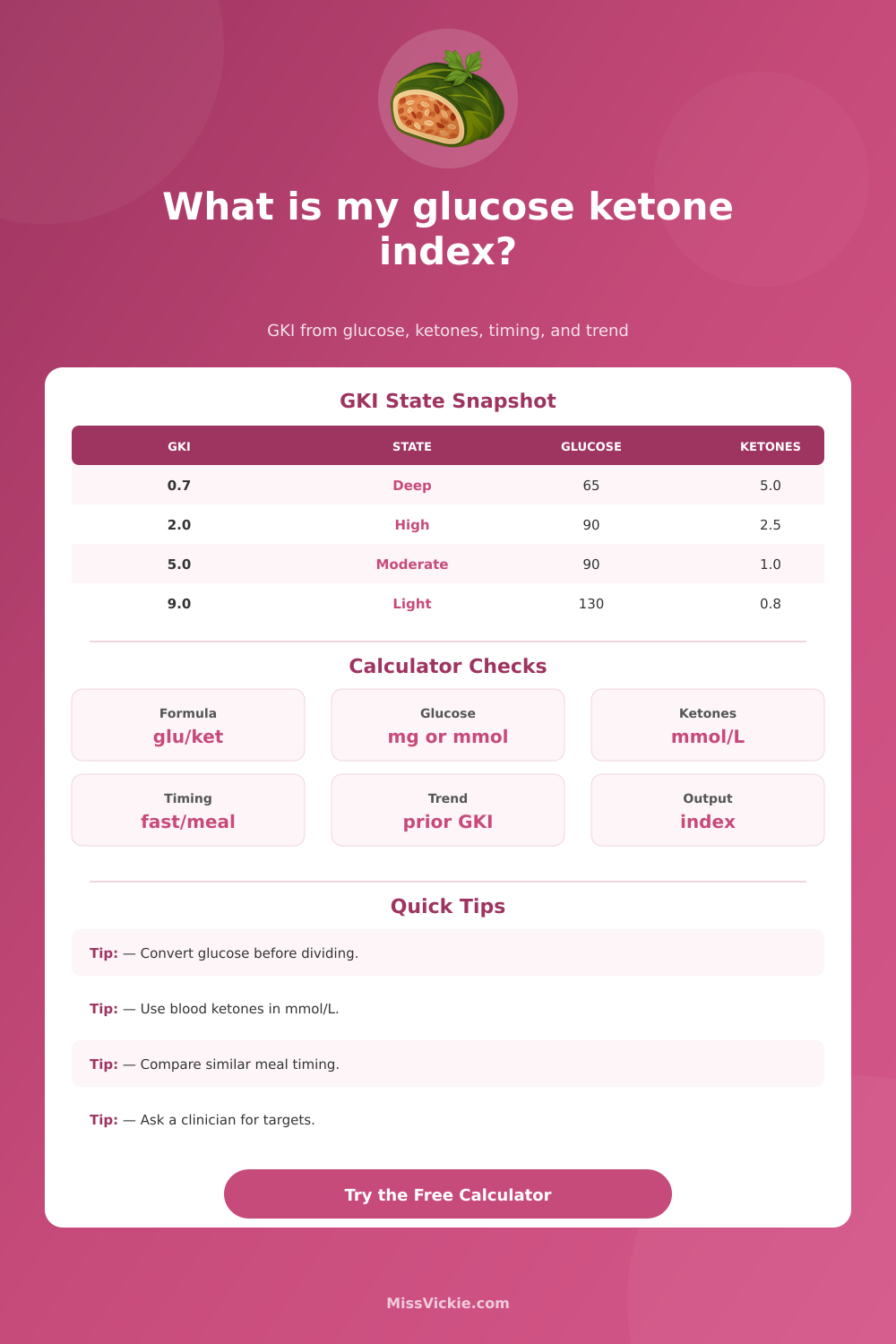
Calculate glucose ketone index from glucose and blood ketones, convert mg/dL to mmol/L, compare fasting or post-meal timing, and view a practical trend note.
Choose a common glucose and ketone scenario, then adjust the unit, fasting state, meal timing, previous GKI, and comparison target.
Calculation Breakdown
Often seen only with strict fasting or therapeutic plans; use clinician guidance.
Common target band for deeper nutritional ketosis discussions.
Often compatible with low-carb eating or early fasting logs.
May reflect mild ketone production, recent food, or rising glucose.
| Formula Step | Input | Conversion | GKI Use |
|---|---|---|---|
| Glucose in mg/dL | 90 mg/dL | 90 / 18.0182 = 5.0 mmol/L | Use 5.0 in numerator |
| Glucose in mmol/L | 5.5 mmol/L | 5.5 x 18.0182 = 99 mg/dL | Use 5.5 in numerator |
| Blood ketones | 1.5 mmol/L | No glucose conversion needed | Use 1.5 in denominator |
| GKI result | 5.0 / 1.5 | Equals 3.3 | Compare with same timing |
| GKI Range | Common Label | Typical Pattern | Tracking Note |
|---|---|---|---|
| Below 1.0 | Deep therapeutic | Low glucose with high ketones | Clinician-supervised if medical |
| 1.0 to 3.0 | High ketosis | Strict keto or longer fast | Compare hydration and timing |
| 3.0 to 6.0 | Moderate ketosis | Low-carb or fasting transition | Often useful for trend logs |
| 6.0 to 9.0 | Light ketosis | Some ketones, higher glucose | Meal timing matters |
| Above 9.0 | Low ketosis signal | Low ketones or higher glucose | Not a diagnosis |
| Glucose mg/dL | Glucose mmol/L | Ketones 0.5 | Ketones 1.5 | Ketones 3.0 |
|---|---|---|---|---|
| 70 | 3.9 | GKI 7.8 | GKI 2.6 | GKI 1.3 |
| 90 | 5.0 | GKI 10.0 | GKI 3.3 | GKI 1.7 |
| 110 | 6.1 | GKI 12.2 | GKI 4.1 | GKI 2.0 |
| 140 | 7.8 | GKI 15.5 | GKI 5.2 | GKI 2.6 |
| Timing | Minutes Since Meal | Expected Use | Comparison Advice |
|---|---|---|---|
| Fasted morning | 0 | Baseline GKI log | Compare to other morning checks |
| Pre-meal | 0 | Before food response | Pair with a 2-hour check |
| 1 hour post-meal | 60 | Early glucose response | Expect more movement |
| 2 hours post-meal | 120 | Meal recovery check | Compare similar meals |
The glucose ketone index are a ratio that compare the level of glucose in the blood to the level of ketones in the blood. Many peoples use the glucose ketone index as a means of understanding how the body is utilize its fuel. The glucose ketone index determine the relative amount of ketones that the body is using compared to the amount of glucose that the body is use.
If the glucose ketone index is low, then the amount of ketones in the blood is high in relation than the amount of glucose in the blood. If the glucose ketone index is high, then the amount of glucose in the blood is high in relation to the amount of ketones in the blood. The glucose ketone index is a more convenient measure of the amount of glucose and ketones in the body over time compared to measuring the glucose and ketone levels separate.
What the Glucose Ketone Index Is and How to Use It
To calculate the glucose ketone index, the individual divides the glucose level in the blood (measured in millimoles per liter) by the ketone level in the blood (measured in the same units). Such a calculation is straightforward and any individual with access to a calculator could perform it. Calculators that perform these calculations are also often able to perform unit conversion from one unit of measurement to the other (from milligrams per deciliter to millimoles per liter) so that the individual can perform the calculation of the glucose ketone index correctly.
The timing of the measurement of glucose and ketones can have an impact upon the glucose ketone index reading. For instance, the glucose ketone index can be expected to be different if the measurement of glucose and ketones is taken after an overnight fast compared to after an individual have consumed a meal. Thus, the individual should note the timing of the measurement.
If the individual does not note the timing of the measurement of glucose and ketones, they may believe that the glucose ketone index has changed when it has actualy changed due to the meal eat by the individual. The type of meal that an individual consumes can also impact the glucose ketone index. For instance, a meal high in carbohydrates will increase the glucose level in the blood and thus the glucose ketone index of that individual.
Conversely, a meal low in carbohydrates will have a lesser impact upon the glucose and ketone levels in the blood of that individual. Finally, meals that contain alcohol will also impact the glucose ketone index of an individual because alcohol impact both glucose and ketone levels in the blood of that individual. Thus, these factors indicate that an individual should understand the glucose ketone index in the context of the meals that an individual consume.
The glucose ketone index is a tracking tool only and should not be considered to be a medical diagnosis of the health of an individual. Many individuals can use the glucose ketone index for different reasons. For instance, some may use it to determine if they are in a state of nutritional ketosis.
Other individuals may use the glucose ketone index to determine how their body react to various conditions. Thus, while the glucose ketone index does not indicate whether an individual has succeeded or failed in some goal, it can indicate the direction that their glucose and ketone levels is moving. Thus, the glucose ketone index should be evaluated in the context of the health and goals of that individual.
For the glucose ketone index to be useful to an individual, that individual is require consistency in the measurements of glucose and ketone levels. The glucose ketone index will be more useful if an individual measures glucose and ketone levels at the same time each day, and under the same conditions. Additionally, the ability of the calculator to allow an individual to enter one or more previous glucose ketone index readings will allow that individual to understand the direction of their glucose ketone index without having to perform the mathematical calculation of the glucose ketone index themselves.
An individual’s hydration status and level of stress may also impact the glucose ketone index. For instance, dehydration can lead to an increase in the glucose levels in the blood, which will lead to an increased glucose ketone index. Additionally, stress and lack of sleep can lead to increased glucose levels in the blood, which will lead to an increased glucose ketone index.
Since the individual cannot easily measure these factors with numbers, they should be noted in the note field of the calculator. By noting these factors in the calculator, the individual will have a better understanding of the reasons for any changes in there glucose ketone index. The glucose ketone index may not always move in a straight line for an individual.
For instance, the glucose ketone index may drop after an individual eats a meal that is high in fat and low in carbohydrates. However, if that individual subsequently experiences a stressful week or eats meals high in carbohydrates, the glucose ketone index may rise for that individual. Such movement of the glucose ketone index is normal and the bodys natural way of reacting to various variable in an individuals life.
The calculator is designed in a way that makes it possible to observe these natural movements in the glucose ketone index. The reference tables within the calculator provide information regarding the glucose and ketone levels that result in different glucose ketone index values. These tables also provide the information necessary to convert between units of glucose measurement (from milligrams per deciliter to millimoles per liter).
The individual does not need to memorize these tables because the calculator will automatically make these unit conversions for that individual. The glucose ketone index should be understood as one part of the overall health of an individual. For instance, if an individuals measured glucose ketone index is higher than that individual may have desired, the individual should consider their timing of measurements, meals, sleep, and hydration level.
Thus, the goal of measuring glucose ketone index is not to achieve the lowest glucose ketone index reading possible, but instead in the ability to understand how the body of an individual respond to the choices that they make.