Calories, kcal, kJ, servings, meal totals, label regions, and macro energy
Calorie to Kilojoule Converter
Convert food Calories, kilocalories, small calories, and kilojoules while scaling servings, building a meal total, comparing label regions, and checking whether macros match the stated energy.
Choose a label or meal scenario, then edit the unit, servings, region, rounding, and macro grams to match the food in front of you.
Conversion Breakdown
Nutrition Facts panels usually show Calories first; those Calories are kcal.
Calories are prominent, with metric nutrient grams and milligrams alongside.
Energy is commonly shown in both kilojoules and kilocalories.
Kilojoules are the leading energy unit, often with Calories in smaller context.
| Starting Unit | To Kilocalories | To Kilojoules | Food Label Note |
|---|---|---|---|
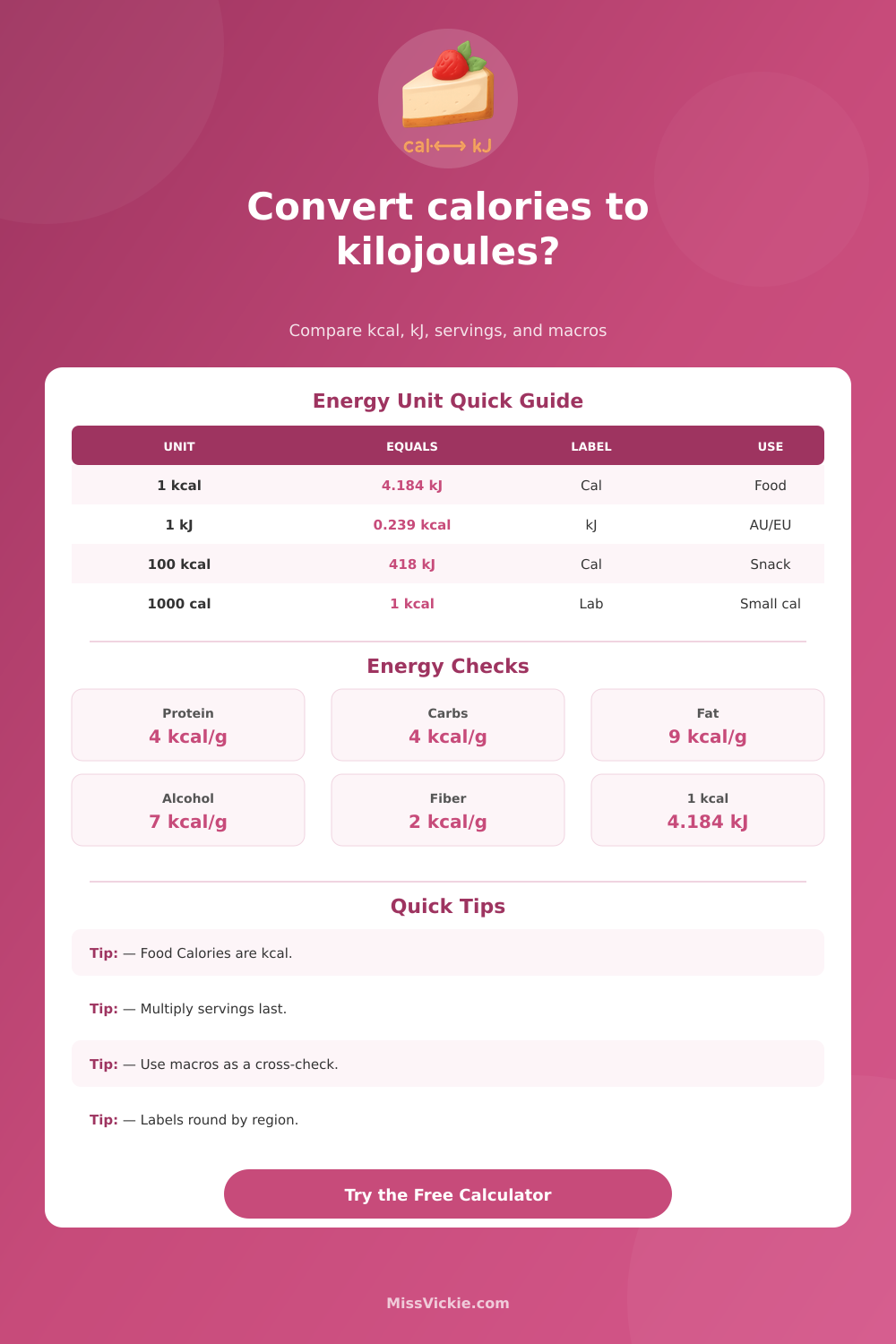
| 1 food Calorie | 1 kcal | 4.184 kJ | Capital-C Calorie means kilocalorie on food labels. |
| 1 kilocalorie | 1 kcal | 4.184 kJ | Same energy as one food Calorie. |
| 1 kilojoule | 0.239 kcal | 1 kJ | Common on UK, EU, Australian, and New Zealand labels. |
| 1 small calorie | 0.001 kcal | 0.004184 kJ | Mostly science notation, not normal food packaging. |
| 100 food Calories | 100 kcal | 418.4 kJ | Useful mental shortcut for snacks. |
| Label Region | Typical Energy Display | Calculator Output | Rounding Habit |
|---|---|---|---|
| United States | Calories | Calories first with kJ support | Often rounded to 5 or 10 Calories. |
| Canada | Calories | Calories first with kJ support | Comparable calorie-first planning display. |
| United Kingdom | kJ and kcal | Both values shown together | Energy commonly appears as kJ/kcal. |
| European Union | kJ and kcal | Both values shown together | Per 100g and per serving labels may both appear. |
| Australia / New Zealand | kJ first | Kilojoules first with kcal support | kJ is the main everyday food energy unit. |
| Macro Source | Atwater Factor | kJ Per Gram | Cross-Check Use |
|---|---|---|---|
| Protein | 4 kcal per g | 16.7 kJ per g | Meat, dairy, beans, tofu, protein powders. |
| Carbohydrate | 4 kcal per g | 16.7 kJ per g | Starch, sugars, grains, fruit, and most packaged carbs. |
| Fat | 9 kcal per g | 37.7 kJ per g | Oils, nuts, dairy fat, chocolate, avocado, fried foods. |
| Alcohol | 7 kcal per g | 29.3 kJ per g | Beer, wine, spirits, liqueurs, and mixed drinks. |
| Fiber option | 0 to 2 kcal per g | 0 to 8.4 kJ per g | Some labels treat fiber differently by formula and region. |
| Food Or Meal Example | Approx kcal | Approx kJ | Serving Planning Note |
|---|---|---|---|
| Small yogurt cup | 100 kcal | 418 kJ | Multiply by cups eaten if using multipacks. |
| Cereal with milk bowl | 250 kcal | 1,046 kJ | Count cereal and milk if their labels are separate. |
| Granola bar | 190 kcal | 795 kJ | Often one bar equals one label serving. |
| Ready meal | 550 kcal | 2,301 kJ | Check whether the tray contains one or two servings. |
| Party platter portion | 375 kcal | 1,569 kJ | Use serving count and items to scale the whole table. |
Reference values use 1 kilocalorie = 4.184 kilojoules. Actual packaged labels may round energy and macro values before printing them.
When you look at the nutrition label on a food package, there is a number that represents the energy content of that food product. The energy content may be listed in Calories or in units of kilojoules. Some countries uses Calories to represent energy content on there food labels while other countries use kilojoules.
Thus, food labels in different countries may use different units of measurement for the energy content of that food product. As a result, it may be necessary to convert the energy content of a food product from one unit of measurement to another. One Calorie contain 1000 small calories of energy.
Calories and Kilojoules on Food Labels
Furthermore, one Calorie contains approximately 4.184 kilojoules of energy. As a result of these values, it is possible to use a conversion factor to convert the Calories to kilojoules or the kilojoules to Calories. Food labels often include the energy content of the product in both large units (Calories) and small units (kilojoules) as well as the number of servings of that food product contains the energy content listed on the label.
The energy value listed on food product labels is an estimate of the energy content of that food. The energy content listed on the label is not a direct measurement of the energy content of the food that you are currenty holding. Instead, determining the amount of protein, carbohydrates, fat, and alcohol that is contained in the food calculates the energy content listed on the food label.
Protein contains approximately 4 Calories of energy per gram, carbohydrates contain 4 Calories of energy per gram, fat contains 9 Calories of energy per gram, and alcohol contains 7 Calories of energy per gram. Fiber, which does not provide the same amount of energy as it is broken down and digested in the body, is somewhat differently categorized on food labels. Different regions of the world have different rules regarding the energy content of fiber, therefore the energy content that is listed on food labels may vary according to the market from which the food is sold.
Servings is another value that is listed on the nutrition label. The energy content is often only provided for one serving of the food product. However, the package may contain more than one serving.
When using the calorie calculator, adjusting the number of servings will allow the calculator to provide the energy content according to the amount of that food product that you intend to consume. This adjustment is necessary for the difference in energy content between one serving versus multiple servings of the same product. Additionally, if you are using the calorie calculator to determine the energy content of a recipe, you may adjust the energy content accordingly so that you dont have to perform the division of that energy content value in your head.
Finally, as indicated above, the different regions of the world have different preferences in the units of energy content that they feature on their food labels. For instance, Canada and the United States feature Calories on their food labels while Australia and New Zealand feature kilojoules on their food labels. Often, the labels in the United Kingdom and the European Union will include both the number of Calories and kilojoules.
These differences are due to the research that went into the region’s nutritional needs. If you choose a specific region on the calculator, it will display the energy content of that specific region. Rounding the energy content is common on the labels for products.
Therefore, the energy content on the label may not be exact. Often, manufacturers round the energy content to the nearest five or ten Calories. Thus, the energy content on the label may be slightly different than the energy content that is calculated by the mathematics of the product.
By using a calculator to determine the energy content of a product, individuals can make sure they are getting the correct amount for their needs. One of the main uses for this energy content calculator is to ensure that the energy content of the product fits the individual’s goals for there energy intake. By being able to view the energy content of a product in their preferred unit of measurement, individuals can make sure that the energy content of the food is appropriate for them.
The macronutrients can also be used to determine if the energy content of the product is accurate; the calculated energy content should match what is listed on the product. To avoid mathematical errors, it is best to first enter the energy content for one serving of the product. After that, multiply by the number of servings in the product.
It is best to choose the correct unit of energy content before multiplying the product; otherwise, the results can be incorrect. This method works for calculating the energy content of a meal and for adjusting a recipe for more or fewer servings. With experience with energy content, individuals may be able to recognize some products as having certain amounts of energy.
For instance, a bowl of cereal may have one thousand kilojoules of energy. By learning these types of benchmarks for energy content, individuals can recognize other products and determine how many kilojoules or how many Calories they contains; even if the amount is listed in a different unit of measurement. Thus, a converter allows individuals to test these scenarios without the need for a manual conversion chart.
While the energy content calculator may be helpful in determining the energy content of a product, it is only one of several factors to consider when evaluating a product’s nutritional value. The other factors to consider are factors like energy density, satiety, and micronutrients. The energy content calculator can help to move quickly between these different units of energy content.
By ensuring that the energy content listed on the product matches the energy content that can be calculated from the product’s ingredients, the manufacturer has provided the necessary information to the consumers.