Guest count, service style, yield, waste, and leftovers
Catering Portion Calculator
Estimate catering portions for buffets, plated meals, stations, boxed meals, and receptions with separate entree, side, dessert, appetite, event length, yield, waste, and leftover controls.
Choose a real event starting point, then fine-tune the portions, service format, yield, waste, and leftover goal.
Catering portion breakdown
Lowest buffer because the kitchen controls the entree, sides, and dessert count.
Guests self-serve unevenly, so entree and sides need visible backup.
Multiple lines spread traffic, but each station needs enough food to look full.
Appetizer pieces replace full plates, with dessert and drinks doing more work.
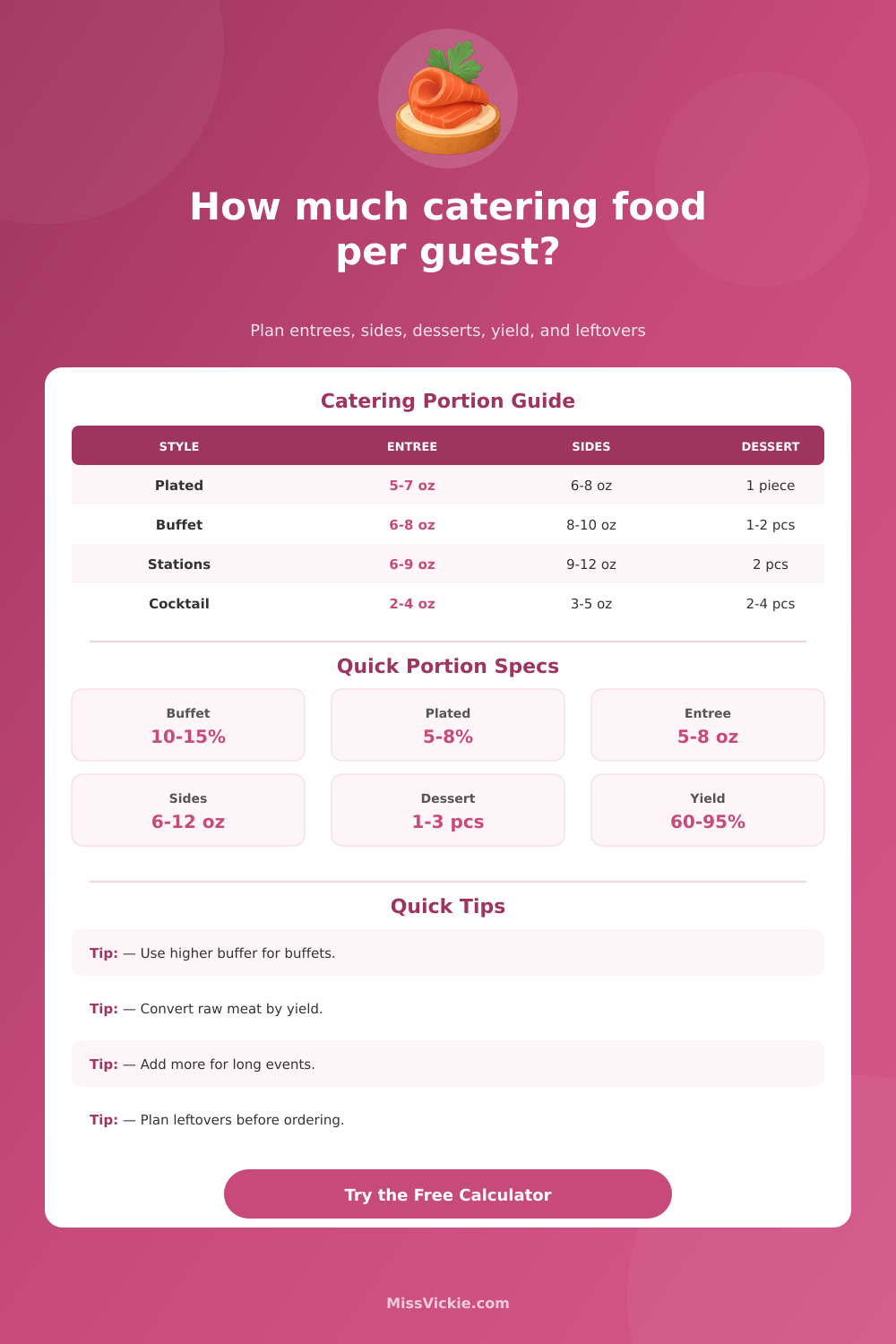
| Event style | Edible entree | Total sides | Dessert | Best starting buffer |
|---|---|---|---|---|
| Plated or boxed meal | 5 to 7 oz | 6 to 8 oz | 1 piece | 5% to 8% because portions are controlled. |
| Classic buffet | 6 to 8 oz | 8 to 10 oz | 1 to 2 pieces | 10% to 15% for uneven serving and refills. |
| Family style | 6 to 8 oz | 8 to 11 oz | 1 to 2 pieces | 8% to 12% because platters sit on tables. |
| Stations or grazing | 6 to 9 oz | 9 to 12 oz | 2 pieces | 12% to 18% so every station stays stocked. |
| Cocktail reception | 0 to 4 oz | 0 to 5 oz | 2 to 4 pieces | 10% to 16% focused on bite counts. |
| Brunch or breakfast | 3 to 5 oz | 6 to 9 oz | 1 piece | 8% to 12% plus extra fruit or pastries. |
| Entree type | Typical edible yield | Waste pressure | Planning note | Good service fit |
|---|---|---|---|---|
| Chicken pieces or sliced chicken | 65% to 75% | Bone, skin, and pan juices | Portions well when pieces are similar size. | Buffet, boxed, family style. |
| Beef roast or carved steak | 68% to 78% | Trim, carving ends, and hold loss | Slice thinly for buffets to protect the count. | Plated, carving station, buffet. |
| Pulled pork or shoulder | 55% to 65% | Bone, fat cap, shrinkage, and sauce | Buy more raw weight than the finished tray suggests. | BBQ buffet, sandwiches, stations. |
| Fish fillet or seafood | 78% to 88% | Skin, flake loss, and delicate holding | Use a tighter buffet window and smaller backup pans. | Plated meals, short buffets. |
| Pasta main or baked pasta | 90% to 98% | Very low trim, some pan residue | Think in cooked weight and pan volume, not dry pasta alone. | Meetings, buffets, vegetarian mains. |
| Vegetarian main dish | 85% to 95% | Sauce, garnish, and serving loss | Add protein-rich ingredients for staying power. | Buffet, plated, mixed menus. |
| Guest count | Plated entree buy | Buffet entree buy | Sides to prepare | Dessert pieces |
|---|---|---|---|---|
| 20 guests | 11 to 14 lb | 14 to 18 lb | 10 to 14 lb | 24 to 36 pieces |
| 40 guests | 22 to 29 lb | 28 to 36 lb | 20 to 28 lb | 48 to 72 pieces |
| 60 guests | 33 to 43 lb | 42 to 54 lb | 30 to 42 lb | 72 to 108 pieces |
| 100 guests | 55 to 72 lb | 70 to 90 lb | 50 to 70 lb | 120 to 180 pieces |
| 150 guests | 82 to 108 lb | 105 to 135 lb | 75 to 105 lb | 180 to 270 pieces |
| 200 guests | 110 to 144 lb | 140 to 180 lb | 100 to 140 lb | 240 to 360 pieces |
| Planning choice | Extra factor | What it protects | Tray strategy | When to use it |
|---|---|---|---|---|
| Minimal leftovers | 0% to 3% | Basic head count only | Serve smaller pans and refill from exact backups. | Boxed meals, strict plated events, limited storage. |
| Light host leftovers | 4% to 8% | Late guests and modest seconds | Hold one small backup pan behind the line. | Office lunches and family celebrations. |
| Planned extra trays | 10% to 15% | Take-home servings and next-day meals | Separate extras before service to reduce waste. | Casual events, BBQ, church meals, open houses. |
| Take-home portions | 18% to 25% | Guest containers and family packs | Label shallow containers before service starts. | Reunions, fundraisers, and hosted celebrations. |
| Long buffet window | 3% to 10% | Grazing, dry edges, and repeated refills | Use smaller hot pans and rotate fresh portions. | Events longer than two hours. |
Planning a catered meal require determining the exact amount of food that guests will consume. The amount of food that will be consumed by the guests will depend on the type of service for the event, the type of crowd that will attend the event, the length of the event, and the amount of food that is desired to be left over at the end of the event. Many hosts has experienced the dilemma of having too much food left over, or not having enough of the main food item for the guest at the event.
Each of these outcomes can be avoided by using the catered meal quantity calculator, which can make an estimation of the amount of food that is required for the guests based off several different factor of the catered meal. In order for the catered meal quantity calculator to return accurate results for the amount of food that is required to be prepared for the guests, the host must understand each of the different factor of the catered meal. Some of the factors include the service format for the meal.
How Much Food to Order for a Catered Meal
For instance, if the food is to be served as a plated dinner, the kitchens will be able to control the amount of food that is served to each guest. However, if the food is to be served at a buffet, each guest will be able to take as much food as they would like from the counters, and return for second helpings. Other factors may include the number of food station that will be set up for the meal.
Each food station will have to provide enough food for the guests to visit the station, even if not all of the guests are eating at the same time. The catered meal quantity calculator will account for these factors, but the host must make a selection of the service format for the meal. The appetite of the guests will change the amount of food that must be ordered for the event.
For instance, the default selection for the calculator may be a standard mixed group of guests. However, many guest will either eat more food than a standard group, such as corporate lunches for individuals who have eaten at breakfast, or they may eat second helpings of food, such as at a rehearsal dinner or family reunion. These different appetite for the guests can be accounted for in the catered meal quantity calculator to allow for the ordering of the correct amount of food for the guests.
The length of the event will change the amount of food that is required for the guests. For instance, if the length of the event is longer than two hours, the guests may request additional portion of food from the stations during the event. Therefore, the food will need to be provided in such a way that it will not dry out during the event.
Factors that relate to the food that will be prepared for the guests include the yield of that food, and the amount of food that will become waste. The yield of the food is the amount of food that will edible after the bones and trimmings are removed from the raw food. Waste is the food that remains on the tray after preparation, food that is picked at when the food is prepared, or food that is left on the edge of the food pan.
These factors will be included in the catered meal quantity calculator so that the weight of the food that will be purchased will include both the yield and waste of the food. For instance, if the type of protein is changed, the catered meal quantity calculator will automatically adjust the yield. The amount of waste for food station can be increased for events that last longer than a meal, and the amount of waste can be decreased for catered plated services.
The leftover food that will be prepared for the guests is another factor in the catered meal quantity calculator. A host may want to have food that remains after the guests have finished eating. For instance, the leftover food may be prepared to allow the staff at the event to consume the food, or the host may want to provide food to the guests that attend the event.
Therefore, the amount of food that will be prepared as leftovers can be accounted for in the catered meal quantity calculator. The amount of food that is provided as leftovers is separate from the food that is prepared as a buffer for the event. The buffer for the event ensures that there will be enough food for the guests during the event, while the amount prepared as leftovers ensures that there will be enough food left for the guests after they finish eating.
These two factor should be separate from one another in the planning of the catered meal. While the catered meal quantity calculator can estimate the amount of food that is required based upon the factors described above, the actual food that is prepared at the event may not math the calculations of the catered meal quantity table. For instance, children typically will eat less of the food than adults, but may eat more dessert than adults.
Additionally, the number of late arrivals for the event may mean that the initial guests have already entirely consume the food. The catered meal quantity calculator can account for the staff members and the light eaters at the event by accounting for them as separate guests in the calculation of the number of guests that will attend the event. Therefore, the final quantities of food that will be prepared will only be accurate if the information provided to the catered meal quantity calculator is accurate.
For instance, if the guests at the event tend to drink more than they eat, lowering the count for the amount of appetizers will be more appropriate than lowering the count for the amount of entrees. Beyond the calculations performed in the catered meal quantity calculator, additional considerations regarding the food that will be prepared for the guests should also be made. For instance, the catered meal quantity calculator can calculate the number of pans or trays of the food that will be prepared.
This number can be used to order the food from the caterer. Using many side dishes of food can make the food appear full for the guests, but using a large pan of food can make the food appear as if it has been pick over by the guests. Using many small plate instead of one large pan can solve this problem.
Another consideration regarding the food that will be prepared is the policy that will be enacted regarding the leftovers. For instance, if the catered meal will include food that the guests will take home after the event, the food should be prepared in pans of shallow dishes that can be easily placed into the bags that the guests will take with them. Additionally, if the caterer would like to have zero waste of food at the event, the caterer could order one backup pan of food that will be kept away from the buffet line of food.
The caterer will only prepare and serve this backup pan if the guests have completely eaten all of the food at the event. Finally, additional considerations regarding the food that will be prepared for the guests include the portions of the food. The portions of the food can be balanced such that there is enough food for all of the guests, but the portions of the food are not too much that the food will lose its quality before the guests begin to eat it.
The catered meal quantity calculator performs the mathematical calculations for the catered meal, allowing the host to focus upon the service format for the food, the guests that will attend the event, and the amount of food that is desired to be left over after the event. Once the host has made the catering decisions, the catered meal quantity calculator will provide the host with the correct amount of food that should be prepared for the guests.