Alcohol Serving Size Calculator
Convert ABV, pour size, bottle or can volume, cocktail ingredients, and batch servings into standard drinks using pure alcohol grams and fluid ounces.
Load a common drink or container, then adjust the ABV, serving count, standard-drink definition, and cocktail ingredients to match your pour.
Serving Breakdown
| Source | Volume | ABV | Pure Alcohol | Std Drinks |
|---|
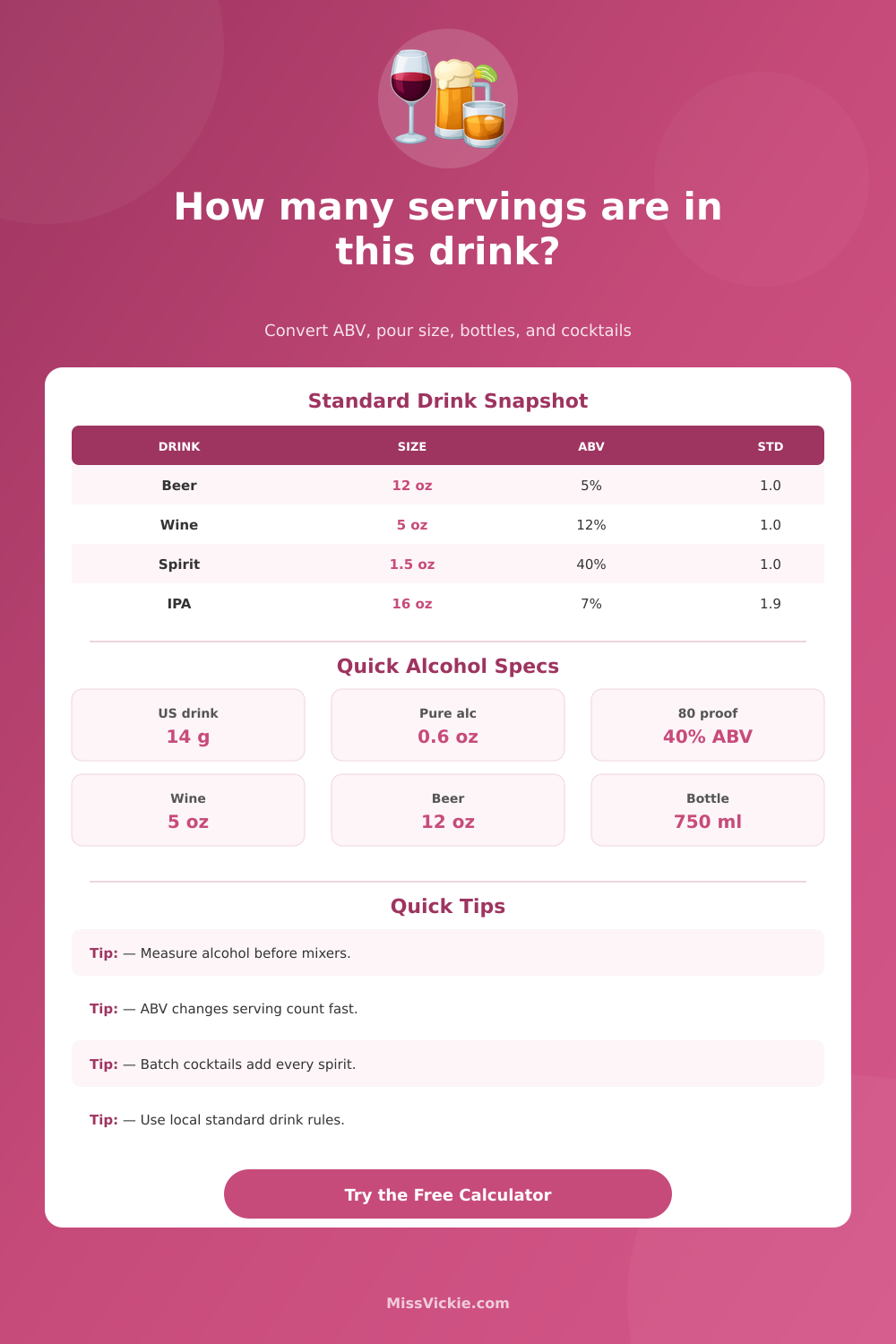
| Drink Type | Typical Size | Typical ABV | US Standard Drinks |
|---|---|---|---|
| Regular beer | 12 fl oz / 355 ml | 5% | About 1.0 |
| Strong beer or IPA | 16 fl oz / 473 ml | 7% | About 1.9 |
| Table wine | 5 fl oz / 148 ml | 12% | About 1.0 |
| 80 proof spirits | 1.5 fl oz / 44 ml | 40% | About 1.0 |
| Fortified wine | 3.5 fl oz / 104 ml | 17% | About 1.0 |
| Liqueur or cordial | 2.5 fl oz / 74 ml | 24% | About 1.0 |
| Container | Volume | Example ABV | Approx. US Standard Drinks |
|---|---|---|---|
| Beer bottle or can | 12 fl oz / 355 ml | 5% | 1.0 |
| US pint beer | 16 fl oz / 473 ml | 6% | 1.6 |
| Wine bottle | 750 ml / 25.4 fl oz | 12% | 5.1 |
| Half bottle wine | 375 ml / 12.7 fl oz | 12% | 2.5 |
| Spirits fifth | 750 ml / 25.4 fl oz | 40% | 16.9 |
| Ready-to-drink can | 12 fl oz / 355 ml | 5% | 1.0 |
| Cocktail Ingredient | Common Pour | Typical ABV | US Standard Drinks Added |
|---|---|---|---|
| Base spirit | 1.5 fl oz / 44 ml | 40% | 1.0 |
| Overproof spirit | 1 fl oz / 30 ml | 57% | 1.0 |
| Orange liqueur | 0.75 fl oz / 22 ml | 30% | 0.4 |
| Vermouth | 1 fl oz / 30 ml | 16% | 0.3 |
| Aperitif | 2 fl oz / 59 ml | 11% | 0.4 |
| Champagne topper | 2 fl oz / 59 ml | 12% | 0.4 |
| Planning Use | Input to Check | Why It Matters | Calculator Field |
|---|---|---|---|
| Dinner wine | Bottle ABV and glass count | Large pours can double serving count | Container mode |
| Beer cooler | Can count and ABV | High ABV cans may exceed one drink | Container mode |
| Mixed drinks | Every alcoholic ingredient | Liqueurs and floaters add up | Cocktail mode |
| Party punch | Total batch volume and servings | Small cups may still be strong | Cocktail mode |
| Tasting flight | Sample pour size | Multiple small pours stack quickly | Single mode |
| Recipe scaling | Servings poured | Batch total must be divided by cups | Servings field |
12 fl oz at 4.2% ABV.
12 fl oz at 5% ABV.
5 fl oz at 12% ABV.
3 fl oz at 40% ABV.
16 fl oz at 7% ABV.
2.5 fl oz spirit plus vermouth.
Tequila plus orange liqueur.
750 ml at 12% ABV.
Drink size confusion occur when a person pours a drink but then recognizes that the drink contain more than one serving of alcohol. This is due to the fact that the human eye isnt a reliable tool for measuring the volume of liquid poured into a glass. In addition, the contents of the drink such as ice, juice, and the volume of the pour of the drink can easily fool the human eye.
An alcohol serving size calculator is a tool that can help to a person to avoid confusion about the size of the alcoholic drinks that they pours for themselves. The size of the serving of alcohol are based off the amount of pure alcohol in the drink as the serving size is not based on the height of the liquid in the glass. For instance, a 12 ounce beer with 5% alcohol is considered to be one serving of alcohol, but a 12 ounce beer with 9% alcohol is considered to be nearly two servings of alcohol.
Know How Much Alcohol Is in Your Drink
An alcohol serving size calculator can make the math easier for the individual by inputting the alcohol by volume and the total amount of the pour of the drink; using an alcohol serving size calculator will save the individual from having to remember the math table for each brand of craft beer. Cocktails can be difficult to calculate the number of servings of alcohol in the drink because cocktails contain more than one alcoholic ingredient. For instance, a margarita contains two different alcoholic ingredient that may result in a drink that contains more alcohol than the individual intended it to contain.
By using an alcohol serving size calculator, an individual can enter each of the ingredients into the tool separately so that the tool calculates the total alcohol content of the cocktail accurate. It is important for the preparation of the cocktail to calculate the total amount of alcohol in the recipe so that the individual can prepare the batch according to the person that is to consume the cocktail. In addition to calculating the number of servings of alcohol in a cocktail by entering each ingredient separately, it is also important to perform what is referred to as container math to calculate the number of servings of alcohol in a container of alcohol.
For instance, a 750 ml bottle of wine may contain a certain amount of servings of alcohol based upon the size of the glass of wine that an individual pours from the bottle. If an individual pours six or seven ounces of wine from the bottle instead of the standard five ounce, then they will finish the bottle of wine more quickly and there will be fewer servings of alcohol in the bottle. By using the container mode on the alcohol serving size calculator, an individual can calculate the number of glasses of wine that the bottle will produce by entering the size of the glass that they would like to use.
The number of grams of alcohol in one serving of alcohol may vary from country to country. For instance, the default setting on an alcohol serving size calculator may be set to the United States standard for alcohol servings. However, the user can change that setting according to the country whose standards on the number of grams of alcohol in one serving of alcohol that is to be followed.
While the difference between 14 grams of alcohol and 10 grams of alcohol may seem small, the difference in the amount of alcohol will impact the total number of servings of alcohol in the drink. Consequently, the total number of servings will impact how the individual consume the alcohol and how they define the alcohol content of the drinks that they serve to their guests. Although mixers may impact how an individual consumes an alcohol-based drink, the mixers do not contain alcohol.
For instance, a person may pour a large glass of soda into a drink that contains a small amount of alcohol. Such a drink may contain the same amount of alcohol as a small glass of alcohol-based drinks. However, the alcohol serving size calculator can separate the alcoholic ingredients from the volume of the mixer in the drink.
By separating the alcoholic ingredients from the volume of the mixer, an individual can view the total amount of pure alcohol in their drink. An individual may make mistakes when drinking alcohol if they treat every alcoholic drink as if every alcoholic drink is the same amount of alcohol. For instance, a pint of strong beer may contain the same number of servings of alcohol as a double serving of spirits or a glass of wine.
However, the percentage of alcohol in each of these drink types may differ. Reference tables on the page can demonstrate the difference between the amount of alcohol in beer, wine, and spirits. These types of tables allow an individual to better understand the amount of alcohol in each type of drink, which allows them to change the type of alcohol that they pour into there glasses.
This concept can also be used to calculate the number of servings of alcohol in a drink that is to be served at a party. For instance, punch recipes typically state the total volume of the drink. However, the total volume of punch does not necessarily indicate the number of servings of alcohol that are contained in the drink.
However, if the individual enters the total batch of punch into the alcohol serving size calculator in the cocktail mode, an individual can calculate how many servings of alcohol are in the total batch. Consequently, if the individual calculates the total number of servings of alcohol in the batch ahead of time, they can adjust the recipe to the amount of alcohol that they would like to pour into each guest’s cup. The alcohol serving size calculator will calculate the total amount of alcohol in a drink, but the tool will not provide a safety verdict on the effects of that alcohol on the body.
For instance, how fast an individual drinks, whether or not they eat prior to drinking alcohol, and the individuals own tolerance for alcohol will all impact the effect of that alcohol on the body. Therefore, while the tool provides an individual with data on the volume and strength of the alcohol in their drink, it cannot calculate the effect that that alcohol will have on their body. The most effective habit for mixing alcohol is to measure the alcohol prior to adding any mixer to the glass.
By measuring the alcohol, an individual can add any amount of mixers that they desire to the drink without changing the total amount of alcohol in the drink. Thus, by measuring the alcohol prior to adding any mixers, an individual turns an invisible variable into a visible variable. Additionally, by measuring the alcohol in the drink, an individual gains the ability to plan for the amount of alcohol in their drink.
It is much better than guessing based off visual cuicks.