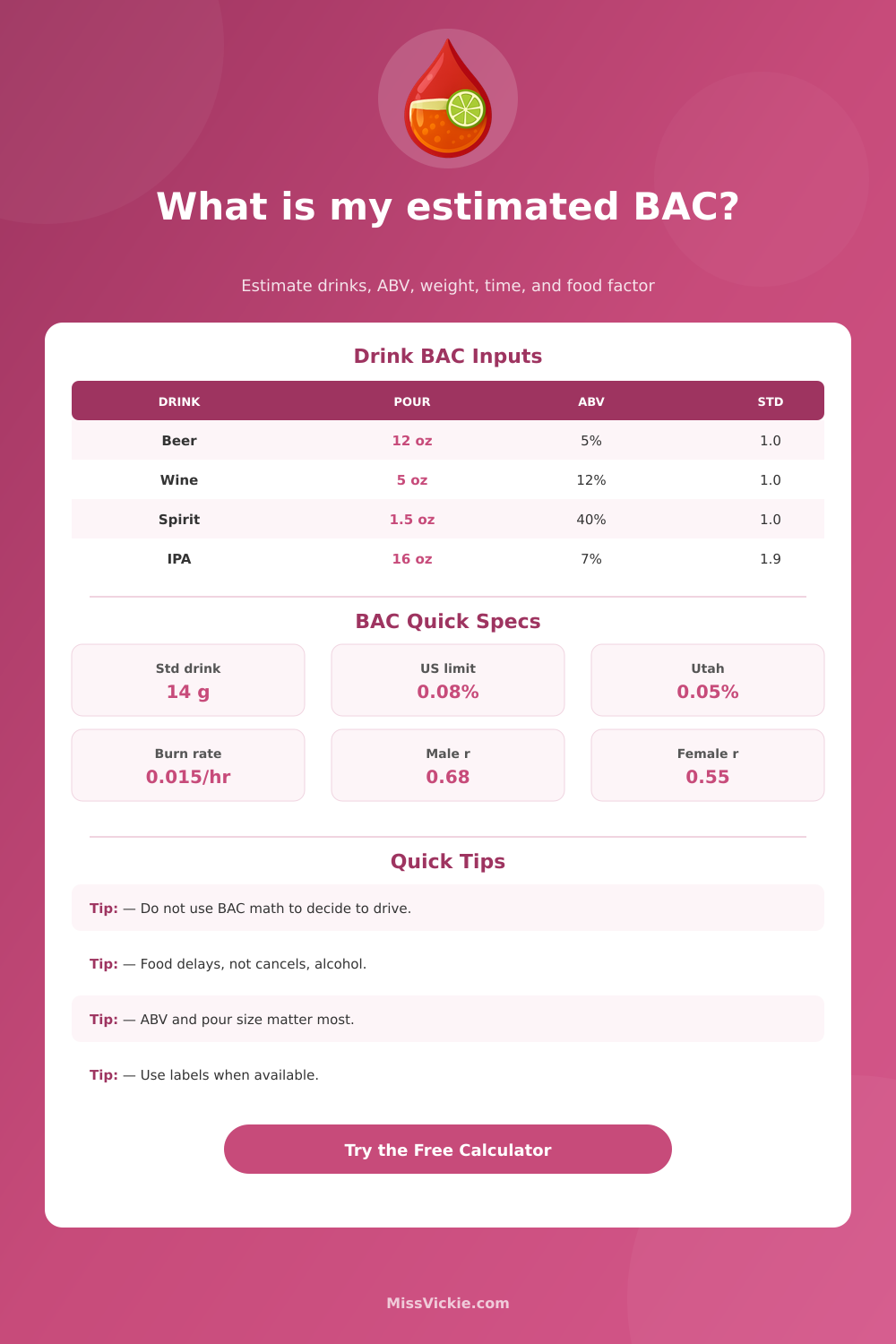
Educational estimate only: drinks, ABV, pour size, body weight, sex coefficient, time elapsed, and food factor
Blood Alcohol Calculator
Estimate blood alcohol concentration from drink strength, serving size, body weight, sex coefficient, elapsed time, food effect, and metabolism rate. This tool never tells anyone it is safe to drive.
Load a common drink scenario, then edit the pour, ABV, body weight, coefficient, time, and food setting to match the actual situation.
Estimate Breakdown
| Drink | Common Pour | Typical ABV | Approx Standard Drinks |
|---|---|---|---|
| Regular beer | 12 fl oz / 355 ml | 5% | 1.0 standard drink |
| Light beer | 12 fl oz / 355 ml | 4.2% | 0.8 standard drink |
| Craft IPA | 16 fl oz / 473 ml | 7% | 1.9 standard drinks |
| Table wine | 5 fl oz / 148 ml | 12% | 1.0 standard drink |
| Sparkling wine | 5 fl oz / 148 ml | 11.5% | 1.0 standard drink |
| Distilled spirit | 1.5 fl oz / 44 ml | 40% | 1.0 standard drink |
| Input | Calculator Use | Default Range | Important Note |
|---|---|---|---|
| Alcohol grams | Pour ml x ABV x 0.789 | 14 g per US standard drink | ABV and actual pour size change this quickly. |
| Body weight | Converted to grams | lb or kg entry | Body composition is not measured by this tool. |
| Sex coefficient | Widmark-style distribution factor | 0.55 to 0.68 common presets | A custom coefficient is still only an estimate. |
| Metabolism | Subtracts BAC per elapsed hour | 0.012 to 0.018 per hour | Actual elimination varies by person and situation. |
| Food factor | Adjusts estimated absorbed peak | 0.70 to 1.08 | Food delays absorption; it does not make alcohol safe. |
| Setting | Factor Used | What It Represents | Safety Caveat |
|---|---|---|---|
| Empty stomach | 1.00 | Fastest absorption assumption | Peak can arrive sooner and feel stronger. |
| Light snack | 0.92 | Small delay and modest peak reduction | Still count the full alcohol load. |
| Full meal | 0.82 | Slower absorption estimate | Later peaks are possible after the meal. |
| Heavy meal | 0.74 | Largest food delay in this tool | Alcohol remains in the body and can rise later. |
| Rapid drinking | 1.08 | Higher peak-risk flag | Short time windows are hard to estimate. |
| Reference Level | Common Meaning | Calculator Flag | Do Not Use For |
|---|---|---|---|
| 0.00% | No alcohol comparison | Zero policy selected | Testing, probation, work, or driving decisions. |
| 0.02% | Low BAC comparison level | Early caution | Claiming unimpaired performance. |
| 0.05% | Utah driving limit and lower global-style threshold | Elevated caution | Assuming legality in any location. |
| 0.08% | Common US adult driving limit outside Utah | High risk comparison | Any advice to drive or operate equipment. |
| Scenario | Alcohol Load | 150 lb, r 0.55, 2 hr | 190 lb, r 0.68, 2 hr |
|---|---|---|---|
| Two 5 oz wines at 12% | About 2.0 standard drinks | Approx 0.049% before personal variation | Approx 0.025% before personal variation |
| Two 16 oz IPAs at 7% | About 3.7 standard drinks | Approx 0.116% before personal variation | Approx 0.067% before personal variation |
| Three 12 oz beers at 5% | About 3.0 standard drinks | Approx 0.087% before personal variation | Approx 0.048% before personal variation |
| Two 1.5 oz spirits at 40% | About 2.0 standard drinks | Approx 0.049% before personal variation | Approx 0.025% before personal variation |
| Two 10 oz margaritas at 13% | About 4.3 standard drinks | Approx 0.139% before personal variation | Approx 0.081% before personal variation |
Alcohol change the way in which a body processes information before the individual feel the effects of the alcohol intoxication. Consequently, because alcohol change the way in which a body processes information, it is important to provide an estimate of an individual’s blood alcohol concentration. While the difference between one drink of alcohol and two drinks of alcohol may not necessarily be readily apparent to the individual who is drinking, the difference between those two amount can have an effect upon the coordination and judgment of that individual.
Individuals can use the calculator to provide a clearer picture of the blood alcohol concentration of an individual then the individual may otherwise be able to determine by memory alone. The calculator use specific data about the individual to calculate that concentration, such as the number of drinks that the individual consumed, the size of each drink, the alcohol by volume of each drink, the weight of the individual, a coefficient that reflect the sex of the individual, the length of time that elapsed while the individual was consuming alcohol, the metabolism rate of the individual, and whether the individual consume a meal prior to consuming alcohol. The mathematical calculations that are used to determine the blood alcohol concentration of an individual begins with determining the amount of alcohol that entered the body.
What Affects Your Blood Alcohol Level
The size of each drink and the alcohol by volume of each drink allow the calculator to determine the amount of gram of alcohol that entered the body. For instance, both a 12-ounce beer that contains 5% alcohol by volume and a 5-ounce glass of wine that contains 12% alcohol by volume will contain the same amount of alcohol. However, a 16-ounce beer that contains 7% alcohol by volume will contain more alcohol than the 12-ounce beer described above.
The drink size and alcohol by volume inputs automatically calculate the amount of grams of alcohol that entered the body. The weight of the individual and the coefficient that reflects the sex of the individual contribute to the amount of alcohol that becomes concentrated within the individuals system. Individuals with larger bodily weights contain more water in the body.
More water in the body lead to the alcohol being more diluted in the body of those of larger weight. Additionally, different individuals has different amounts of water within their bodies, as those of different sexes have different water percentages in their bodies. The sex coefficient can account for these difference in water percentages within the bodies of individuals of different sexes.
As such, the sex coefficient contribute to the accuracy of the estimate of blood alcohol concentration. The length of time that elapsed while the individual was drinking alcohol and the metabolism rate of the individual work to determine the amount of alcohol that remain in the body after the initial period during which the individual drank alcohol. The amount of alcohol that leaves the body at a steady rate is approximately 0.015% alcohol in the blood per hour.
However, an individual’s metabolism rate may differ from that average rate; genetic make-up and health of the liver may impact an individual’s metabolism rate, as well as whether the individual consume a meal prior to drinking alcohol. The length of time and metabolism rate can be accounted for in the calculator to provide an estimate of the blood alcohol concentration of the individual at this current time. The factor that reflect whether the individual consumed a meal prior to consuming alcohol works to account for the effects of food upon the absorption of alcohol by the body.
If an individual consume a meal prior to drinking alcohol, the body will absorb the alcohol at a slower rate. The slower absorption rate of alcohol by the body will result in less concentrated alcohol being introduce into the system. The factor that reflects whether the individual consumed a meal prior to drinking allow for the calculator to account for the impact that such reduced alcohol absorption may have upon the blood alcohol concentration of the individual.
In addition to calculating the blood alcohol concentration of the individual, the calculator also display the thresholds of blood alcohol concentration that the government recognizes as legal limit for individuals who are driving motor vehicles. For instance, the legal limit for individuals who are of the age of 18 years or older is 0.08% blood alcohol concentration. Additionally, 0.05% blood alcohol concentration is the legal limit for individuals who are of the age of 16 years or older.
Individuals may become impaired at levels of blood alcohol concentration that are lower than these legal limits. While the calculator display thresholds of blood alcohol concentration, the accuracy of those thresholds as they relate to the actual blood alcohol concentration of the individual depend upon the accuracy of the individual’s inputs into the calculator. Typical drinking scenarios may not always be the same as the scenarios that are described by the calculator.
For instance, an individual may not always pour wine into a glass that is the same size as the standard serve size of that wine, and individual bartender may not always measure the amount of spirits that are poured into a drink. Consequently, to increase the accuracy of the estimate of blood alcohol concentration, those individuals should use the alcohol by volume and size values that the individual actualy consumed. The calculator should not be relied upon as the final answer regarding the level of intoxication of the individual for the estimate of blood alcohol concentration that is calculate by the calculator.
For instance, even if the estimated blood alcohol concentration of an individual is below the legal limit for those individuals, the individual may still have slowed reaction times to certain events. Additionally, an individual with that level of blood alcohol concentration may have reduced peripheral vision. Furthermore, even if the estimate of blood alcohol concentration of the individual is relatively high, it does not necessarily mean that the individual will exhibit any visible sign of intoxication.
The calculator may provide an estimate of the blood alcohol concentration of the individual, but individual responses to alcohol may differ from the predictions of the mathematical formula that is programmed into the calculator. One of the best strategies to utilize by those individuals who wish to limit their alcohol consumption is to plan the individual’s transportation prior to beginning to consume alcohol, and to set a limit to the number of drinks that they will consume prior to beginning to drink alcohol. By take a decision prior to beginning to drink alcohol, the importance of the calculator becomes less important for that individual.
The calculator can help individuals to understand the effects that alcohol can have upon the body, but not utilizing the calculator to justify an individual’s decision to drink alcohol after they have already begun to do so is a helpful strategy to limit the consumption of alcohol by those individuals. The individual must pay the most attention to the amount of liquid that is in each glass of alcohol, as well as the alcohol by volume of that liquid. The individual’s weight and sex coefficient will remain the same for that individual, but the length of time that they have been consuming alcohol, as well as the factor related to the consumption of a meal by those individuals will change more frequent.
Consequently, paying attention to these factor will allow for the individual to provide a more accurate estimate of their blood alcohol concentration than they would be able to otherwise provide.