Caffeine Sleep Calculator
Estimate how much caffeine may remain at bedtime from drink type, dose, time consumed, finish speed, caffeine half-life, sleep time, and personal sensitivity.
Load a common caffeine situation, then adjust the dose, bedtime, half-life, and sensitivity to match your evening.
Calculation Breakdown
These cards reuse your dose, half-life, sensitivity, and buffer, then compare the same caffeine amount at different hours before bedtime.
Waiting for input.
Waiting for input.
Waiting for input.
Waiting for input.
Half-life means the time it takes for the estimated caffeine amount in the body to fall by half. These are planning examples, not personal medical advice.
| Hours Since Caffeine | 3 Hour Half-Life | 5 Hour Half-Life | 7 Hour Half-Life | What It Means |
|---|---|---|---|---|
| 4 hours | 40% remains | 57% remains | 67% remains | Fast clearers may still have a noticeable portion left. |
| 6 hours | 25% remains | 44% remains | 55% remains | A six hour rule changes a lot by half-life. |
| 8 hours | 16% remains | 33% remains | 45% remains | Slow clearance can leave nearly half the dose. |
| 10 hours | 10% remains | 25% remains | 37% remains | Morning timing matters less than afternoon timing. |
| 12 hours | 6% remains | 19% remains | 30% remains | A late large dose may persist into bedtime. |
| Drink Type | Typical Caffeine | Remaining After 6 Hr at 5 Hr Half-Life | Sleep Timing Note |
|---|---|---|---|
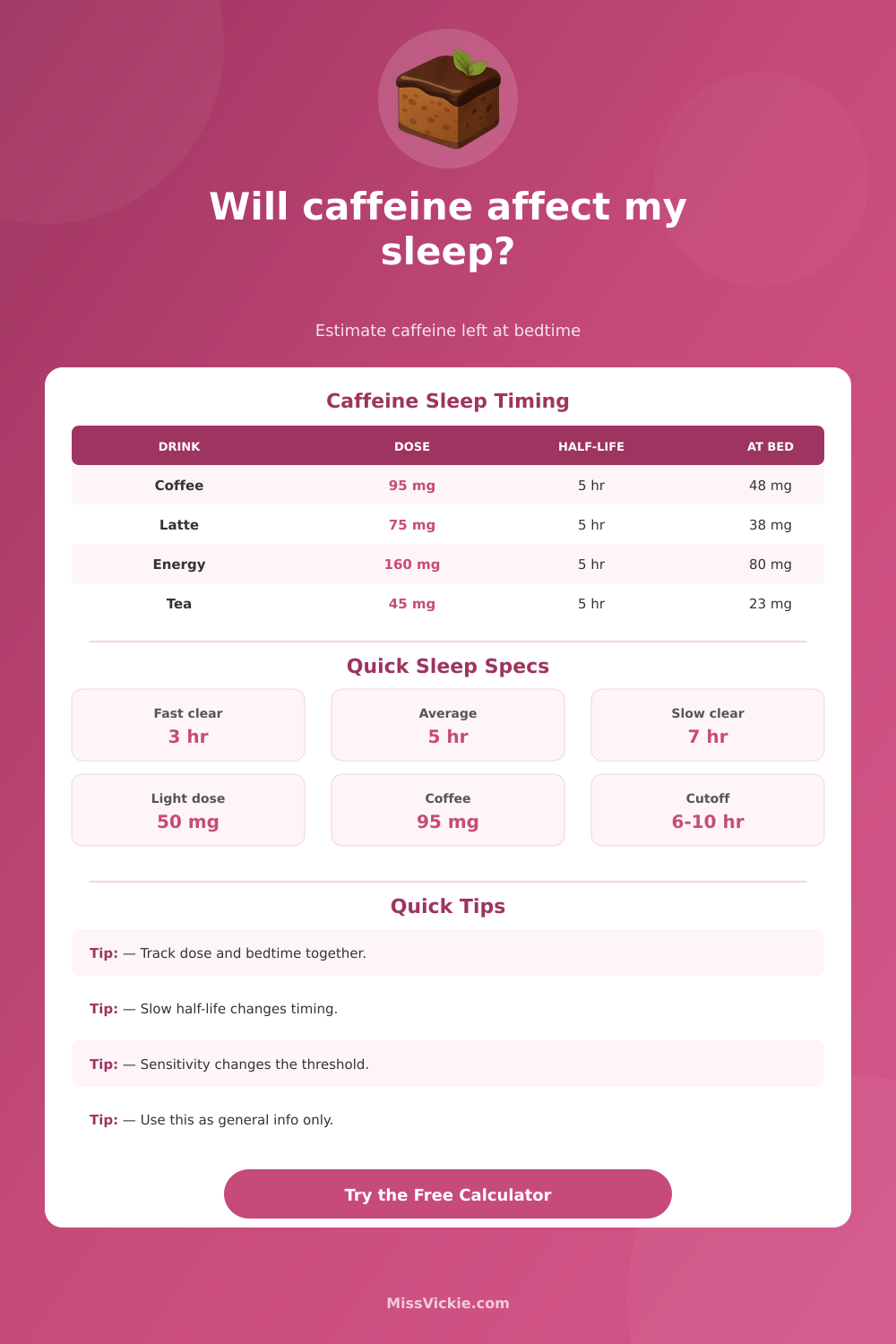
| Brewed coffee, 8 fl oz | 95 mg | 41 mg | Can still be near a moderate sleep target. |
| Espresso, 1 shot | 63 mg | 27 mg | Small dose, but evening timing still matters. |
| Cold brew serving | 150 mg | 65 mg | Higher dose pushes cutoff earlier. |
| Energy drink can | 160 mg | 70 mg | Often needs a wider bedtime buffer. |
| Black tea mug | 47 mg | 20 mg | Lower dose, but sensitive sleepers may notice it. |
| Decaf coffee | 5 mg | 2 mg | Usually small, though servings can add up. |
| Sensitivity Setting | Half-Life Adjustment | Default Sleep Target | Use When |
|---|---|---|---|
| Low sensitivity | 0.90x entered half-life | 60 mg | You rarely notice afternoon caffeine. |
| Typical sensitivity | 1.00x entered half-life | 40 mg | You want a middle-of-the-road estimate. |
| Sensitive sleeper | 1.18x entered half-life | 25 mg | Small evening amounts can feel stimulating. |
| Very sensitive sleeper | 1.35x entered half-life | 15 mg | You prefer a conservative caffeine buffer. |
| Dose | Target Remaining | 3 Hr Half-Life Cutoff | 5 Hr Half-Life Cutoff | 7 Hr Half-Life Cutoff |
|---|---|---|---|---|
| 50 mg tea or soda | 25 mg | 3.0 hr before bed | 5.0 hr before bed | 7.0 hr before bed |
| 95 mg coffee | 40 mg | 3.7 hr before bed | 6.2 hr before bed | 8.7 hr before bed |
| 150 mg cold brew | 40 mg | 5.7 hr before bed | 9.5 hr before bed | 13.3 hr before bed |
| 200 mg large drink | 40 mg | 7.0 hr before bed | 11.6 hr before bed | 16.3 hr before bed |
Caffeine take longer to leave the system than most people thinks. If you consume caffeine during afternoon, it may still be in your system late enough to interfere with your sleep. The body clears caffeine according to a schedule.
While each persons schedule are different, there are a variety of factor that influence that schedule. For example, age, medications, pregnancy, and smoking status can all impact how quickly the body clears caffeine. Thus, the half-life of caffeine is not the same for all individual, and the half-life of caffeine can change according to those different individual factors.
How Long Caffeine Stays in Your Body and Affects Your Sleep
Another critical factor that influences how caffeine affect sleep is the time that the caffeine is consumed. For instance, if an individual finishes a drink containing caffeine at 3pm, that caffeine will begin to decline in the system by 10pm. The decline of caffeine in the body is not, however, linear; more caffeine is cleared from the body during the first few hours after it is consume compared to later hours.
Additionally, if the person consumes the caffeine slowly over a period of time it will remain in the system for longer than if it was consumed quick. Furthermore, if the caffeine is consumed with food it will take longer for the caffeine to be absorbed into the system, meaning that its peak amount in the system will be reached later. The calculator that is provided on this page use mathematics to determine how much caffeine remains in the body at the target bedtime.
To use the calculator, an individual must enter information regarding the type of drink that contains the caffeine, the number of serving of that drink that were consumed, the start and finish times, the half-life of the caffeine, and the sensitivity level of the individual to the drink. The calculator will provide an estimate as to how much caffeine remains in the body at the target bedtime. Additionally, the calculator will also display how much earlier the individual would of had to stop consuming caffeine to limit its presence in the body to a specific threshold.
Tables are also provided on the page to display the amount of caffeine that can be found in various drinks in different amounts of caffeine, as well as the different speeds at which caffeine can be cleared from the system. Sensitivity to caffeine is another factor that can change the amount of caffeine that an individual can tolerate. For instance, an individual that is highly sensitive to caffeine may feel the effects of even small amount of caffeine, while an individual with low sensitivity to caffeine may not experience the effects of caffeine.
This sensitivity factor is used to adjust the half-life and the target number of milligrams of caffeine in the body. While not a medical diagnosis of sensitivity to caffeine, this adjustment allows the individual to determine if the cutoff time for caffeine intake is working for their sensitivity to the compound. There are a variety of factor in the body that may complicate the effects of caffeine on the body.
For instance, stress can increase the feeling of alertness in the body. Furthermore, if an individual consumes food late at night, it is possible that that late meal can mask the effects of caffeine. Additionally, the consumption of alcohol can affect the quality of an individual’s sleep.
For instance, if an individual consumes alcohol near bedtime, that alcohol can change the individual’s sleep patterns. Thus, any caffeine remaining in the body will have an effect upon sleep that is already fragile due to the alcohol consumption. These factor are not considered by the mathematical equation used in the calculator, but they may still have an impact upon the individual’s consumption of caffeine.
It is also a mistake to assume that each drink of caffeine is the same as every other drink of caffeine. For instance, an eight-ounce cup of brewed coffee may contain a different amount of caffeine than a twelve-ounce cup of cold brew coffee; the amounts can differ by more than fifty milligrams. Furthermore, drinks like energy drinks and tea contain different amounts of caffeine than coffee.
Additionally, chocolate desserts contain caffeine as well. Thus, the caffeine calculator can help an individual to calculate the total amount of caffeine that they have consumed by the time they wish to go to sleep; the calculator can be adjusted to account for these different type of drinks. It is also a mistake to assume that the half-life of caffeine is always the same.
For instance, if an individual experiences a very stressful day or begins a new medication it is possible that the half-life of caffeine changes; the body may require longer period of time to clear that caffeine. Thus, if an individual finds that caffeine that they typically consume at 4pm is having strong effects upon sleep, it is possible that the half-life of caffeine for that individual has changed due to some other factor. By altering the half-life factor in the caffeine calculator to reflect this new half-life an individual can find their new boundary for caffeine consumption.
Thus, the purpose of the calculator is to provide an understanding of how much caffeine remains in the system when the individual desires to sleep. There are a variety of method for managing caffeine intake. For instance, an individual can shift the time at which they consume caffeine to an earlier time of the day; they could also reduce the number of servings of caffeine that they consume, or they could choose to drink a beverage with less caffeine during the afternoon.
These changes are easier to make with caffeine calculator than without; the calculator allows the individual to estimate how much caffeine remains in their system compared to the amount of caffeine that they may otherwise intuitively believe remains. Furthermore, the same logic can be applied to the amount of caffeine that is consumed in the morning; since the body has had time to clear the caffeine after it is consumed during the morning, most adults are capable of consuming coffee in the morning without any sleep deprivation caused by caffeine. Thus, the caffeine calculator may be used in the morning as well; caffeine after an interval of ten or twelve hours will leave the system, leaving very little caffeine in the body; this can reduce the amount of concern that an individual has regarding caffeine consumption in the morning.
Thus, the caffeine calculator allows an individual to determine what combination of beverages containing caffeine will have the least amount of effect upon sleep, and to test various combinations against bedtime.