Flour, water, preferment, style, and baker percentages
Dough Hydration Calculator
Calculate actual hydration, target water, preferment contribution, oil, sugar, salt, yeast, and total dough weight for bread, pizza, sourdough, focaccia, ciabatta, and enriched dough.
Load a realistic dough setup, then adjust the flour, water, starter, flour type, dough style, and target hydration for your recipe.
Dough Breakdown
These cards treat total flour as 100%, including the flour already inside your preferment.
Firm dough, strong kneading, shiny crust after boiling.
Elastic dough that stretches without flowing across the bench.
Soft dough with enough strength for a fine, even crumb.
Moderate tackiness, open scoring, and crisp lean crust.
Higher hydration for a chewy crumb and longer fermentation.
Slack dough, oil-rich pan, and dimples before baking.
Very wet dough with folds, bubbles, and minimal shaping.
Sticky handling because rye binds water differently than wheat.
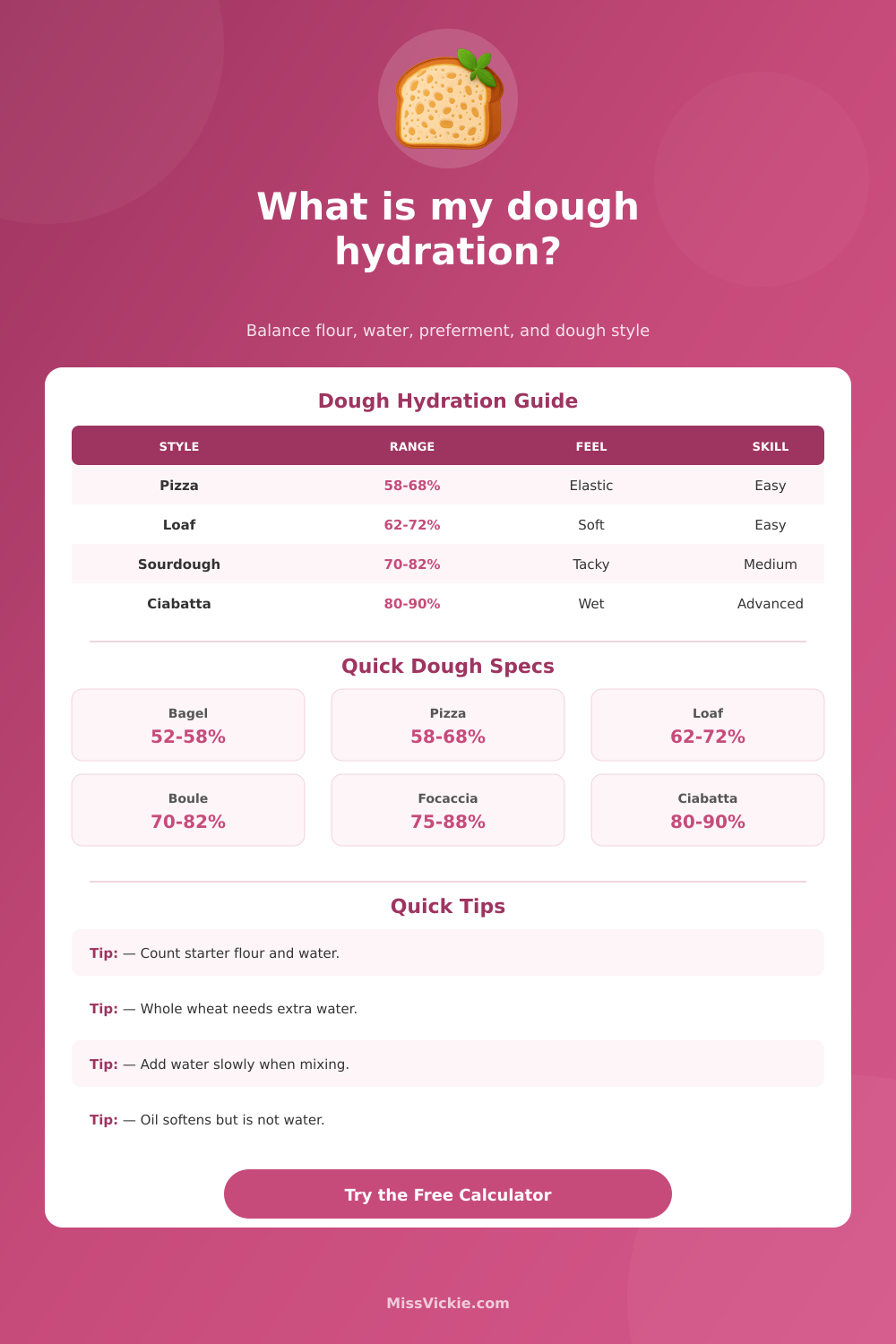
| Dough Style | Typical Hydration | Mixing Feel | Best Use |
|---|---|---|---|
| Bagel or pretzel dough | 52% to 58% | Firm, dry, high resistance | Boiled doughs, tight crumb, chewy bite |
| Neapolitan or thin pizza | 58% to 65% | Elastic, smooth, slightly tacky | Hand-stretched pizza with defined edge |
| Sandwich loaf | 62% to 72% | Soft, supple, easy to shape | Pullman, pan loaf, rolls, buns |
| Baguette | 65% to 75% | Tacky but still shapeable | Lean crusty loaves and batards |
| Country sourdough | 70% to 82% | Sticky early, stronger after folds | Open crumb artisan boules |
| Pan pizza | 68% to 78% | Soft and extensible | Oiled pans, Detroit, Sicilian, grandma style |
| Focaccia | 75% to 88% | Wet, bubbly, pourable after proof | Sheet-pan bread with dimples and olive oil |
| Ciabatta | 80% to 90% | Very wet, fold-driven strength | Rustic slippers, open holes, crisp crust |
| Flour Type | Water Adjustment | Why It Changes | Practical Note |
|---|---|---|---|
| All-purpose flour | Baseline | Moderate protein and moderate absorption | Good starting point for sandwich loaves and basic pizza |
| Bread flour | Add 2 to 4 points | More protein can hold more water | Often feels tighter than all-purpose at the same hydration |
| High-gluten flour | Add 4 to 7 points | Strong gluten network absorbs and traps more water | Useful for bagels, New York pizza, and long cold ferments |
| Tipo 00 flour | Reduce 1 to 3 points | Fine milling and low bran can feel softer sooner | Keep hydration moderate unless the flour is very strong |
| Whole wheat blend | Add 5 to 10 points | Bran and germ compete for water | Autolyse helps the dough soften before kneading |
| Rye blend | Add 6 to 12 points | Pentosans bind water but do not build elastic gluten | Expect stickiness even when the dough is properly hydrated |
| Spelt blend | Add 1 to 4 points | Absorbs water quickly but has delicate gluten | Mix gently and avoid chasing strength with extra flour |
| Gluten-free bread blend | Add 8 to 18 points | Starches, gums, and psyllium need longer hydration | Hydration may look like batter before it sets |
| Preferment Type | Common Hydration | Flour Share In 200 g | Water Share In 200 g |
|---|---|---|---|
| Liquid levain or 100% starter | 100% | 100 g flour | 100 g water |
| Poolish | 100% | 100 g flour | 100 g water |
| Stiff levain | 60% | 125 g flour | 75 g water |
| Biga | 50% to 60% | 125 to 133 g flour | 67 to 75 g water |
| Wet sponge | 125% | 89 g flour | 111 g water |
| Rye sour | 80% to 100% | 100 to 111 g flour | 89 to 100 g water |
| Ingredient | Typical Baker % | Effect On Dough | Adjustment Cue |
|---|---|---|---|
| Water | 52% to 90% | Controls extensibility, openness, and stickiness | Change in small 2% to 3% steps |
| Salt | 1.8% to 2.5% | Strengthens gluten and balances flavor | Reduce slightly for salty toppings or fillings |
| Oil or butter | 0% to 10% | Tenderizes crumb and slows drying | Oil is baker percentage but not hydration |
| Sugar or honey | 0% to 8% | Feeds browning and softens crumb | High sugar slows fermentation |
| Instant yeast | 0.05% to 2% | Sets proofing speed for yeasted dough | Use less for cold proof and more for same-day dough |
| Prefermented flour | 5% to 35% | Adds flavor, acidity, and fermentation momentum | High preferment may need cooler or shorter bulk time |
Dough hydration refers to the ratio of flour to water in a dough recipe. Dough hydration is one of the main factors that will determine the behavior of the dough. If you change the amount of water within a dough recipe, the dough will change.
If you change the amount of flour within a dough recipe, the dough will change as well. People often attempt to treat dough hydration with a single number. However, dough hydration are a balance of three component within the dough: flour, water, and other ingredients.
What is dough hydration
The balance of flour and water will impact the feel of the dough when one touches it, as well as the appearance of the finished bread or pizza. One of the components of dough that people should remember is that the flour contain water. Therefore, any hydration calculations for dough must also include the water content of the flour.
If people use preferments in the dough, such as sourdough starter or poolish, more flour and more water will be added to the dough. A sourdough starter, for example, typically contains equal weight of flour and water. Thus, an addition of sourdough will contribute to both flour and water to the recipe.
A calculator can separate flour from the preferment and the water from the preferment. If people fail to account for the water content of the sourdough starter, the hydration percentages will be incorrect for the recipe and the recipe will fail to bake proper. The type of flour that people use will impact the hydration of the dough.
Bread flour contains more protein than all-purpose flour. Consequently, bread flour can hold more water than all-purpose flour. Additionally, whole wheat flour and rye flour contain bran and pentosans.
These ingredient will hold more water than white flour. People can use the tool to select the flour that they will use in their recipe and the tool will alter the amount of water that is needed in the recipe. If people replace bread flour with a whole wheat flour blend, the dough will feel tighter or wetter.
Other ingredients, such as oil, sugar, and salt, dont impact the hydration percentage of the dough. However, they do have an impact on the dough. Oil will allow the dough to tenderize and will impact the staling process of the dough.
However, it does not impact the hydration percentage. Sugar will impact the browning of the dough and the softening of the crumb. Salt will strengthen the gluten in the dough and impact the rate at which it ferment.
These percentages can be seen in the calculator so that people can adjust the dough without impacting the hydration of the recipe. Different types of bread requires different hydration levels for the dough. Sandwich loaves, for instance, may have a hydration level of the low sixties while a ciabatta recipe may have a hydration level of the eighties.
These percentages are required in the recipes because the hydration level will impact the crumb of the bread and how it can be handled. The presets for different bread styles will allow people to select how much the hydration levels should be changed from the target hydration level. The comparison grid for different dough types will show the differences in their hydration level.
For instance, people can see why bagel dough may be firm while focaccia dough is more slack. Rye dough blends typically contain ingredient that will make the dough feel sticky when it is tested. Consequently, extra water may be required for these recipes to allow for proper mixing of the dough.
Additionally, the hydration levels of the dough will impact the way in which the dough is handle once it is on the bench. For instance, ciabatta dough will require folding while bagel dough will require kneading. The calculator will help with the mathematics of the recipe so that people can focus on their dough.
Other components to consider when calculating the hydration levels of the dough is the bench flour and the handling loss. Bench flour is that portion of flour that remains on the counter while people are mixing the dough. Handling loss is that portion of flour that adheres to the bowl in which the dough is mixed.
A small percentage of bench flour can be added to the recipe so that the total weight of the dough is accurate. The total weight of the dough is important for people who would like to produce a specific amount of dough. The calculator will provide a breakdown of all of the ingredient for the dough.
People can see the amount of flour that came from the preferment, the amount of water that is needed to reach the target hydration levels, and the total weight of the dough. This breakdown prevents people from adjusting one ingredient and changing the remaining ingredient of the recipe. While dough hydration percentages provide a good start for creating dough, people will need to use their own judgment for recipes that contain whole grain or gluten-free ingredients.
Dough that contains whole grains or gluten free ingredients will appear wet when first prepared but may tighten with time due to the absorption of water by the bran. While the tool will provide the baseline for the recipe, people will need to use there hands to determine if more water is needed for the dough. With experience with the tool, people will begin to recognize the impact that the weight of the preferment will have upon the hydration of the dough.
If the sourdough starter that is used is wet, it will increase the hydration levels of the recipe. If people add oil to the dough, it will allow for the dough to be more supple. However, oil will not impact the hydration percentage of the dough.
Understanding these relationship with each ingredient will provide people an understanding of how to adapt the recipe according to the type of flour that is used or the type of preferment that is selected.