Age target, diet pattern, food sources, supplement label, and sun-equivalent estimate
Vitamin D Calculator
Estimate general vitamin D coverage from foods, supplements, and a cautious sun-equivalent estimate, then compare it with age and life-stage targets.
Choose a realistic starting pattern, then adjust the food, supplement, and sun fields. This is general nutrition information only, not medical advice or a deficiency diagnosis.
Vitamin D Breakdown
High natural food source; amount varies by type.
Useful oily fish source in mixed diets.
Milk or fortified plant drink, label dependent.
Plant-forward source when UV-treated.
Small but common food contribution.
Fortified breakfast foods vary by label.
Common supplement label amount.
Not intake; shown as cautious equivalent credit.
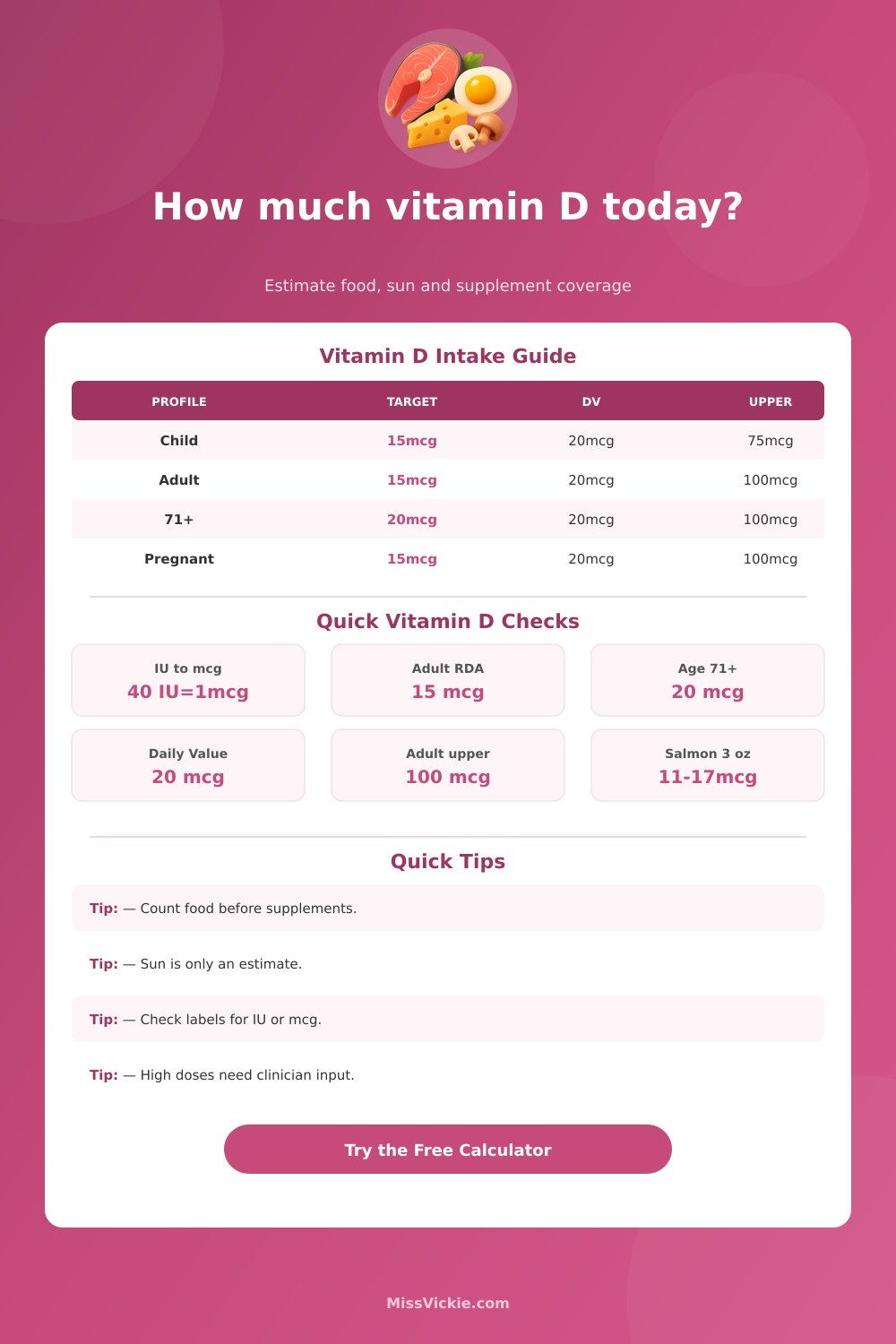
| Age Or Life Stage | RDA Or AI | IU Equivalent | Planning Note |
|---|---|---|---|
| Infants 0-12 months | 10 mcg AI | 400 IU | Use pediatric guidance for supplements. |
| Children 1-8 years | 15 mcg RDA | 600 IU | Same RDA as older children, lower upper limit. |
| Teens 9-18 years | 15 mcg RDA | 600 IU | Growth years often rely on fortified foods. |
| Adults 19-70 years | 15 mcg RDA | 600 IU | Compare labels with the 20 mcg Daily Value too. |
| Adults 71+ years | 20 mcg RDA | 800 IU | Higher target because vitamin D needs rise with age. |
| Pregnant or breastfeeding | 15 mcg RDA | 600 IU | Use prenatal labels and clinician advice for dosing. |
| Age Group | Upper Limit | IU Equivalent | What It Means |
|---|---|---|---|
| Infants 0-6 months | 25 mcg | 1000 IU | Do not exceed without pediatric guidance. |
| Infants 7-12 months | 38 mcg | 1500 IU | Formula, drops, and foods should be counted. |
| Children 1-3 years | 63 mcg | 2500 IU | Supplement labels matter more than food totals. |
| Children 4-8 years | 75 mcg | 3000 IU | Check gummies and multivitamins together. |
| Age 9+ years | 100 mcg | 4000 IU | Includes adults, pregnancy, and breastfeeding. |
| Food Source | Typical Serving | Vitamin D Estimate | Best Fit |
|---|---|---|---|
| Cooked salmon | 3 oz | 11-17 mcg / 440-680 IU | Mixed and pescatarian diets. |
| Rainbow trout | 3 oz | About 16 mcg / 640 IU | High natural source. |
| Canned light tuna | 3 oz | About 1 mcg / 40 IU | Pantry meals and salads. |
| Fortified milk or plant drink | 1 cup | About 2.5-3 mcg / 100-120 IU | Daily routine source. |
| UV-exposed mushrooms | 1/2 cup | About 8-10 mcg / 320-400 IU | Vegetarian and vegan meals. |
| Large egg | 1 egg | About 1 mcg / 40 IU | Small steady contribution. |
| Fortified cereal | 1 serving | About 2 mcg / 80 IU | Label-dependent fortified source. |
Food values vary by product, species, fortification, and serving size. Use package labels when available.
| Sun Field | Low Setting | Moderate Setting | Calculator Treatment |
|---|---|---|---|
| Exposure strength | Minimal to low exposed skin | Moderate arms and face | Creates a capped mcg-equivalent estimate. |
| Season and latitude | Winter, high latitude, mostly indoor | Summer or lower latitude | Reduces or increases the sun credit multiplier. |
| Outdoor minutes | 0-10 minutes | 15-30 minutes | Long sessions are capped for conservative planning. |
| Safety note | Sunburn is not needed | Shade and sunscreen still matter | Sun credit is not counted as food intake. |
Question 2: Why is it important to know how much vitamin D you consume daily? Although many peoples is aware of the importance of vitamin D for the body, many individuals are unaware of the amount of vitamin D that they consumes daily. Such uncertainty in the vitamin D intake for many individuals is typicaly exhibited during the winter month, or after a blood test reveals that an individual have low levels of vitamin D in there system.
To help individuals understand the amount of vitamin D that they consume each day, calculators are available online that can help individuals to determine their daily intake of vitamin D. Such a calculator will ask individuals to provide information regarding their age, life stage, diet pattern, food intake, supplement intake, and amount of sunlight exposure. The age of an individual is one of the factors that is considered in the estimation of an individual’s vitamin D intake because the needs of the body for vitamin D change as the individuals ages. For instance, individuals experience an increase in the needs for vitamin D after the age of seventy, due to the decreased ability of the skin of older individuals to produce vitamin D from the sunlight exposure.
Why You Need to Know How Much Vitamin D You Get Each Day
Additionally, individuals’ life stage can impact the vitamin D intake that an individual need to consume daily. For instance, individuals who is pregnant or breastfeeding require additional vitamins, and the prenatal vitamins that those individuals take contain a certin amount of vitamin D.
An individual’s diet pattern is one of the factors that will impact the amount of vitamin D that an individual consumes daily. For instance, individuals who follow a pescatarian diet pattern will consume more vitamin D then individuals who follow a vegan diet pattern.
Additionally, individual are required to input the amount of vitamin D that they consume from food sources. Foods that contain vitamin D include oily fish, fortified drinks, fortified cereals, eggs, and UV mushrooms. Each of these food source will have vitamins that is multiplied by the amounts of those products that the individual consumes each day.
Additionally, the vitamin D intake that is calculated from food also must be adjusted according to a diet factor that takes into account the number of food sources from which an individual consumes their vitamins. The amount of vitamin D that is consumed from supplements must also be entered into the calculator. The amount of vitamin D from the supplement should be entered, as well as the amount of day each week that the supplement is taken.
Additionally, the amount of vitamin D from sunlight exposure can be entered into the calculator; however, sunlight exposure can vary from individual to individual, and may be difficult to determine. For example, individuals who live at high latitudes may recieve very little sunlight throughout the year. Additionally, individuals who live near the poles will have less sunlight exposure than those who live near the equator.
Furthermore, sunlight exposure that is entered into the calculator will likely not be the same as the amount of vitamin D that the body actualy ingests. For these reasons, the amount of vitamin D that can be ingested from sunlight is typically limited in these calculators for vitamin D intake. In addition to the questions that the individual entering the calculator must answer, reference tables are also provided on the calculator that provides information regarding the targets for vitamin D according to age, and the upper limit of vitamin D that individuals should consume each day.
Additionally, tables that describe the amount of vitamin D that is contained in certain food items will help individuals to more easy calculate their daily vitamin D intake. Additionally, mistakes can be made when calculating vitamin D intake, such as incorrectly treating sunlight as an input that is the same as food intake, or ignoring the need to average the vitamin supplement intake over the week. The structure of the calculator avoids these errors.
Additionally, there are other variables in the body that these calculators dont account for. For instance, the absorption of vitamin D from the body may change based off the amount of fat that an individual consumes during the day. Additionally, medications can alter how the body metabolizes vitamin D, as can other health conditions of the body.
The only true way to determine the amount of vitamin D that is in the body is through a blood test. Therefore, the calculator is a tool that can help individuals to determine whether any changes should of been made to their diets. Overall, vitamin D intake comes from a variety of sources, such as the diet, supplements, sunlight, and the bodys ability to synthesize the vitamin from precursors.