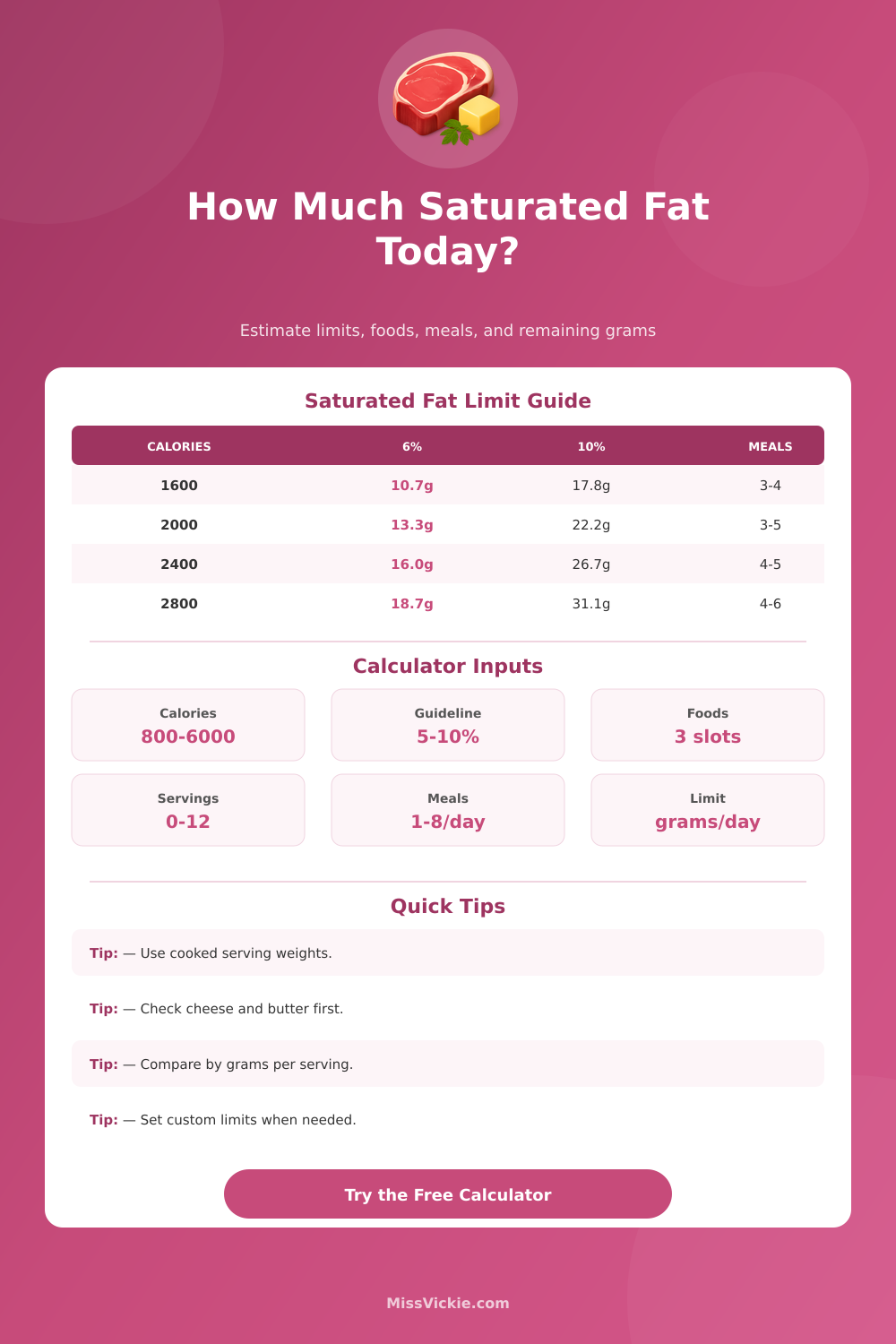
Calories, guideline percent, daily limit, meals, food entries, serving sizes, and remaining grams
Saturated Fat Calculator
Estimate a general daily saturated fat limit from calories, compare it with foods you enter, and split the remaining grams across meals or snacks.
Choose a common eating pattern, then adjust the calorie target, guideline percent, meal count, and food servings.
Saturated Fat Breakdown
| Guideline Setting | Percent Of Calories | 2,000 Calorie Limit | Best Use In This Calculator |
|---|---|---|---|
| Very low target | 5% | 11.1g saturated fat | A strict planning scenario for comparing lower-saturated-fat days. |
| Stricter pattern | 6% | 13.3g saturated fat | A conservative general-information target often used for heart-aware meal planning. |
| Moderate target | 7% | 15.6g saturated fat | A middle setting when you want a smaller cap than the broad 10% reference. |
| General limit | 10% | 22.2g saturated fat | A common dietary guideline ceiling for general adult meal planning. |
| Custom setting | 1% to 15% | Depends on calories | Use when a label, dietitian, clinician, or personal plan gives a specific number. |
| Food | Reference Serving | Sat Fat Estimate | Category Note |
|---|---|---|---|
| Butter | 14g tablespoon | 7.2g | Very dense; a small spoonful can use a large share of the day. |
| Cheddar cheese | 28g slice | 5.3g | Cheese portions are compact, so weighing helps. |
| Whole milk | 244g cup | 4.6g | Dairy drinks add up when used in coffee, cereal, and recipes. |
| Cooked ground beef | 85g portion | 5.9g | Lean percentage and drained fat change the final number. |
| Whole egg | 50g large egg | 1.6g | Moderate per egg, but multiple eggs change the total. |
| Olive oil | 14g tablespoon | 1.9g | Mostly unsaturated fat, but still contains some saturated fat. |
| Calories | 6% Daily Limit | 10% Daily Limit | Across 4 Meals At 6% | Across 5 Meals At 10% |
|---|---|---|---|---|
| 1,600 calories | 10.7g | 17.8g | 2.7g per meal | 3.6g per meal |
| 1,800 calories | 12.0g | 20.0g | 3.0g per meal | 4.0g per meal |
| 2,000 calories | 13.3g | 22.2g | 3.3g per meal | 4.4g per meal |
| 2,400 calories | 16.0g | 26.7g | 4.0g per meal | 5.3g per meal |
| 2,800 calories | 18.7g | 31.1g | 4.7g per meal | 6.2g per meal |
| Higher Sat Fat Choice | Lower Sat Fat Comparison | Typical Difference | Calculator Use |
|---|---|---|---|
| Butter, 14g | Olive oil, 14g | About 5.3g less saturated fat | Swap the food slot and keep the serving size steady. |
| Cheddar, 28g | Plain Greek yogurt, 170g | Often 4g to 5g less | Useful for sauces, bowls, and snacks. |
| Ground beef, 85g | Chicken breast, 85g | Often 5g less | Compare cooked serving weights in the food rows. |
| Coconut milk, 60g | Whole milk, 60g | Often 8g less | Small amounts of coconut milk can change the day total quickly. |
| Dark chocolate, 30g | Fruit or berries | Usually far lower | Use the dessert preset to test remaining allowance. |
Small servings can carry several grams of saturated fat before the meal is built.
Serving size matters because cheese is dense and milk portions can repeat daily.
Lean cuts, drained cooking fat, and egg count all shift the entered total.
Many choices are mostly unsaturated, though they still contain some saturated fat.
Saturated fat exist in many different foods. Saturated fat is a type of fat that is difficult for an individual to track without use of a specific tool. Many of the foods that contains saturated fat include cheese, butter, cooking oils, and milk.
Because saturated fat contributes to the total number of calories that an individual consumes, it is necessary for each individual to determine the number of grams of saturated fat that they would like to consuming each day. A saturated fat calculator can help an individual to determine the number of grams of saturated fat that they should consume each day. The calculator can be helpful in that it can take the percentage of calories that an individual desire from saturated fat and convert that percentage into a number of grams that can be compared with the grams of saturated fat contained in the foods that they would like to consume.
How to Use a Saturated Fat Calculator
To use the saturated fat calculator tool, an individual must first determine their target number of calories that they would like to consume each day. The number of calories that an individual consume each day is important because it determines the number of grams of saturated fat that an individual can consume with their chosen percentage of those calories. To calculate the grams of saturated fat that an individual should consume each day, the individual must multiply the number of calories that they wish to consume by the percentage of those calories that they would like to derive from saturated fat, and then divide that number by nine.
Each gram of fat contains nine calories, so dividing by nine allows an individual to find the number of grams of fat that contains the same number of calories as the number of calories that the individual calculated within the first step. The saturated fat calculator tool automatically calculate these two steps, saving the individual from having to manually calculate the number of grams of saturated fat that they should consume. The percentage of saturated fat that an individual desires to consume each day can also be adjusted.
If the individual desires to consume fewer gram of saturated fat each day, such as a percentage of five or six percent, then they will have fewer grams of saturated fat available for foods that are high in saturated fat. An individual can instead choose a higher percentage, such as ten percent, which will allow for the individual to consume more saturated fat each day, but which may make it easier for that individual to consume too much of the fat. For example, each percentage point may be associated with only a few grams of saturated fat, but a tablespoon of butter contain seven grams of saturated fat.
An individual can also use the tool to select the foods that they would like to consume, and to calculate how many gram of saturated fat that the food contains. Each food type can have the grams of the food entered, and the individual can select how many times that food will be consumed during the day. Multiplying the number of grams of the food by the amount of grams of saturated fat per gram of that food, and adding each of these numbers together will calculate the total grams of saturated fat that that individual will consume during the day.
This method for calculating the saturated fat that will be consumed is more accurate than estimate the amount of saturated fat that will be consumed by each food. This method requires the individual to use actual grams of the food. Additionally, this method allows the individual to easily see the impact that changing one food to another have upon the grams of saturated fat that will be consumed during the day.
An individual can view the amount of saturated fat that is left for that day after selecting the foods that they will consume. This amount of saturated fat can be distributed to each meal that will be consumed during that day, or it can be saved for foods like sauces, cooking fats, or snacks. Additionally, an individual can use the planning buffer percentage to reserve some of the saturated fat that they will consume during the day.
Using a planning buffer allows an individual to account for the fact that the grams of saturated fat listed on the nutrition label for foods may be rounded grams, the portions of food that may be consumed at a restaurant may differ from the grams of food that are measured at home, and the individual may need to prepare meals for others in addition to themselves. Using a planning buffer will allow the individual to not hit the limit of saturated fat grams that they will consume during the day on paper, but which they may need to exceed in actual meals that are prepare and consumed. The number of meals that an individual consumes during a day also play a role in how the saturated fat allowance will be used.
For example, if the individual chooses to spread the grams of saturated fat that are calculated for the individual to be consumed during three meals, then each meal will need to contain a greater amount of saturated fat than if that allowance was to be spread over five meals. Using this strategy for distributing the saturated fat allowance to each meal works well if the individual only prepares meals at home, but poses a risk for individuals who use restaurants to prepare some of the meals that they consume during the day. Some foods contain more grams of saturated fat than others.
Foods like butter and coconut milk are high in saturated fat. Cheese contains a relatively high amount of saturated fat grams in a relatively small portion of food. Lean meats and fish contains less saturated fat, but the number of grams of saturated fat that are consumed still depends upon the portion sizes of those foods, and the number of meals that contain those meats.
Olive oil also contains a small amount of saturated fat, so the more that an individual use olive oil in the cooking of meals, the more grams of saturated fat the individual will consume during that day. However, the saturated fat calculator does not account for the way that an individual may feel while consuming foods with specific amounts of saturated fat. For instance, if the individual sets their target for saturated fat grams to a very low amount, they may feel tired or weak throughout their day.
A medium amount of saturated fat grams may allow an individual to have some of the foods that are high in saturated fat, such as cheese or butter, during specific meals, while still allowing for flexibility in their schedule to consume those foods. An individual may use the style selector to account for the type of days that they may have. For example, if the individual will be going to restaurants during the day, or if they will be baking bread or desserts at home during the day, these different eating contexts may prompt the use of different settings within the tool to adjust the amount of saturated fat grams that will be consumed during the day.
The best way to use the saturated fat calculator is before the individual begins to eat during the day. By using the tool prior to eating, an individual can experiment with different foods and determine how many grams of saturated fat each food contains. Thus, an individual can make changes to their diet to ensure that they will consume no more than the amount of saturated fat that they calculated that they should consume during the day.
Such planning with the saturated fat calculator will allow the individual to establish a habit of checking the portions of the foods that they eat, and thinking in grams of saturated fat of those foods. Additionally, the tool allows an individual to experiment with portions of food without making each meal a math problem.