Calories, macro split, meal count, fat mix, cooking oil, and food style
Fat Intake Calculator
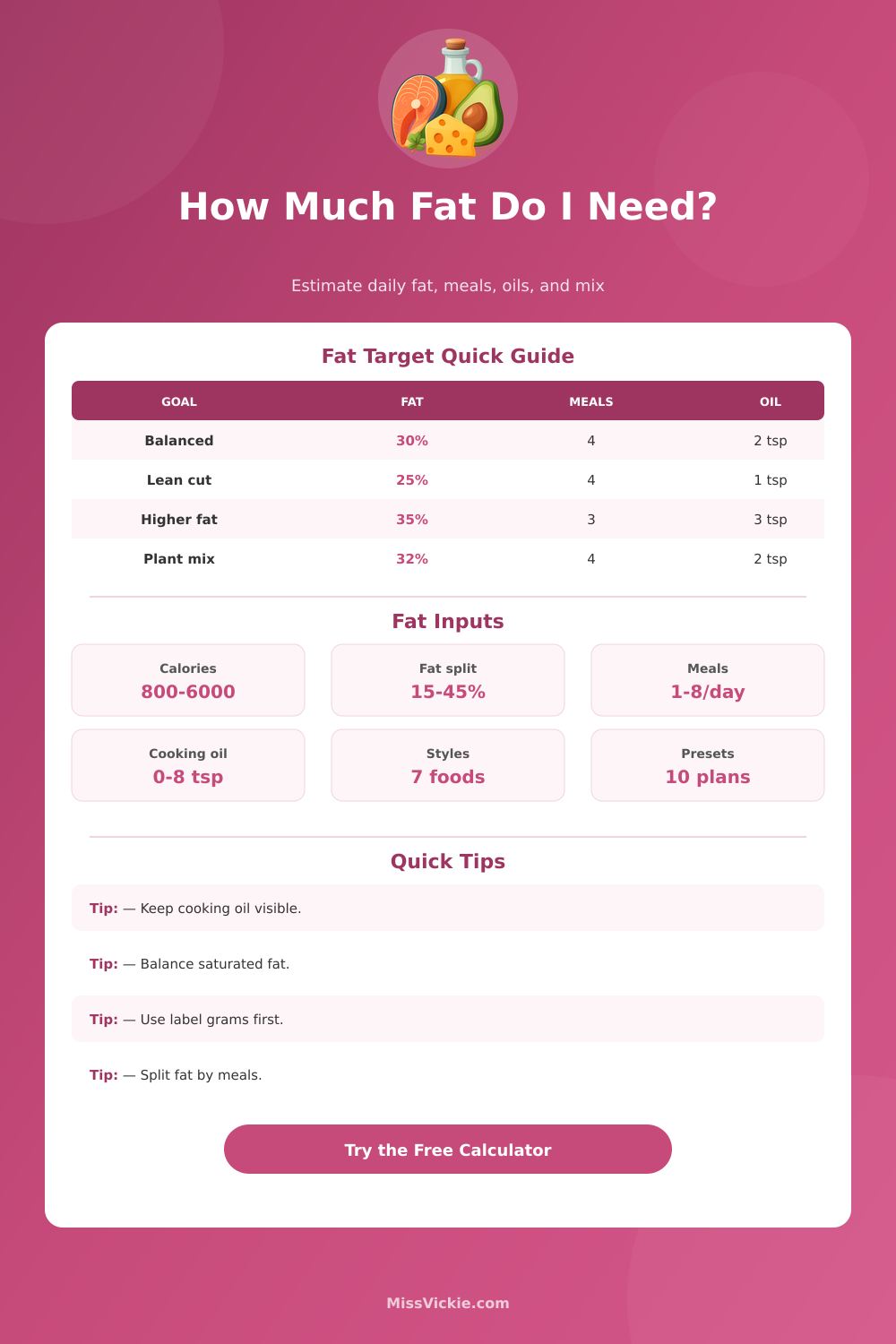
Estimate a daily fat target from calories, macro split, goal, meals, fat type mix, cooking fat, and common food style. This is general nutrition planning information.
Pick a common eating pattern, then adjust the numbers to match your own calorie target and cooking habits.
Fat intake breakdown
| Macro split | Calories from fat | Best planning use | Example at 2,000 kcal |
|---|---|---|---|
| Lean 20% | Lower fat lane | Useful when calories are tight and protein or carbs need more room. | 44 g fat |
| Moderate 25% | Middle-low lane | Often fits simple home meals with measured cooking oil. | 56 g fat |
| Balanced 30% | Classic mixed lane | A practical default for mixed meals, dairy, eggs, nuts, and oils. | 67 g fat |
| Higher 35% | Richer meal lane | Works when meals use more olive oil, avocado, nuts, or fattier proteins. | 78 g fat |
| Low carb 40% | High fat lane | Leaves less room for carbohydrate foods and needs intentional fiber planning. | 89 g fat |
| Cooking fat | Fat per teaspoon | Fat type tendency | Kitchen planning note |
|---|---|---|---|
| Olive oil | 4.5 g | Mostly monounsaturated | Good default for sauteing, salads, and roasted vegetables. |
| Avocado oil | 4.5 g | Mostly monounsaturated | Neutral flavor when you want less olive taste. |
| Canola oil | 4.5 g | Mixed unsaturated | Useful for baking, griddles, and mild dressings. |
| Butter | 4.0 g | Higher saturated | Count it clearly when spreading, baking, or finishing sauces. |
| Coconut oil | 4.5 g | Higher saturated | Flavorful, but it can use saturated fat room quickly. |
| Food style | Typical fat sources | Calculator effect | Best check |
|---|---|---|---|
| Mixed home meals | Eggs, dairy, oils, meat, sauces | Keeps the selected macro split close to neutral. | Measure cooking oil and spreads. |
| Mediterranean-style | Olive oil, fish, nuts, yogurt | Slightly favors unsaturated fat in the mix. | Watch poured oil and nuts. |
| Plant-forward | Avocado, seeds, nuts, tahini | Raises unsaturated target and lowers saturated estimate. | Use grams for nut butters. |
| Lean protein focused | Chicken, fish, low-fat dairy | Leaves more fat room for dressings and sides. | Do not forget marinades. |
| Restaurant or takeout | Hidden oils, cheese, frying fats | Adds a caution factor to cooking-fat share. | Assume more oil than home cooking. |
| Daily target | 3 eating slots | 4 eating slots | 5 eating slots |
|---|---|---|---|
| 45 g/day | 15 g each | 11 g each | 9 g each |
| 60 g/day | 20 g each | 15 g each | 12 g each |
| 75 g/day | 25 g each | 19 g each | 15 g each |
| 90 g/day | 30 g each | 23 g each | 18 g each |
| 105 g/day | 35 g each | 26 g each | 21 g each |
Common in olive oil, avocado, nuts, and many mixed meals.
Common in seeds, walnuts, seafood, soybean oil, and canola oil.
Often tracked as a calorie-percent guardrail for general planning.
Visible oil, butter, and spreads can use the daily target quickly.
Fat is an nutrient that can provide energy to your body and can make you feel a certain way throughout the day. Fat can also make you feel satisfied after eating a meal. When planning meals, it is important to consider the amount of calories that you will consume, the number of meals that you will consume, and the types of fat that you will use in the meals.
Fat have the ability to flavor meals and also slows the digestive processes. The amount of fat that you should consume can be calculated with the information about the number of calories that you need to consume daily. Your chosen macronutrient split will determine the percentage of your calories that should be from fat.
How to Count Fat in Your Meals
The amount of fat that you will consume from cooking will also be factored into this calculation. The calculator will display the total amount of fat that you will consume, the amount of fat from cooking, and the amount of fat that will remain for the remainder of your meals. The calculator will also provide an estimation of the amount of saturated fat and unsaturated fat that your body will be consume.
People often make mistakes when calculating there daily fat consumption. Using oil in cooking is easy to measure, but using oil in sauces that is added to food is more difficult. The cooking fat field in the calculator allows individuals to decide how much fat they will use in cooking.
If the amount of fat used in cooking is too high, the amount of food that can be consumed is low. Therefore, individuals must decide how much fat they want to use in cooking to ensure they have enough fat gram for the other foods that they plan to consume. Food style can alter the amount of fat that is consumed by an individual.
For instance, individuals who choose a Mediterranean-style diet will consume more olive oil and fish, which contain unsaturated fats. Diets that contain alot of takeout food will contain more fat. The food style that is chosen will be factored into the calculation of the amount of fat that will be consumed.
Although these are not rules that must be followed, they do help individuals to understand the effect that food style has on fat consumption. The saturated fat guardrail will give individuals an estimation of the amount of saturated fat that will be consumed by the body. This does not contain a limit on the amount of saturated fat, but it will provide an estimate of the ceiling of the amount of saturated fat that should be consumed by an individual.
Knowing the amount of saturated fat that will be consumed is useful for individuals to decide between different fats. For instance, they may opt for butter rather than olive oil. The saturated fat will be displayed for individuals to determine if they need to consume lighter meals or if the current amount of saturated fat is acceptable for their body.
The total amount of fat grams that are calculate should be divided by the number of meals that are consumed daily. If an individual eats four meals daily, the total fat grams will be divided by four. If an individual eats three meals daily, the total fat grams will be divided by three.
Dividing the total fat grams by the number of meals that are to be consumed is important because the fat is not even throughout all food. Some meals will contain more fat grams than others. If the percentage of fat that is consumed is increased, the amount of calories that can be obtained from carbohydrates is decreased.
If the percentage of fat is decreased, the amount of calories that can be obtained from carbohydrates, produce, or grain is increased. Although the goal field will allow individuals to select the fat percentage that they consume, the individual must make the final decision. If an individual consumes packaged foods, the fat that is contained in those foods should be entered into the calculator.
The amount of fat from packaged food will show individuals how much fat that is already consume by the body. The remainder of the fat is usable for food that is cooked or eaten that does not contain fat. If individuals dont enter the fat content from packaged foods, they may consume too much fat.
Many individuals make mistakes with the calculator by attempting to hit the target of the fat that they will consume. The amount of fat that is consumed can be a few grams more or less than the target that the calculator calculates. It is not necessary for the fat to be hit exactly.
Instead, the focus should be on ensuring that the fat content in cooking is measured, and the amount of saturated fat that is consumed is within the limit of what is healthy for the individual. The calculator will help individuals to understand these variable, but it is not the tool that they should use for perfect precision in the diet. The calculator will provide individuals with the fat that they should consume daily.
If the number of fat grams that are to be consumed per meal is too low, individuals can change the number of meals that they eat or the percentage of the calories that come from fat. If the amount of fat grams that are used in cooking is too high, individuals can use more precise measurement of the oil that is used in the cooking. These changes to the meal plan will allow the individual to stick to there target of fat grams daily.
By aligning the cooking fat, food style, and the number of meals that are to be consumed, the number of fat grams that are calculated daily can become the guide for an individual diet.