Total carbs, fiber grams, servings, meal totals, net carbs, and food-label comparison
Carb To Fiber Ratio Calculator
Compare a food or meal by dividing total carbohydrate grams by dietary fiber grams, estimating net carbs, and checking how the result lines up with common food categories.
Choose a common food profile, then adjust the label numbers, servings, category, and meal fields to match the item you are reading.
Calculation Breakdown
Beans, peas, and lentils often bring high fiber with steady total carbs.
Non-starchy vegetables are usually fiber-rich for their carb load.
Whole fruit varies by type, serving size, skin, and seeds.
Oats and whole wheat usually compare better than refined grains.
Fiber can be high, but calories and serving size change context.
Vegetables and beans lower the ratio; rice, bread, and sauces raise it.
Check the actual label because added fiber varies widely.
White rice, white bread, and many sweets often have little fiber.
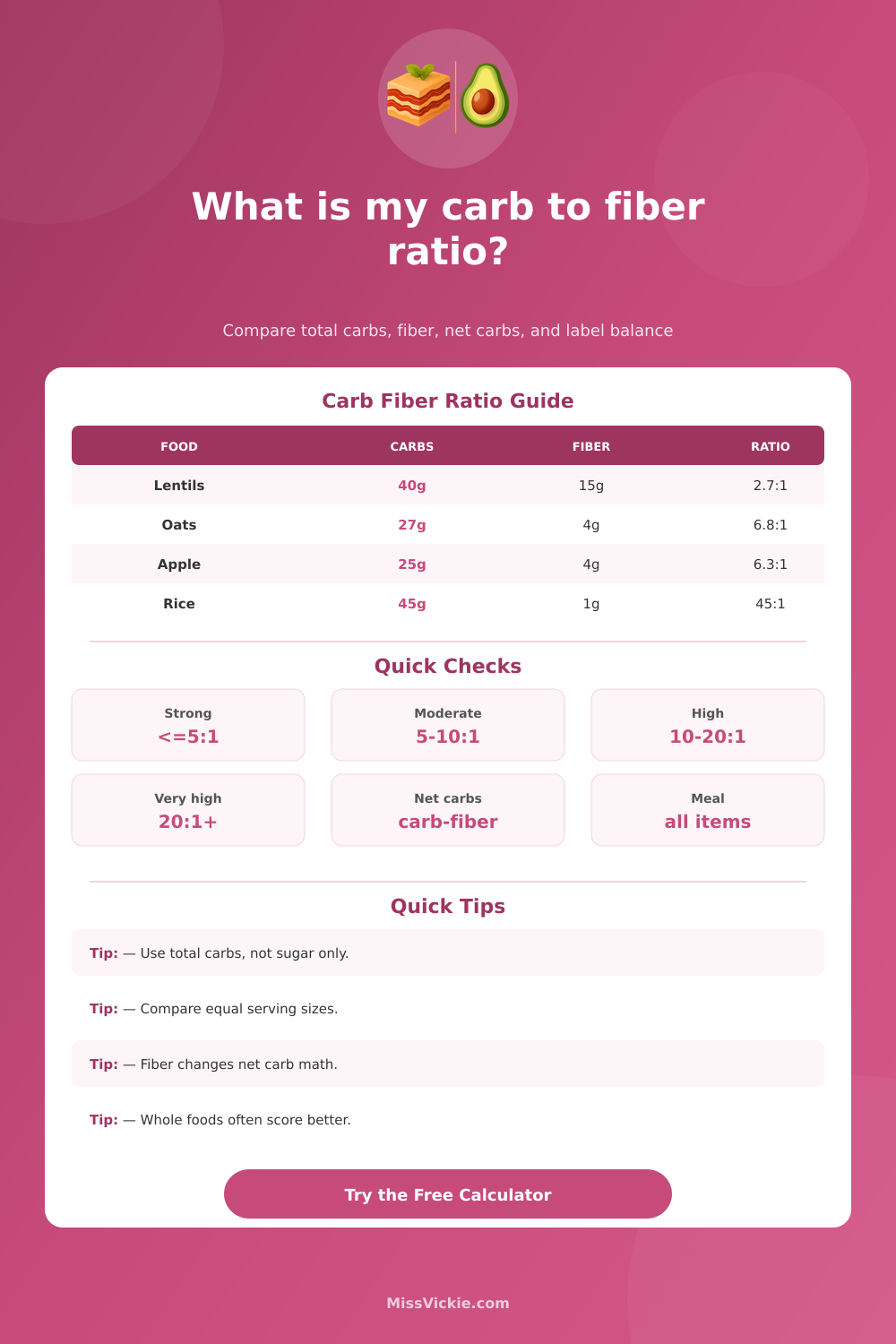
| Ratio Band | Carb To Fiber Result | General Meaning | Label Reading Note |
|---|---|---|---|
| Fiber-rich | Under 5:1 | High fiber relative to carbohydrate grams | Common with legumes, seeds, many vegetables, and some berries. |
| Moderate | 5:1 to 10:1 | Useful fiber but more carb-heavy | Common with oats, whole fruit, and many whole-grain foods. |
| Carb-forward | 10:1 to 20:1 | Carbs dominate the label more than fiber | Often seen in breads, cereals, snacks, and mixed meals. |
| Low-fiber carb | Over 20:1 | Very little fiber for the total carbohydrate load | Typical of white rice, refined flour foods, sweet drinks, and sweets. |
| Food Type | Typical Serving | Total Carbs | Typical Fiber Range |
|---|---|---|---|
| Cooked beans or lentils | 1 cup | 35 to 45 g | 12 to 16 g, often a strong ratio |
| Cooked oatmeal | 1 cup | 25 to 30 g | 4 to 5 g, often moderate |
| Whole fruit | 1 medium piece | 15 to 30 g | 3 to 6 g, depends on type and skin |
| Cooked brown rice | 1 cup | 44 to 50 g | 3 to 4 g, usually carb-forward |
| White rice or refined pasta | 1 cup | 40 to 45 g | 1 to 3 g, often low-fiber |
| Label Field | How The Calculator Uses It | Formula | Watch Point |
|---|---|---|---|
| Total carbohydrate | Starts the ratio and meal total | Total carbs divided by fiber | Use total carbs, not only sugar or starch. |
| Dietary fiber | Lowers the ratio and the net carb estimate | Total carbs minus fiber | If fiber is higher than carbs, the calculator caps net carbs at zero. |
| Servings counted | Scales label values into a meal total | Serving value times servings | Useful when eating more or less than one label serving. |
| Other meal items | Adds side dishes, sauces, drinks, or toppings | Scaled label values plus other meal values | Meal ratio can change quickly when a low-fiber side is added. |
| Sugar alcohols | Optional net carb adjustment only | Total carbs minus fiber minus selected sugar alcohols | Use only when the label clearly lists the amount. |
| Preset | Carbs | Fiber | Why It Compares That Way |
|---|---|---|---|
| Black beans | 40.8 g | 15 g | Legume fiber keeps the ratio strong even with meaningful carbs. |
| Lentil soup | 32 g | 11 g | Broth and legumes produce a fiber-rich meal estimate. |
| Oatmeal bowl | 27 g | 4 g | Moderate ratio, often improved by berries, chia, or flax. |
| Whole wheat pasta | 37 g | 6.3 g | Better than refined pasta, but still grain-forward. |
| White rice | 45 g | 0.6 g | High carb total with very little fiber per serving. |
Despite the fact that two foods may contains the same amount of total carbohydrates, the effect that the carbohydrates have on the body can be different from food to food. One food may make a person feel full for a long time after eating the food, while another food that contains the same amount of carbohydrates may make a person feel hungrier again very quick after eating the food. The difference between these two foods is the amount of fibers that is present in that food.
The fiber-to-carbohydrate ratio is one way to indicate the relationship between these two component of the foods. The fiber-to-carbohydrate ratio is important in that fiber play a role in the digestion of the carbohydrates that the body consume. Fiber slows the digestion of the food by the body, which helps to prevent blood sugar levels from rising too quick after eating the food.
Understanding the Fiber-to-Carbohydrate Ratio
Additionally, fiber add bulk to the food that is eaten, which makes a person feel full after eating that food. Foods that contain a low amount of fiber will move quickly through the digestive system of the body, and may not provide the same amount of energy to the body as foods that contain more fiber. For instance, foods like white rice and lentils may contain the same amount of carbohydrate as each other, but lentils contain more fiber than white rice.
Therefore, the lentils will have a different effect on the body than the white rice. In order to understand the fiber to carbohydrate ratio of a food, it is first important to understand each of the different input variable for that ratio. One of the variables is the amount of total carbohydrates that is contained in the food.
Another variable is the amount of dietary fiber that is contained in that food; this number can be subtracted from the total carbohydrates to find the amount of net carbohydrates in the food. In addition to these two variables, it is also important to consider the serving size of the food. Many person dont consume the amount of food of the stated serving size on the label.
If the serving size changes, the total carbohydrates and total dietary fiber will change, which will change the ratio of those two components in the food. Finally, it is also important to consider the other items that are consume with the food; adding other items to a meal will also change the total dietary fiber and carbohydrate content of that meal. The results of the fiber-to-carbohydrate ratio can be classified into different bands.
Foods that have a ratio of less than 5 to 1 are foods like legumes, vegetables, and fruits. Foods that have a ratio between 5 to 1 and 10 to 1 are foods like oatmeal and whole grain. Foods that have a ratio higher than 20 to 1 are foods like refined starch.
These bands help to show where a specific food fall in comparison to others. While these bands can help individuals understand the fiber to carbohydrate ratio of the foods that they eat, they do not tell a person if that food is good or bad for the body. One common mistake that individuals makes with the fiber-to-carbohydrate ratio is to consider the ratio of only one food that is eaten.
Instead, individuals should also consider the other food items that are consumed with that food. For instance, while a food like lentil stew may have a high fiber-to-carbohydrate ratio, adding foods with little fiber like white rice will lower the ratio of that meal. Therefore, individuals should use the field for meal components in the calculation of the ratio.
Additionally, when comparing two packaged foods, individuals should ensure that the serving size are the same for both foods. In addition to the fiber-to-carbohydrate ratio, there are other variables that affect how the body respond to the food that it consumes. For instance, the way in which the food is cooked will alter the rate at which the body break down the carbohydrates in that food.
Additionally, the ripeness of the food will alter the amount of fiber and carbohydrate content of that food. Finally, the meal that is prepared at home can contain ingredient that are not listed on the food label. Each of these variables indicate that the fiber-to-carbohydrate ratio is just one piece of information about the foods that are consumed.
The ratio is not the final word on the impact of food on the body; other factor like the fat and protein content in the food also impact the body in the same meal. If individuals become familiar with the fiber-to-carbohydrate ratio, they may begin to seek foods that contain more fiber than those that do not. Foods that contain fiber and carbohydrates include bean, vegetables, and whole grains.
While the goal is not to eat foods with the lowest ratio of fiber to carbohydrates, understanding the impact that food have on the body allows individuals to automatically recognize the ratio of fiber to carbohydrates in foods and meals.