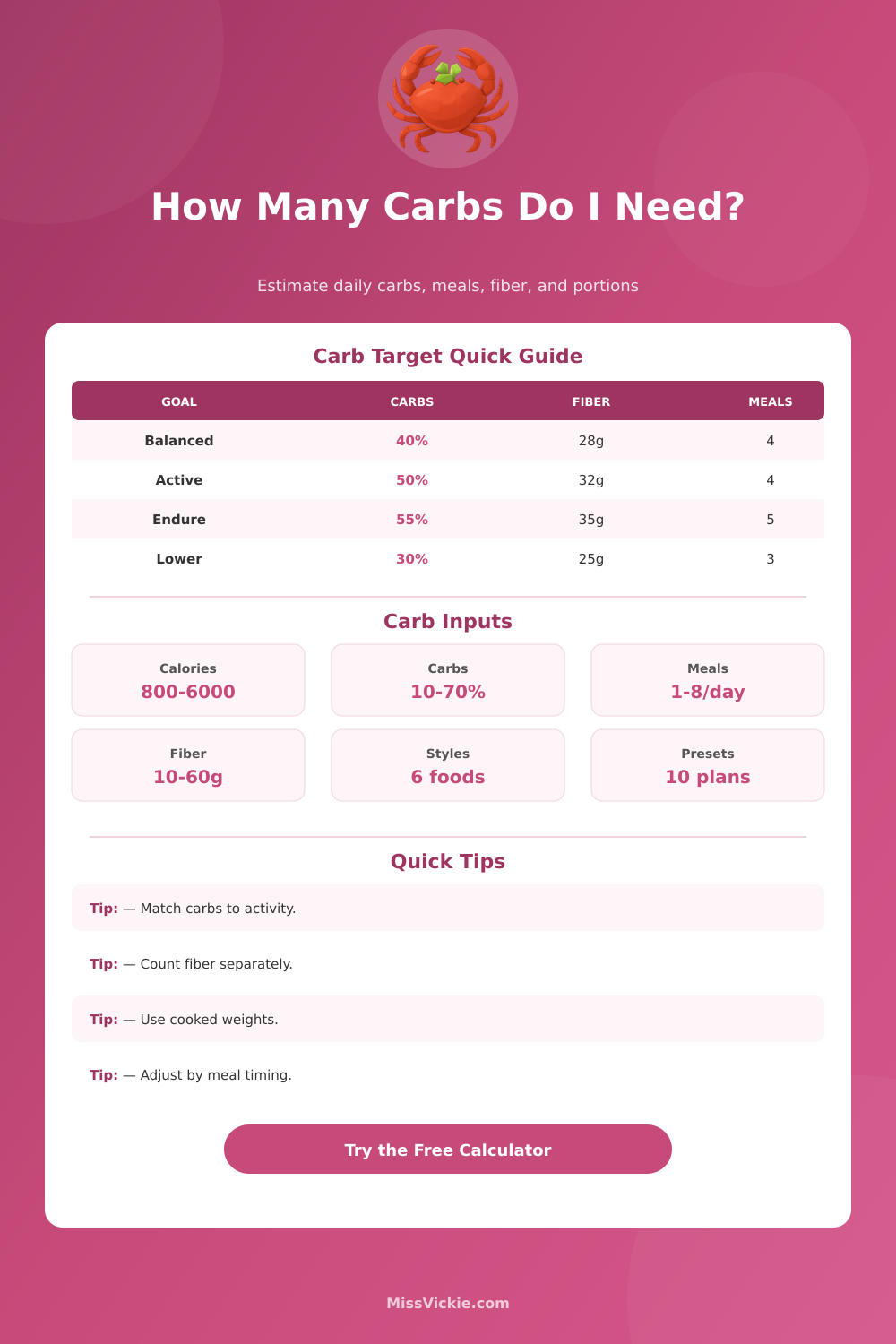
Calories, carb percent, activity, training goal, meals, fiber, and food portions
Carb Calculator
Estimate a daily carbohydrate target from your calorie goal, macro split, activity level, training goal, meal count, fiber target, food style, and preferred carb source.
Pick a common eating pattern, then adjust the numbers to match your own calorie target and meal timing.
Carb Target Breakdown
| Split Style | Carb Share | Example At 2,000 Calories | General Use |
|---|---|---|---|
| Very low carb | 10 to 20% | 50 to 100g carbs | Specialized low-carb planning; may feel restrictive for active days. |
| Lower carb | 25 to 35% | 125 to 175g carbs | Smaller starch portions with more protein, vegetables, and fat. |
| Balanced | 35 to 45% | 175 to 225g carbs | Flexible everyday eating for many mixed meals. |
| Active | 45 to 55% | 225 to 275g carbs | Useful when activity, training, or long days raise carb demand. |
| Endurance style | 55 to 65% | 275 to 325g carbs | Higher-carb days centered on repeated or longer training sessions. |
| Planning Factor | Lower Adjustment | Middle Adjustment | Higher Adjustment | Practical Meaning |
|---|---|---|---|---|
| Low movement day | -12% | -8% | -4% | Carbs can move slightly lower when activity is light. |
| Moderate activity | -2% | 0% | +4% | A balanced split usually stays close to the selected macro target. |
| High activity | +4% | +8% | +12% | More total carbs can be useful around harder sessions. |
| Calorie deficit | -8% | -5% | -2% | Protein and vegetables often get priority when calories are lower. |
| Muscle gain | +2% | +5% | +8% | Extra calories often leave room for more starch or fruit. |
| Endurance session | +8% | +12% | +16% | Higher-carb timing may be useful before and after long sessions. |
| Food, As Served | Carbs Per 100g | Fiber Per 100g | Approx 45g Carb Portion | Planning Note |
|---|---|---|---|---|
| Cooked white rice | 28g | 0.4g | 161g cooked | Easy to batch cook and portion by cooked weight. |
| Cooked oats | 12g | 1.7g | 375g cooked | Higher water content means a larger bowl for the same carbs. |
| Baked potato | 20g | 1.8g | 225g cooked | Useful when you want a filling lower-fat starch. |
| Cooked pasta | 31g | 1.8g | 145g cooked | Weigh after cooking because softness changes water uptake. |
| Black beans | 23.7g | 8.7g | 190g cooked | Counts as both a carb and fiber-rich plant protein source. |
| Banana | 23g | 2.6g | 196g edible | Convenient for snacks or pre-training timing. |
| Meal Count | Daily Target Example | Even Split | Training Window Option | Use Case |
|---|---|---|---|---|
| 3 meals | 210g carbs | 70g each | 90g near training, 60g others | Simple routine with larger meals. |
| 4 meals | 240g carbs | 60g each | 75g pre/post, 45g others | Balanced meals plus one snack. |
| 5 meals | 250g carbs | 50g each | 65g pre/post, 40g others | Smaller meals or long workdays. |
| 6 meals | 270g carbs | 45g each | 55g pre/post, 38g others | Frequent snacks, travel days, or sports schedules. |
Works well with rice, oats, potatoes, fruit, vegetables, and mixed meals.
Places more carbs around activity while keeping meal portions predictable.
Plant-forward plans can reach fiber goals with beans, oats, berries, and potatoes.
Uses smaller starch portions and more non-starchy vegetables in each meal.
Carbohydrates is needed as an energy source for the brain and the muscles, as well as for determining how a person will feel in between meal. You must determine how many carbohydrates you need based off the way that you live and training. A carbohydrate calculator can assist you in determining the proper amount of carbohydrates that you should consume each day based upon your individual need.
The first selection on a carbohydrate calculator are the total daily calories that you consume. The total daily calories that an individual consumes set a limit to the total energy that the body consumes each day. The number of calories that are entered will impact the amount of carbohydrates that is calculated for that individual; a person who consume 2,000 calories daily will require a different amount of carbohydrates than an individual who consumes 2,800 calories daily.
How to Use a Carbohydrate Calculator
Thus, total daily calories are one of the initial factor that must be entered into a carbohydrate calculator. Activity level is another of the factors that the carbohydrate calculator considers. An individual who is relatively inactive will require less carbohydrate than an individual who perform long walks or lifting activities daily.
An activity level determination will allow the calculator to adjust the carbohydrate target to that individuals activity. The goal that an individual desires for their training will also impact carbohydrate need. For individuals who wish to lose fat, consuming moderate amount of carbohydrates will allow them to consume more protein and vegetables.
For individuals who wish to gain muscle, they will require more carbohydrates to meet the total calorie needs for muscle gain. Endurance athlete will require even more carbohydrates to refill their glycogen stores after performing long training effort. Thus, the training goals of an individual will impact the carbohydrate target for that individuals training program.
The number of meals that an individual eats will impact the amount of carbohydrates that are consumed with each meal. An individual who eats four meal daily will consume different amount of carbohydrates with each meal than an individual who consumes six meal daily. By entering the number of meals that an individual eats into the calculator, the calculator can divide the target carbohydrates into these meal.
This provides an even distribution of carbohydrates to be consumed with each meal and allows for a even greater inclusion of carbohydrates with each training session. Fiber is another aspect of the diet that relate to the consumption of carbohydrates. An individual can consume more high-fiber food to meet their carbohydrate target.
These food will provide the carbohydrates necessary to meet individual target. Determining the fiber target for an individual will ensure that they dont consume too many or too few carbohydrate. The style of the food that an individual consumes will impact the carbohydrates that are consumed.
Foods like cooked rice will contain different carbohydrate than foods like cooked oats and black beans. By entering information regarding the food that an individual will consume, the calculator will determine the amount of that food that must be consumed to meet the carbohydrate target of that individual. Another selection on the carbohydrate calculator is the timing of the carbohydrates that an individual is to consume.
The carbohydrate calculator can be used to determine the portion of carbohydrates that are to be consumed both before and after training. This will ensure that individuals who perform intense training will have steady performance during those activity. This portioning will also ensure that the other meal consumed by an individual are not too large or small.
The tables referenced within the carbohydrate calculator will provide example of the carbohydrate targets for individuals with different activity level and carbohydrate splits. These tables are not strict rule that an individual must follow, but they do provide examples of the range of carbohydrates that are consumed by individuals with different level of activity. These tables allow for an individual to compare the carb target for a balanced diet to that of an endurance athlete diet.
The carbohydrate calculator cannot measure how a person feel with their physical body. Some individuals will feel good consuming high amount of carbohydrates, but other individuals may develop issue such as bloating with the consumption of high amount of carbohydrates. The calculator does not take into account factor like sleep or stress, which can impact the way that an individual feels physicaly.
Therefore, the calculator is a guess as to the amount of carbohydrates that should be consumed by an individual; small adjustment to the carbohydrate target can be made after a week of tracking the food that is consumed by an individual. An individuals portion habit can impact carbohydrate consumption. If an individual weigh the food that they eat, the portion size can be monitored to determine if they are meeting their carbohydrate target.
If an individual does not weigh the foods that are consumed by the individual, the portion sizes may not be meeting the target for the carbohydrates that the calculator calculates. A buffer percentage is included in the calculator to account for potential error in portion sizes of the food that is consumed daily by an individual. An individuals carbohydrate need are not permanent; they will change over time.
An individuals need will change with alteration in their training or schedule. Therefore, the carbohydrate calculator can be performed again to determine the new carbohydrate target for an individual whose life have changed.