Birth weight, age, feeding type, recent weigh-ins, and oz or gram output
Newborn Weight Gain Calculator
Compare a baby's birth weight, current age, current weight, feeding type, previous weigh-in, and diaper count with broad newborn weight-gain ranges for general tracking.
Choose a realistic starting point, then change the details to match the baby's actual weights and your clinician's guidance.
Growth Breakdown
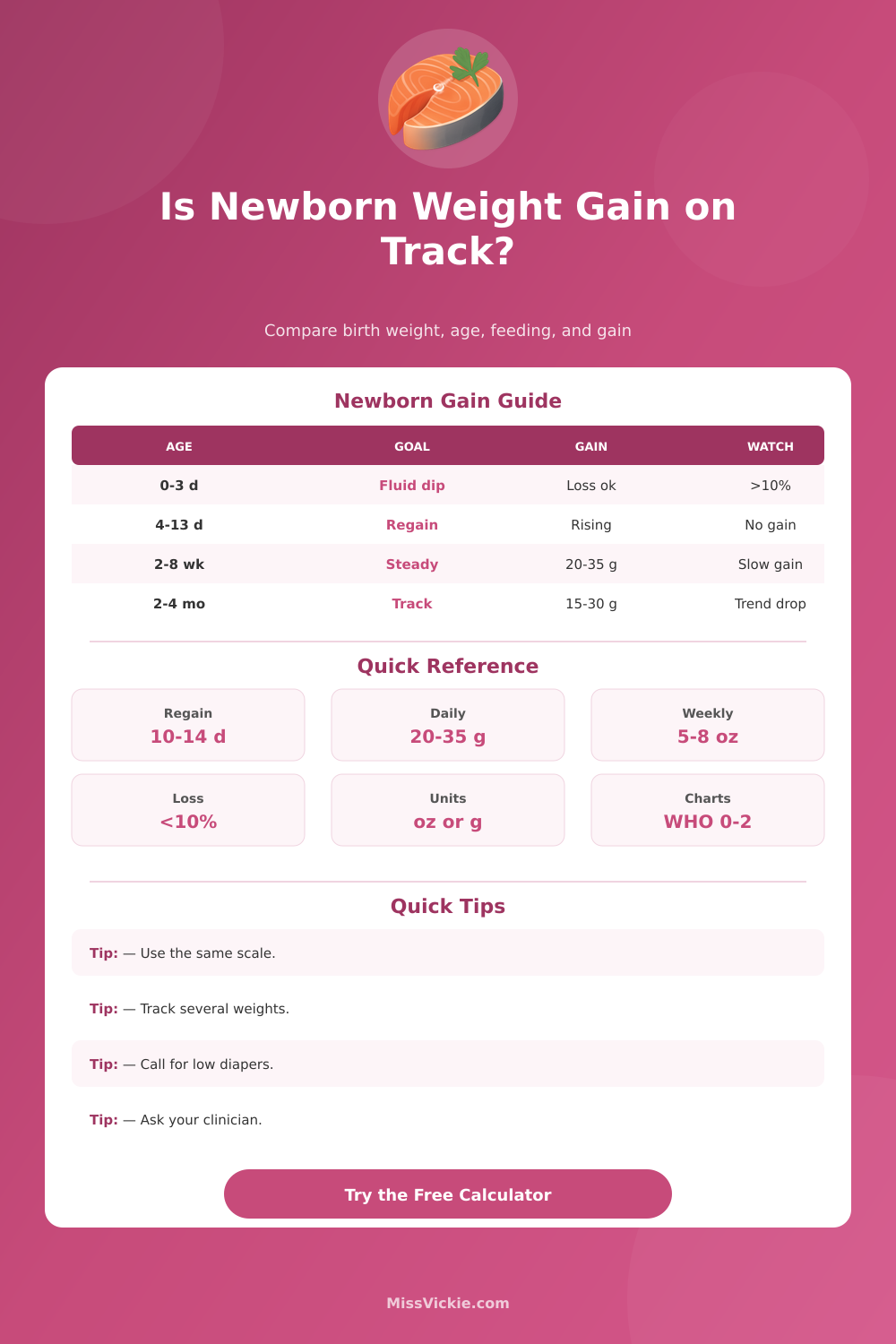
A small early loss is common while fluid shifts and milk intake are being established.
The trend should usually move upward toward birth weight, often by days 10-14.
Many term infants gain roughly 20-35 g per day once feeding is established.
Velocity gradually slows; clinicians focus on the plotted growth curve and the whole baby.
| Age | Broad Weight Pattern | Calculator Range | Clinician Check |
|---|---|---|---|
| Birth to day 3 | Early fluid loss can be normal. | About 0-8% below birth weight | Discuss loss near or above 10%. |
| Days 4-7 | Weight should begin turning upward as intake rises. | Still may be below birth weight | Ask about feeding if loss continues. |
| Days 8-14 | Many newborns regain birth weight. | Near birth weight to slightly above | Call if not regaining by 10-14 days. |
| 2-8 weeks | Steady gain is expected after intake is established. | 20-35 g/day, about 5-8 oz/week | Slow gain needs individualized review. |
| 2-4 months | Gain remains steady but often slows a little. | 15-30 g/day, about 4-7 oz/week | Use WHO chart trend, not one weight. |
| Feeding Type | Early Pattern | Calculator Adjustment | Note |
|---|---|---|---|
| Mostly breastfed | May regain birth weight closer to the 10-14 day window. | Uses standard newborn velocity band | Latch, transfer, diapers, and jaundice matter. |
| Mostly formula-fed | Often shows a slightly faster gain after early days. | Adds a small upper-range allowance after 2 months | Do not change volumes without care-team guidance. |
| Combination fed | Pattern depends on total intake and milk transfer. | Uses a middle adjustment | Compare several weights on the same scale. |
| Fortified feeds | Usually prescribed for specific growth needs. | Flags clinician-directed interpretation | Use the medical plan first. |
| Birth Weight Group | Range | How Calculator Uses It | Watch Point |
|---|---|---|---|
| Low birth weight | Under 2500 g, under 5 lb 8 oz | Labels as low birth weight and narrows assumptions | Often needs a clinician growth plan. |
| Average term range | 2500-4000 g, about 5 lb 8 oz to 8 lb 13 oz | Uses standard term newborn gain bands | Trend should stay reasonably consistent. |
| Larger newborn | Over 4000 g, over 8 lb 13 oz | Allows a little more absolute daily gain | Percent change may look smaller. |
| Preterm or NICU | Any birth weight with special follow-up | Shows caution text instead of assuming a term curve | Use corrected age and the care plan. |
| Weigh-In Detail | Best Practice | Why It Matters | Action |
|---|---|---|---|
| Scale | Use the same calibrated scale when possible. | Small newborn gains can be hidden by scale differences. | Prefer clinic scale for concerns. |
| Clothing | Use naked weight or a dry diaper consistently. | Clothes can add several ounces. | Record conditions with the weight. |
| Timing | Compare weights several days apart. | Single-day changes can reflect feeding, stool, and fluid. | Follow your clinician's recheck schedule. |
| Symptoms | Combine weight with feeding, diapers, alertness, and jaundice. | Weight alone does not show hydration or illness risk. | Call promptly for concerning signs. |
A newborn weight gain calculator can help with understanding the weight of a newborn. Many mothers worry when their newborn babies loses weight in the first few days of life, but it is actualy normal for babies to lose some of their newborn weight during this time. The calculator will show the weight comparison for normal newborn babies.
To use this calculator, you will need to provide the calculator with information regarding the baby’s birth weight, current weight, age in days, feeding type, and the number of days between weigh-ins. For example, you can compare a baby that weighed 7 pound at birth to a baby that weighs 7 pounds and 2 ounces at day 12 to another baby that also weighed 7 pounds at birth but only weighs 6 pounds and 2 ounces at day 12. The calculator will provide information regarding the change in weight since birth, the daily gain of the baby’s weight, the weekly gain of the baby’s weight, and it will compare that data to a velocity band for that baby that changes according to an age of the baby.
How to Use a Newborn Weight Gain Calculator
This calculator wont replace the care of a clinician for the baby, but it will help to eliminate the need to manually calculating these variables. Newborns lose weight because their bodies is losing the excess fluid that they had when they were born. Babies that lose five to seven percent of their birth weight are within normal limits.
Clinicians will monitor any babies that lose more than ten percent of their birth weight to ensure that they are feeding properly. After the first two weeks, babies should gain between twenty and thirty-five grams per day. If the feeding type is breast milk, babies may take longer to regain their birth weight than formula fed babies.
The feeding type can affect a baby’s weight gain. If a baby is receiving breast milk, the supply of milk will increase over time. The ability of a baby to effectively extract milk from their breasts will also increase over time.
For babies who is fed only formula, the number of grams delivered will be easier to measure from the beginning. For babies who are receiving both breast milk and formula feeds, the outcome will be somewhere in between these two options. The calculator will not know how much milk the baby is consuming, but it will make a modest adjustment within the velocity band to provide an accurate reading based off the feeding method that you select.
The conditions of the weigh-ins can alter the weight of the babies. The scale that is used, whether the baby is wearing clothing, and whether the baby has eaten will all impact the weight of the babies. The calculator will perform a quality check to ensure that the outcome is trustworthy.
The most trustworthy comparisons will be made if the same scale is used and the babies are weighed without clothing or in a dry diaper. If the conditions are not the same, the calculator will reveal this information. Using a calculator to compare only a single weigh-in may show interesting results, but it is far more valuable to use the calculator to compare several weights of the babies over time.
For example, a baby that is below their birth weight at 10 days old but gaining 25 grams per day may have a more different outcome than a baby that is below their birth weight but only gaining 8 grams per day. The baby gaining 25 grams per day may only need time to catch up to their birth weight, while a care provider may need to monitor the baby gaining only 8 grams per day. The number of wet diapers that a baby produces in a 24 hour period should be at least six after the fifth day of life.
The newborn weight gain calculator can take into account the number of diaper that the baby produces in a day. While the number of wet diapers alone will not reveal if there is a problem with the baby’s feeding, it can be used in conjunction with the information from the calculator to reveal if the baby is feeding enough to establish a proper weight gain. Other factors that may impact the weight of a baby include sleepiness, number of bowel movement, and jaundice.
The calculator will note these factors if they are entered. For babies born prior to 37 weeks of gestation or babies who are late preterm babies (between 37 and 38 weeks of gestation), different weight gain targets should be used. These babies will have a different maturity choice noted in the calculator.
The calculator may also include comments regarding plans for the baby that the care team created. The velocity bands for babies change as the baby ages. For example, the velocity band for babies in the first three days of life will focus upon the weight loss of the babies.
Between days four and fourteen, the focus shift to gaining their birth weight. After day 14, the velocity band becomes steady for the first two months of life. These numbers are not exact; they are broad and general guidelines to ensure that the babies are gaining the appropriate amount of weight.
To use the calculator, input the weights in your selected units, state the days between weigh-ins, and indicate the feeding method of the baby. The calculator will provide the daily and weekly rate of weight gain and a comparison to the velocity band for that baby. The value of this calculator may be found in the comparison of the baby’s current rate of weight gain to the rate of weight gain that is expected after the birth of the baby.
Weight is just one piece of information regarding the health of a newborn baby. Other factors to consider include whether the baby is comfortabley feeding, alert, has normal skin color, and normal bowel movements. If the outcome of the calculator falls within the middle range and the baby is content, the data is normal.
If the outcome falls outside of the normal range or if the baby is exhibiting any signs of concern, it is recommended that the mother and care team have a conversation about the baby’s health. Consistently weighing the babies and noting the trend will help the mothers and caregivers to understand the health of the babies. The calculator will run the number to reveal the trend.