Pre-pregnancy BMI, gestational week, current gain, target range, trimester pace, and singleton or twins
Pregnancy Weight Gain Calculator
Estimate whether current pregnancy weight gain is below, within, or above a BMI-based range, with a week-by-week target path and trimester pace notes for one baby or twins.
Start with a common week and BMI scenario, then adjust the fields to match your own pre-pregnancy measurements and care team's guidance.
Breakdown
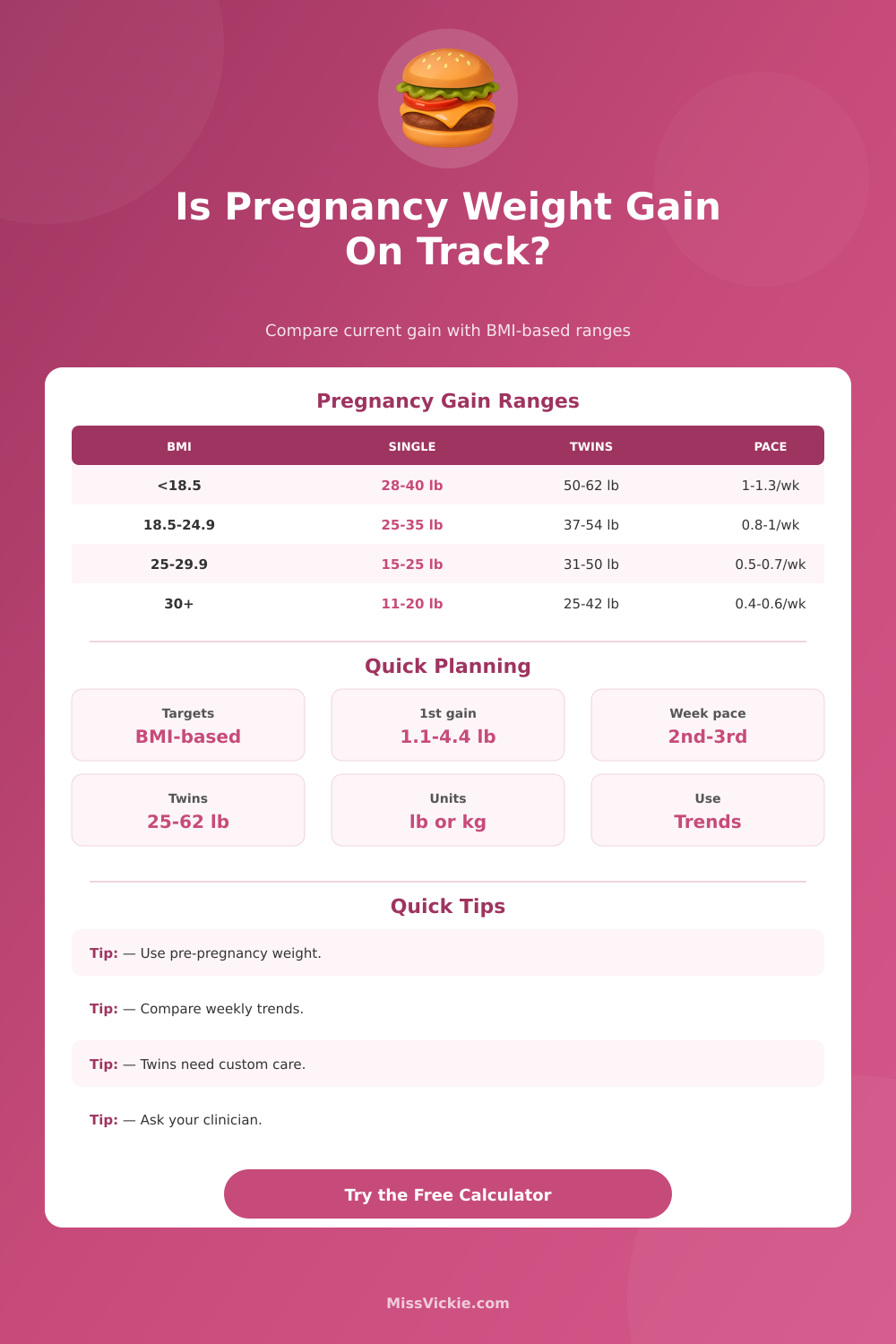
Singleton target is higher, with about 1.0 to 1.3 lb per week after the first trimester.
Typical singleton path averages about 0.8 to 1.0 lb per week in the 2nd and 3rd trimesters.
Recommended total gain is lower, often about 0.5 to 0.7 lb per week after week 13.
The calculator uses a slower singleton pace, about 0.4 to 0.6 lb per week after week 13.
| Pre-Pregnancy BMI Category | BMI Range | Singleton Total Gain | Twin Total Gain |
|---|---|---|---|
| Underweight | Less than 18.5 | 28-40 lb (12.5-18 kg) | 50-62 lb (22.5-28 kg) |
| Normal weight | 18.5-24.9 | 25-35 lb (11.5-16 kg) | 37-54 lb (17-25 kg) |
| Overweight | 25.0-29.9 | 15-25 lb (7-11.5 kg) | 31-50 lb (14-23 kg) |
| Obesity | 30.0 or higher | 11-20 lb (5-9 kg) | 25-42 lb (11-19 kg) |
| BMI Category | First Trimester Planning | 2nd And 3rd Trimester Pace | Calculator Path |
|---|---|---|---|
| Underweight | About 1.1-4.4 lb total | About 1.0-1.3 lb/week | Linear progress from week 14 to the selected target point. |
| Normal weight | About 1.1-4.4 lb total | About 0.8-1.0 lb/week | Middle path uses the midpoint of 25-35 lb unless changed. |
| Overweight | About 1.1-4.4 lb total | About 0.5-0.7 lb/week | Lower overall gain range means a smaller week-to-week slope. |
| Obesity | About 1.1-4.4 lb total | About 0.4-0.6 lb/week | Care-team goals may differ, especially with medical conditions. |
| Pregnancy Type | What Changes | Calculator Handling | Care Note |
|---|---|---|---|
| Singleton | Uses standard BMI total gain ranges | Expected gain is based on first trimester gain plus 2nd and 3rd trimester progress. | Ask your clinician if nausea, diabetes, fetal growth, or swelling changes the plan. |
| Twins, normal BMI | Total range rises to 37-54 lb | Expected path is steeper and delivery-week planning defaults can be adjusted. | Twin pregnancies need individualized monitoring and may deliver before 40 weeks. |
| Twins, overweight BMI | Total range rises to 31-50 lb | The calculator uses the twin range but still bases category on pre-pregnancy BMI. | Use this as a discussion aid, not a strict prescription. |
| Triplets or more | Standard public ranges do not fit well | This calculator is limited to singleton and twins. | Use a clinician-directed plan for higher-order multiples. |
| Status | Calculator Trigger | What It Means | Helpful Next Step |
|---|---|---|---|
| Below path | Current gain is below the expected week path by more than the selected window. | One low reading may reflect nausea, timing, or normal scale noise. | Compare several readings and discuss intake, symptoms, and fetal growth checks. |
| On track | Current gain falls inside the selected window around the expected path. | The result aligns with the calculator's BMI-based trend estimate. | Keep using consistent weigh-in timing and bring trends to visits. |
| Above path | Current gain is above the expected week path by more than the selected window. | Fluid shifts, constipation, scale timing, or rapid gain can affect the number. | Ask about swelling, blood pressure, nutrition, and individualized goals. |
| Custom plan | Provider-directed pace is selected. | The public BMI range is shown, but the week path follows your custom pace. | Use the custom field only when your care team has given a target. |
Pregnancy weight gain is a topic that many individuals discuss during their prenatal visits. Within the clinic appointments, there are often charts and number that help to track the weight gain that is expected for the pregnancy. The total amount of weight that is gained during pregnancy isnt the only factor that is consider, however. Other factors to consider include the weight of the pregnancy, the number of babies that is within that pregnancy, and the number of weeks that the pregnancy still remains within the body of the mother. One tool that can help to calculate the amount of weight that should be gained during pregnancy is a pregnancy weight gain calculator. To use the calculator, an individual provide information about their height and their pre-pregnancy weight to the calculator. Based off those two parameter, the calculator can determine an individual’s Body Mass Index (BMI) prior to pregnancy. The calculator apply different ranges of recommended pregnancy weight gain based upon the BMI that was calculated for that individual. These ranges are also altered according to whether the individual is carrying a singleton or twin pregnancy. In addition to BMI, the pregnancy calculator consider the number of weeks that the pregnancy has occurred, the weight that has already been gained during pregnancy, and the pace at which the individual desires to gain the remainder of their pregnancy weight. Based upon the information that is provided to the calculator, the calculator will output an understanding of whether the pregnancy weight gain is below, within, or above of the expected path for that individual, as well as the pace at which the individual needs to gain the remainder of their pregnancy weight to reach their desired target point. Each of the piece of information that are provided to the pregnancy weight gain calculator can help to alter the weight gain recommendations for that individual. For instance, the weight that an individual weighed prior to pregnancy is one of the more important pieces of information that is required for the calculator to provide accurate information about the weight that an individual should gain during pregnancy. The week within pregnancy is also an important variable for the calculator to determine the amount of weight that should be gained by the pregnant individual. The weight that is gained during the first trimester of pregnancy is typically more less than the weight that is gained during the second and third trimesters. The singleton versus twin pregnancy variable is used to alter the amount of weight that is expected to be gained by the mother during pregnancy. Finally, the target point that an individual desire to reach within pregnancy is another important variable within the pregnancy calculator. This target point can help to determine if the individual is to aim for the lower, middle, or upper range of the recommended pregnancy weight gain ranges.
The output of the pregnancy weight gain calculator will determine whether the pregnancy weight gain of an individual is indicated as being on track, below the path, or above the path for that pregnancy. Those who are indicated as being on track with their pregnancy weight gain are within the range of the expected path for that individual. The width of that range may shift according to the pregnancy of that individual. Those who are indicated as having gained either too little or too much of their pregnancy weight relative to the expected path of that individual may require adjustment in the hydration, eating, or pregnancy symptom patterns of that individual. The ranges of pregnancy weight gain that are provided to the calculator are based upon large research study of pregnancies. Those ranges are an indication of the weight that should be gained during pregnancy for an average individual, but a clinician can alter that range according to the symptoms, pregnancy complication, and growth of the fetus of that individual. During the first trimester of pregnancy, the weight that is gained by the pregnant individual is typically much less than the weight that is gained during the second and third trimesters. An individual may gain very little weight during the first trimester, or they may even lose a small amount of weight during the first trimester of pregnancy as a result of the nausea that can occur during that period. A pregnancy weight gain calculator may make several assumption regarding the weight gain that occurs during the first trimester. After the 14th week of pregnancy, the weight gain is to increase, and the pace of weight gain is to remain steady until the delivery of the baby. The pregnancy weight gain calculator uses both the field for pregnancy week and the field for delivery week. These two fields determine the number of week that remain in pregnancy, which allows the calculator to determine the pace at which the pregnancy should gain the remainder of their weight.
How to Use a Pregnancy Weight Gain Calculator
The pregnancies of twins will exhibit different recommendation for the amount of weight that should be gained by the mother during pregnancy compared to pregnancies that contain only a singleton baby. The weight gain ranges for twins are higher than the weight gain ranges for singletons, as the mothers body must gain the weight of two babies and two placenta. The calculator will automatically adjust to show the higher range of weight gain for pregnancies with twins, but the calculator will still use the individual’s pre-pregnancy BMI to determine the appropriate category for their pregnancy weight gain calculation. There are some variable that are not accounted for by the pregnancy weight gain calculator. For instance, variables like fluid, constipation, and the time of day that pregnancy weight is measured can alter that individual’s weight by several pounds. The pregnancy weight gain calculator does not account for these variables. However, the trends within an individual’s pregnancy weight are important variable to account for. The pregnancy weight gain calculator also has certain limit. For instance, the pregnancy weight gain calculator does not account for pregnancies that contain higher multiples than twins, such as triplet pregnancy. These pregnancies have their own ranges of pregnancy weight gain, and those ranges are outside of the parameter of the pregnancy weight gain calculator. In the same way that pregnancies with triplets have individualized plan for the pregnant individual, pregnancies with medical histories regarding condition like diabetes or hypertension have individualized plans for those individuals. The pregnancy weight gain calculator does not have feature to account for these condition.
The pregnancy weight gain calculator should of been used in a way that considers some variable and ignores others. For example, an individual can utilize the pregnancy weight gain calculator to enter the information of the individual in order to determine the expected path for pregnancy weight gain. The pattern of pregnancy weight gain is more important than the weight that is gained during a single week of pregnancy. If the pattern of pregnancy weight gain for that individual is within the expected path, the conversation between that individual and their clinician may shift to other aspect of pregnancy. If the pattern of pregnancy weight gain for that individual is outside of the expected path, the pregnancy weight gain calculator provides a starting point for that individual and their clinician to discuss adjustment in the pregnancy of that individual. Thus, the goal of the pregnancy weight gain calculator is not to determine the total weight of the individual, but the goal of the calculator is to provide an understanding of the direction and the pace of the pregnancy weight gain for that individual.