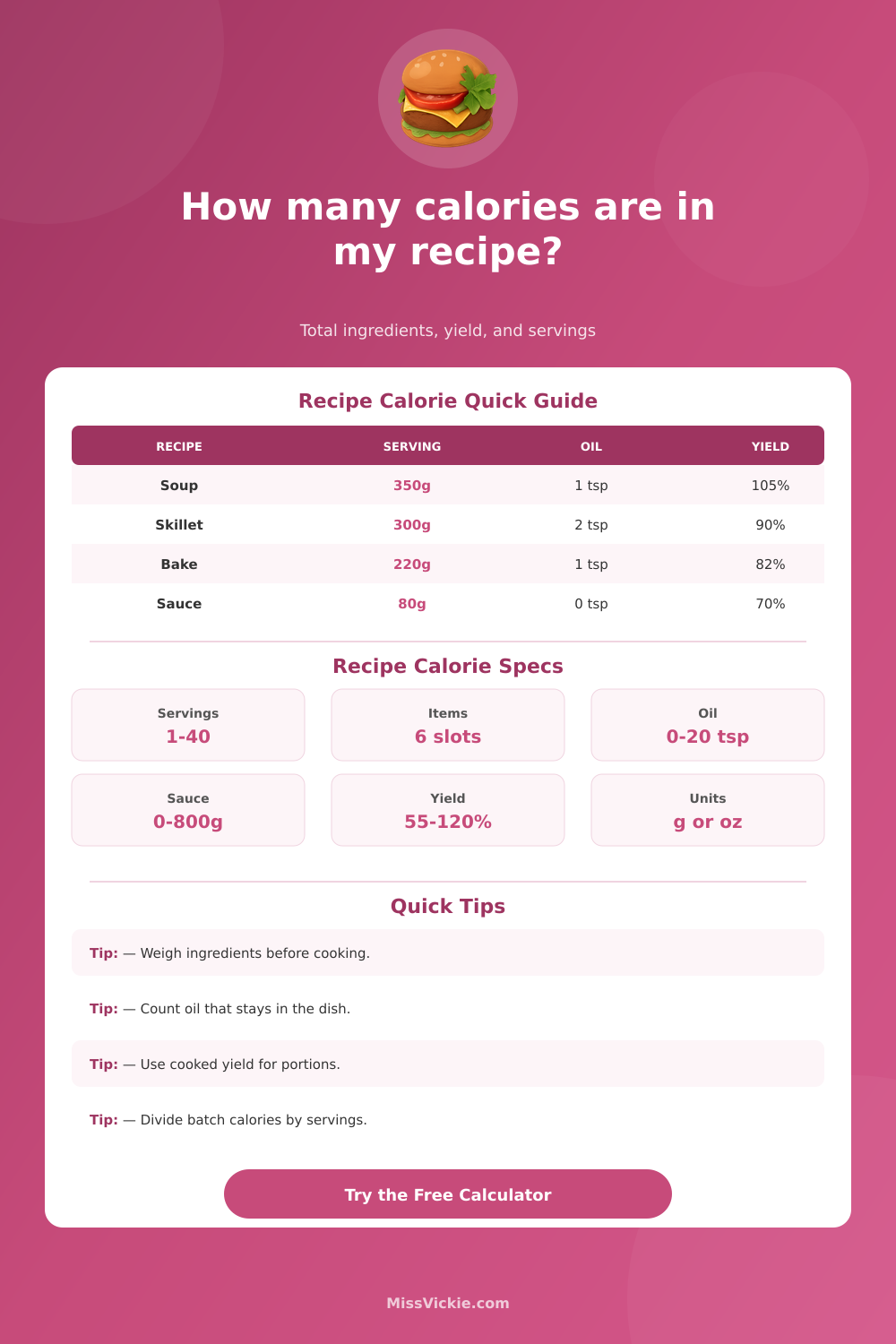
Ingredient quantities, servings, cooked yield, oil, sauce, and per-serving calories
Recipe Calorie Calculator
Total a homemade recipe from measured ingredient weights, cooking fat, sauce add-ins, finished yield, and serving count so each portion has a practical calorie estimate.
Choose a common homemade recipe pattern, then edit the ingredient slots, oil, sauce, serving count, and cooked yield to match your batch.
Recipe calorie breakdown
Meat, seafood, eggs, tofu, or legumes from ingredient 1.
Rice, pasta, potatoes, flour, beans, or grains from ingredient 2.
Vegetables, tomatoes, roots, greens, fruit, or moist add-ins.
Cheese, nuts, sugar, oil, sauce, dairy, and finishing calories.
| Ingredient | Calories Per 100g | Protein Per 100g | Useful Quantity Cue | Recipe Note |
|---|---|---|---|---|
| Chicken breast, cooked | 165 kcal | 31g | 450 to 900g batch | Works well in casseroles, bowls, and tray bakes. |
| Lean ground beef | 217 kcal | 26g | 450 to 700g batch | Drain excess fat separately if not served. |
| Salmon fillet | 206 kcal | 22g | 120 to 180g serving | Higher natural fat makes fewer oil teaspoons necessary. |
| Shrimp | 99 kcal | 24g | 120 to 200g serving | Low calorie protein that picks up sauce quickly. |
| Extra-firm tofu | 144 kcal | 17g | 150 to 250g serving | Pressing changes water, not total calories. |
| Cooked lentils | 116 kcal | 9g | 160 to 250g serving | Counts as both protein and carbohydrate in many recipes. |
| Ingredient Group | Example | Calories Per 100g | Common Batch Amount | Planning Note |
|---|---|---|---|---|
| Cooked grains | Rice, quinoa | 120 to 130 kcal | 500 to 1000g | Use cooked weight if the grain was cooked before mixing. |
| Pasta | Cooked pasta | 158 kcal | 450 to 900g | Weigh after boiling for plate-ready recipes. |
| Potatoes | White or sweet | 90 to 93 kcal | 600 to 1200g | Roasting lowers yield but does not remove calories. |
| Vegetables | Greens, broccoli, peppers | 17 to 45 kcal | 300 to 900g | Large vegetable volume can dilute calorie density. |
| Cheese or nuts | Cheddar, almonds | 403 to 579 kcal | 30 to 180g | Small weights can dominate a recipe total. |
| Flour or sugar | Baking staples | 364 to 387 kcal | 100 to 500g | Use gram weights for baked goods when possible. |
| Add-In | Serving Basis | Approx Calories | Batch Cue | What To Watch |
|---|---|---|---|---|
| Olive or canola oil | 1 tsp, about 4.5g | 40 kcal | 2 to 8 tsp | Count the portion absorbed or served in the final dish. |
| Butter | 1 tsp, about 4.7g | 34 kcal | 2 to 10 tsp | Butter has water and milk solids, so it is slightly lower than oil. |
| Marinara or salsa | 100g | 30 to 50 kcal | 200 to 800g | Low calorie sauces still add to large batch totals. |
| Teriyaki or BBQ sauce | 100g | 89 to 172 kcal | 60 to 300g | Sweet sauces can raise calories quickly. |
| Light coconut milk | 100g | 75 kcal | 200 to 500g | Reduced sauces become more calorie dense after simmering. |
| Cream or dressing | 100g | 340 to 484 kcal | 30 to 250g | Use grams rather than spoonfuls for creamy recipes. |
| Recipe Style | Yield Range | Typical Serving | Calorie Density Effect | Example |
|---|---|---|---|---|
| Soup or chili | 95 to 115% | 300 to 450g | Lower per 100g | Lentil soup, beef chili |
| Skillet meal | 85 to 98% | 250 to 350g | Moderate per 100g | Stir-fry, taco filling |
| Roasted tray | 70 to 88% | 220 to 320g | Higher per 100g | Chicken potato tray |
| Casserole or bake | 78 to 95% | 180 to 300g | Depends on cheese and sauce | Pasta bake, breakfast bake |
| Reduced curry | 65 to 85% | 180 to 280g | Higher after simmering | Tofu curry, pan sauce |
| Baked loaf | 82 to 95% | 45 to 90g | Dense per 100g | Banana bread, muffins |
Seafood, chicken, turkey, tofu, and lentils add structure without much oil.
Rice, pasta, potatoes, beans, and grains usually set the main batch weight.
Vegetables and tomatoes add volume, water, fiber, and lower calorie density.
Oil, cheese, nuts, cream, sugar, and sauces can drive most recipe calories.
Cooking allows you to control the flavors and portion size of the food that you prepare in the kitchen. However, cooking also requires you to calculate the calorie in your food. You add several ingredient to the pot, you use oil in the pan, and you use sauce to finish the dish, so it isnt immediately apparent the total number of calories in the dish that you prepare.
This lack of clarity in the total calories in the food presents problems if you are attempting to reach a specific calorie goal or if you are attempting to divide a large batch of food into several meal. To overcome this problem, you should use the weights of each ingredient in the dish and take into account how the weight of the ingredients change during the cooking process. You can then divide that total weight by the number of portion of the dish that you intend to serve.
Counting Calories When You Cook
The ingredients that contain the total calories in the dish are the same ingredients that you use every night to cook your meal. You can choose a protein or an plant-based base for your meal. You can add starches or grains to your meal.
You can add vegetables or fruit to your meal. You can add cheese, nut, or sweeteners to your meal. You can also decide how much fat that you will add to the pan in which you will cook your ingredients.
Some of that fat will remain in the pan, but some of it will remain in the food that you prepare. Sauce can also add to the total calories in your dish. Some sauces contain alot of water and tomato while other sauces contain additional sugar or cream to the sauce.
When you measure out the ingredients for your meal, the cooking process will change the weight of the food that you cook. You will lose moisture from the food, but in the case of soups, you will add moisture to the food. Once you cook your food, you can divide that total weight by the number of portions of food that you will serve.
Yield is another factor that people often leave out when cooking. For instance, if you cook a tray of vegetables and salmon, the cooked vegetables and salmon will lose some of there water in the cooking process. If you cooked chili, it is possible that the chili lost moisture when it cooked, or it could of gained moisture during the cooking process.
The change in the weight of the food will impact the total calories in the food, allowing for the calculation of the calorie density of the food. Calorie density is the amount of energy contained in every hundred gram of the food that you cook. Two food dishes can contain the same amount of total calories, but they may look and feel different on the plate.
If you track the yield of the food that you cook, you can use that measurement to prepare the next batch of food that you prepare in your kitchen. Oil is another ingredient that you must pay attention to when preparing and cooking your food. While a teaspoon of oil may seem like a small amount to add to your food, you must take into account how many serving of food contain that teaspoon of oil.
Some of the oil will remain in the pan after cooking your food, but some of the oil will travel with the food to the plate. You must change the percentage of oil in your food so that you do not incorrectly calculate the calories that you prepare for the food. The same applies to the sauce that you prepare for the food.
A light salsa contains less calories than a reduced teriyaki sauce. When you measure the ingredients for your recipe, the cooking process will change the weight of the food. You can divide the total weight by the number of portions that you will serve.
Macronutrients contain the same ingredients as your food. Protein sources like chicken, fish, and lentils will give you protein that will keep you feeling full after eating. Starches and grains will make your meal feel complete.
Vegetables will lower the calorie density of your meal and add fiber and water to your meal. Rich ingredient like cheese or nuts will add flavor quickly to your meal and are often used when you want your food to satisfy your hunger without eating a large volume of food. Each of these ingredients play a vital role in the recipe that you cook in your kitchen.
People make common errors when they track their food intake. People add the ingredients to the food before they cook it. Then they forget to account for the loss of moisture from the food when they cooked it.
People count the teaspoons of oil that they use to cook their food. However, they often forget some of that oil will remain in the pan. People prepare a recipe for a large batch of food and plan on dividing it into four portion.
However, when you cook the food, there will be six portions that will satisfy each member of the household. You must account for these details when you prepare your meal. Real life can complicate food tracking.
Any food that is prepared and left sitting will lose moisture when reheated. The portion of food that you cook may cook to a different weight than the original food. If you cook a meal for a party, you may have to prepare more food than you serve.
When you prepare food for meal prep containers, there will be some residue left in the container and that will not travel to the plate. These common scenarios are not reason to stop tracking the food that you cook in your kitchen. They are, however, reasons to treat the food tracking calculation as an estimate of the total calories in your food.
The value of calculating calories in your food will help you make decisions about the food that you cook. You can compare the calories in two recipes before you cook the recipe. You can adjust the amount of oil in your food or the amount of vegetable that you use in the recipe.
You can use the calorie information as an explanation for why some meals contain a lot of calories but taste very light. With this information, you can make adjustments in the future to control how many calories that you consume from the food that you prepare. Another benefit of calculating the calories of the food that you cook is that you will learn which ingredients contain the most calories.
You will also learn which ingredient you can adjust in the recipe. For instance, you might find that changing the amount of oil that you use when you cook your food matters more than changing one vegetable for another in the recipe. You might find that the yield of the food matters more than the amount of oil.
Through this process of cooking, you will become aware of the various ingredient in your meal and how they affect the total calories in the dish. The final benefit of calculating the total calories of each ingredient will help you when you eat the food that you cook. If you understand how the calories from each ingredient contribute to the total calories in your food and how the total weight of the food affects the number of calories per portion, you will be able to plate your food appropriately for your appetite and weight goal.
The numbers that you calculate will no longer be a constraint on the food that you cook. They will become a map of the food that you prepare. You will have confidence in your cooking ability because you will understand the effect that your cooking decisions will have on your food.
You will also be able to make adjustments to the food that you cook due to your newfound knowledge.