Household size, meal prep, fresh food, freezer, drinks, and shelf math
Fridge Size Calculator
Estimate the refrigerator capacity you need from people, meals at home, fresh and frozen storage split, bulk buying, beverage space, leftovers, and shelf volume efficiency.
Start with a common kitchen pattern, then adjust household, shopping, beverages, freezer share, and shelf packing style for your real week.
Capacity Breakdown
| Household pattern | Typical total capacity | Fresh section target | Freezer target | Notes |
|---|---|---|---|---|
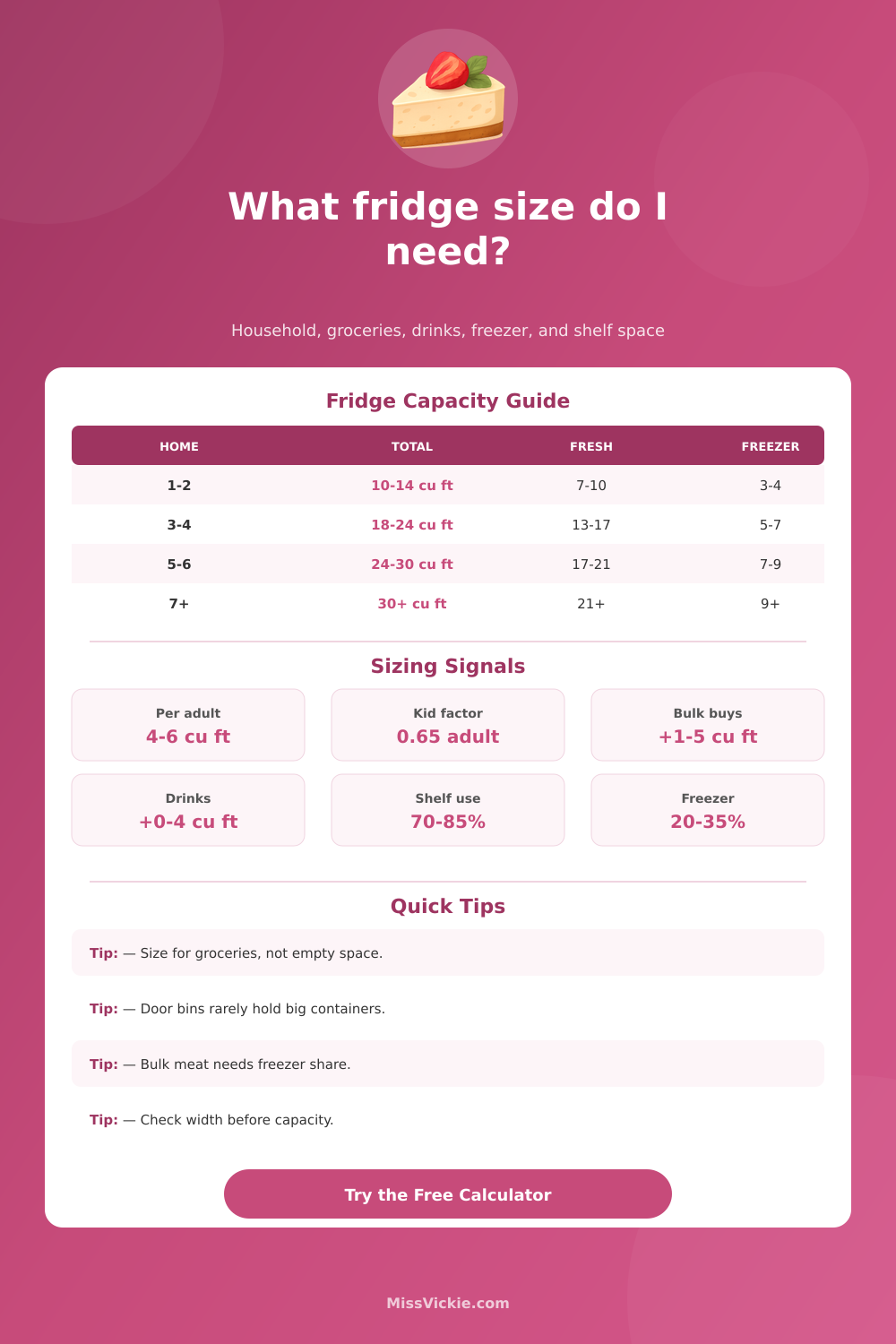
| Single person or small apartment | 10 to 14 cu ft | 7 to 10 cu ft | 3 to 4 cu ft | Works best with frequent shopping and modest drinks. |
| Couple cooking several nights | 14 to 18 cu ft | 10 to 13 cu ft | 4 to 5 cu ft | Add space if weekly meal prep or beverages are common. |
| Family of three to four | 18 to 24 cu ft | 13 to 17 cu ft | 5 to 7 cu ft | Most full-size French door and bottom-freezer models fit here. |
| Large family or heavy prep | 24 to 30 cu ft | 17 to 21 cu ft | 7 to 9 cu ft | Look for wide shelves and freezer organization, not just headline capacity. |
| Bulk shopper or entertainer | 30+ cu ft combined | 21+ cu ft | 9+ cu ft | Often better solved with a kitchen fridge plus secondary freezer. |
| Storage driver | Add to fresh section | Add to freezer | When it matters most | Calculator treatment |
|---|---|---|---|---|
| Weekly meal prep | 1.0 to 2.5 cu ft | 0.5 to 1.5 cu ft | Stacked lunch boxes and cooked grains | Uses meal prep frequency and leftover count. |
| Bulk produce | 1.0 to 3.0 cu ft | 0 to 1.0 cu ft | Large greens, fruit boxes, trays, and dairy | Bulk setting increases both sections based on fresh share. |
| Bulk meat or frozen meals | 0.3 to 1.0 cu ft | 2.0 to 5.0 cu ft | Warehouse packs, freezer meals, and sale meat | Freezer-forward and deep bulk settings raise freezer share. |
| Beverage storage | 0.5 to 4.0 cu ft | 0 cu ft | Cans, bottles, pitchers, milk, juice, and party drinks | Added directly to fresh section demand. |
| Pans and tall containers | 0.5 to 2.5 cu ft | 0 cu ft | Holiday leftovers, sheet pans, cakes, and stockpots | Handled through usable shelf volume. |
| Fresh/frozen pattern | Fresh share | Freezer share | Best match | Watch point |
|---|---|---|---|---|
| Fresh groceries, frequent shopping | 75% to 85% | 15% to 25% | French door or bottom freezer | Freezer drawers can feel small for bulk packs. |
| Balanced household food storage | 65% to 75% | 25% to 35% | Bottom freezer or side-by-side | Check wide shelf space for pizza boxes and trays. |
| Frozen meals and bulk meat | 50% to 65% | 35% to 50% | Side-by-side plus extra freezer | Main-fridge freezer sections fill quickly. |
| Beverage and entertaining use | 80% to 90% | 10% to 20% | French door plus drink fridge | Door bins do not replace shelf depth. |
| Shelf volume setting | Usable capacity factor | What it means | Good for | Capacity impact |
|---|---|---|---|---|
| Open shelves | 85% | Low containers, adjustable shelves, little wasted height | Organized meal prep boxes and shallow produce bins | Needs the least headline capacity. |
| Typical mixed shelves | 78% | Regular jars, cartons, leftovers, and produce drawers | Most households | Balanced default for planning. |
| Tall bottles and pans | 72% | Pitchers, stockpots, cakes, and upright containers | Families and entertainers | Raises recommended capacity by about 8%. |
| Crowded stacked storage | 66% | Uneven containers, packed bins, and awkward leftovers | Bulk buyers and weekly prep | Raises headline capacity sharply. |
Choosing a refrigerator require that you consider many factor about the refrigerator that you need to purchase. You must consider the type of food that you will buy and cook, as the refrigerator must be able to hold those food. Many people select refrigerators based off only upon the total cubic feet that the refrigerator can hold.
However, the total cubic feet of a refrigerator dont always indicate how much food can be placed within the refrigerator. Furthermore, the interior shelf and interior bins of the refrigerator will impact how you are able to store your food; therefore, you should also consider this factor when you are purchasing a refrigerator. One of the first factors to consider when you are selecting a refrigerator is your household size.
How to Choose the Right Refrigerator
However, household size do not always represent the needs that you will have from your refrigerator. For instance, a household that consists of two eating outside of the home will require less volume within there refrigerator than a household consisting of two adults that cook every meal in the home. In addition to considering the number of individuals that live in the home, it is also important to consider the presence of children within the household.
Children often require different snack and drink than adults, and the presence of young children within a household will alter the amount of food that must be store within the refrigerator. The calculator provided in this blog consider these factors and allows users to input their household size; the calculator considers the household size for these reason. The type of meals that are prepared in the household will also impact the amount of refrigerator space that is required.
Individuals who cook meal from scratch will require more space within the refrigerator to store the cooking utensil and containers for those meals. Additionally, individuals that cook meals in batches will require more freezer space within their refrigerator. The calculator provided on this blog also considers these factor; the reason for its consideration of these factors is that they will impact the refrigerator needs of the individuals.
The practice of buying bulk food is another factor that will impact the amount of refrigerator space that is needed. Many individuals buy bulk package of meat or produce from warehouse stores. These bulk packages often fill the refrigerator with foods.
Some of these bulk foods go into the fresh section of the refrigerator, but others go into the freezer section of the refrigerator. Therefore, if an individual owns a second refrigerator or chest freezer, they will require less space within their kitchen refrigerator. The calculator also considers this factor; the reason for its inclusion is to account for refrigerators that already exists in other areas of the home.
Another consideration is the amount of space that will be needed for beverages. Refrigerators often include bin for the doors that hold item like milk, juice, and cases of water. The space for these beverages may mean that there is not enough space within the refrigerator for other foods.
The calculator considers this factor, as, because these beverage require a certain amount of space within the fresh food section of the refrigerator. Another consideration is the way that the shelves within the refrigerator will be utilized. Many refrigerators have drawer, bins, and gap for air movement within the refrigerator that takes up the space within the refrigerator.
Shelf usability will also impact how much of the total volume of the refrigerator is actually usable. Refrigerators also may have gap between the shelves for tall bottles or containers that may not allow for the shelves to be used efficient. The usable shelf volume is another factor within the calculator; the reason for its consideration is that it account for these gaps within the refrigerator.
Finally, the style of the refrigerator may also impact the way that the fridge is used. For instance, french door refrigerators may have a feature where the shelves within the refrigerator are large and used for storing item such as produce or leftovers. Side-by-side refrigerators may have more freezer space than fresh food space but have narrow shelf within the refrigerator.
Top freezer refrigerators may have more efficiency with small household but may have a freezer located at a different height than the bottom freezer refrigerators. Finally, the width of the kitchen within which the refrigerator is to be placed. The width of the kitchen will determine the type of refrigerator that can be placed within the kitchen.
You must measure the width of the opening within the kitchen to account for the depth of the refrigerator and the space needed for the refrigerator to open and close. Refrigerators may have different depth. If the kitchen within which the refrigerator is to be placed is narrow in width, fewer refrigerator unit may be able to be placed in that kitchen.
Therefore, the width within the calculator for the refrigerator is another factor that must be considered in purchasing a refrigerator that meet the needs of the kitchen and household.