Fruit Tray Calculator
Plan fruit trays by guest count, event length, serving size, fruit mix, edible yield, cut loss, platter count, refill style, and crowd appetite.
🍉Fruit tray presets
Choose a party, brunch, buffet, shower, school, or dessert-tray starting point, then adjust the tray and yield details.
📝Fruit tray inputs
Fruit Tray Plan
The results separate ready-to-eat fruit from raw shopping weight, then split the plan across display platters and chilled refills.
Fruit tray breakdown
🧺Quick tray metrics
📊Serving size guide
| Fruit tray role | Edible fruit per guest | Best event length | Tray planning note |
|---|---|---|---|
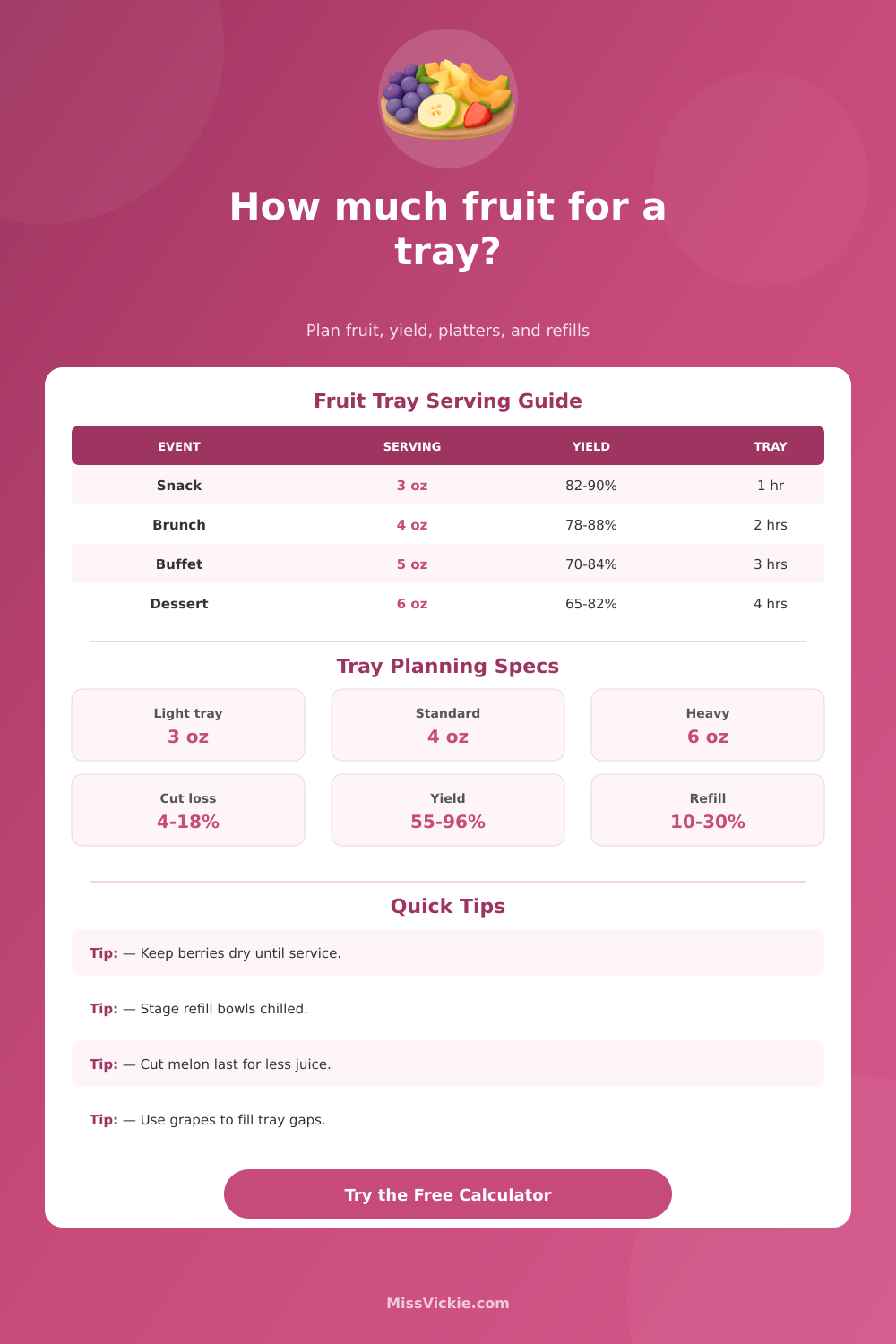
| Light snack or coffee break | 2.5 to 3.5 oz | 30 to 90 minutes | Good when fruit is one of several small snacks. |
| Breakfast or brunch board | 3.5 to 4.5 oz | 1 to 2 hours | Pairs with pastries, yogurt, egg dishes, or coffee service. |
| Side dish with meal | 4 to 5 oz | 1.5 to 3 hours | Works for cookouts, showers, family meals, and potlucks. |
| Buffet or open house | 4.5 to 6 oz | 2 to 4 hours | Use chilled refills instead of overloading the first tray. |
| Dessert table fruit | 5 to 7 oz | 1 to 3 hours | Guests take more fruit when it balances cakes, cookies, or chocolate. |
| Kids party tray | 2.5 to 4 oz | 1 to 2 hours | Favor grapes, berries, melon chunks, orange wedges, and apple slices. |
🫐Edible yield table
| Fruit group | Typical edible yield | Buy for 10 lb edible | What is lost |
|---|---|---|---|
| Berries and seedless grapes | 92% to 96% | 10.4 to 10.9 lb raw | Stems, soft berries, sorting, and light drying. |
| Apples, pears, peaches | 82% to 90% | 11.1 to 12.2 lb raw | Cores, pits, bruises, peel preference, and browning trim. |
| Orange and citrus segments | 68% to 76% | 13.2 to 14.7 lb raw | Peel, pith, membranes, seeds, and segment trimming. |
| Watermelon, cantaloupe, honeydew | 48% to 62% | 16.1 to 20.8 lb raw | Rind, seed cavity, soft spots, and rind-side trimming. |
| Pineapple and mango | 50% to 68% | 14.7 to 20 lb raw | Skin, core, pit, eyes, fibrous ends, and shaping trim. |
| Prepared cut fruit | 96% to 99% | 10.1 to 10.4 lb purchased | Mostly container juice and pieces too small for display. |
🔪Cut loss and platter capacity table
| Cut or service style | Extra loss after edible yield | Display density | Best use |
|---|---|---|---|
| Whole berries and grapes | 2% to 4% | High, little juice | Fast trays, kids parties, garnish clusters, and gap filling. |
| Large chunks | 5% to 8% | Medium-high | Melon, pineapple, mango, apples, and mixed buffet trays. |
| Neat slices and fans | 8% to 12% | Medium | Brunch boards, showers, citrus wheels, apple fans, and pears. |
| Skewers, picks, or cups | 10% to 14% | Controlled portions | Outdoor service, school events, individual portions, and receptions. |
| Small dice or fruit salad | 14% to 18% | Compact and juicy | Yogurt bars, cups, spoon service, and breakfast buffets. |
| Decorative carving | 18% to 25% | Lower edible fill | Centerpieces, carved melon baskets, floral shapes, and display work. |
🍽Common platter count table
| Guest count | Light tray | Standard tray | Heavy fruit service | Typical display plan |
|---|---|---|---|---|
| 10 guests | 2 lb edible | 2.5 to 3 lb edible | 4 lb edible | One small tray or one 12 inch platter. |
| 20 guests | 4 lb edible | 5 to 6 lb edible | 8 lb edible | One full tray or two small trays. |
| 30 guests | 6 lb edible | 7.5 to 9 lb edible | 12 lb edible | Two display trays with chilled backup. |
| 50 guests | 9.5 lb edible | 12.5 to 15 lb edible | 20 lb edible | Three to four trays or rolling refills. |
| 75 guests | 14 lb edible | 19 to 23 lb edible | 30 lb edible | Four to six trays, staged in waves. |
| 100 guests | 19 lb edible | 25 to 30 lb edible | 40 lb edible | Six to eight trays with cold backup pans. |
🍍Fruit comparison grid
Very high edible yield, delicate handling, low cutting loss, and strong color for premium trays.
Lower raw yield because of rind and seeds, but economical for large volume once cut.
Bright flavor and good firmness, with core, skin, eyes, and juice loss to include.
Almost all edible, easy to portion, sturdy on trays, and useful around softer cut fruit.
Great for winter trays, but peel, pith, and segment membranes lower purchase yield.
Good yield and crunch, but plan browning control and a little core and bruise trim.
Sweet tropical option with pit and peel loss; best mixed with firmer fruit.
Attractive slices, moderate peel loss, and a softer texture that needs careful layering.
💡Two fruit tray tips
Planning a fruit tray involves calculating how much fruit you need to buys to ensure that everyone who is attending the event gets to eat. You will need to consider a number of factors, including the number of guests that will attend the event, the length of the event, and the style in which you will serve the fruit. Small gatherings require small amount of fruit to be purchased, while large gatherings will require the purchase of more fruit.
Additionally, if the event is to last for a longer period of time, then more fruit will be required due to the fact that the guests will eat more fruit during that period of time. The calculator included on this page asks for the number of guests that will attend the event, the length of the event, and the style in which you will serve the fruit. The serving style will impact the amount of fruit that each guest eats; a buffet style of service will require more fruit to be present at the event than a snack style of service.
How Much Fruit to Buy for a Fruit Tray
Additionally, the length of the event can also impact how many refills of fruit are necessary for the event; if the event will last longer than 90 minutes, then a refill strategy will be required. Yield profiles will have a significant impact upon the amount of fruit that is purchased for the fruit tray. The yield profile will determine the difference between the weight of the raw fruit that is purchased and the weight of the fruit that is edible and can be eaten by the guests.
For instance, fruits like melon and pineapple have significant rinds that guests must remove before they can eat the fruit. Thus, when the fruit is prepared, there will be a significant decrease in the weight of that fruit. Therefore, more melon and pineapple will need to be purchased than the amount of prepared fruit that will be served.
Berries and grapes have high yield profiles because there is little waste when preparing those fruits for serving. Thus, when choosing the type of fruit that will be included in the fruit tray and the yield profile of each type of fruit, the calculator can determine the weight of the raw fruit that will need to be purchased. The cut style of the fruit will impact the weight of the fruit that is prepared and the number of platters of fruit that will be required for the event.
If you cut the fruit into small pieces, there will be more trimming of the fruit that is required. Thus, there will be a decrease in the yield of raw fruit that is prepared, and there will be a decrease in the amount of fruit that can be displayed on each platter. Additionally, small pieces of fruit will release more juice than large pieces of fruit.
The calculator considers these variables in determining the number of platters of fruit that will be required for the event. The length of the event will impact the refill plans that are made for the event. If the length of the event is longer than 90 minutes, it is possible that the guests will eat all of the fruit that is placed on the platter during the first portion of the event.
Therefore, it is necessary to plan for refills during the event. Additionally, having a plan for refills will ensure that the fruit remains fresh and does not become too warmly while placed on the table for the guests. The calculator allows for adjustments to the amount of fruit that is required and the size of each platter of fruit that is to be prepared.
The appetite of the crowd may impact the amount of fruit that should be purchased for the fruit tray. If the crowd contains individuals that prefer foods that are high in fruit content, then those guests will eat more fruit than by individuals that prefer foods that contain less fruit. For these reasons, it is necessary to determine the expected appetite of the crowd that will attend the event.
This will allow the fruit tray designer to account for the fact that more fruit will be required for those who prefer foods high in fruit content. The reference tables contain information regarding the edible yields of the different groups of fruit. These tables allow for an understanding of the fact that fruits like watermelon will contain more raw weight than berries because watermelon will have a larger rind.
Additionally, the tables make clear that fruit like citrus segment will require care in their preparation because they are more difficult to prepare than some of the other fruits. One of the most common mistakes in planning for the placement of fruit trays at an event is to assume that the fruit that is placed on the first tray will last the event. After the initial serving of the fruit tray, the guests will eat the fruit quickly.
Therefore, it is necessary to have backup fruit in the refrigerator. This ensures that the fruit will remain cold and fresh. If a refill plan is chosen for the fruit tray, the calculator will reflect the weight of the additional fruit that should be prepared for the event.
Another of the most common mistakes in planning for a fruit tray is to fail to consider the physical capacity of the platters of fruit. The size of the platter will limit the amount of fruit that can be displayed. The size of the fruit and the amount of juice that is produced by the fruit will limit the amount of fruit that can display on the platter.
Considering these factors will allow for the determination of the number of platters that will be required for the display of the fruit. For example, the capacity of the platter can be used to determine if two platters or three platters will be required for the amount of fruit that will be prepared. The numbers that are generated by the calculator can be adjusted to meet the specific requirements of the event.
For instance, you can adjust the capacity of each platter if the number of platters that are suggested by the calculator may be too high for the specific event. Additionally, the percentage of the total amount of fruit that is to be included as a buffer can be increased in the case where the host is worried that there may be too little fruit for the guests. The calculator allows for the host to establish the total amount of fruit that will be prepared based on major variables of the fruit and fruit tray, but the host is still in charge of making the final decisions regarding the fruit and fruit tray.
Success in the hosting of the event will be experienced when the decision is made to purchase enough fruit to ensure that there is enough edible fruit to be served to each guest and to plan for the inclusion of refills of fruit during the event.