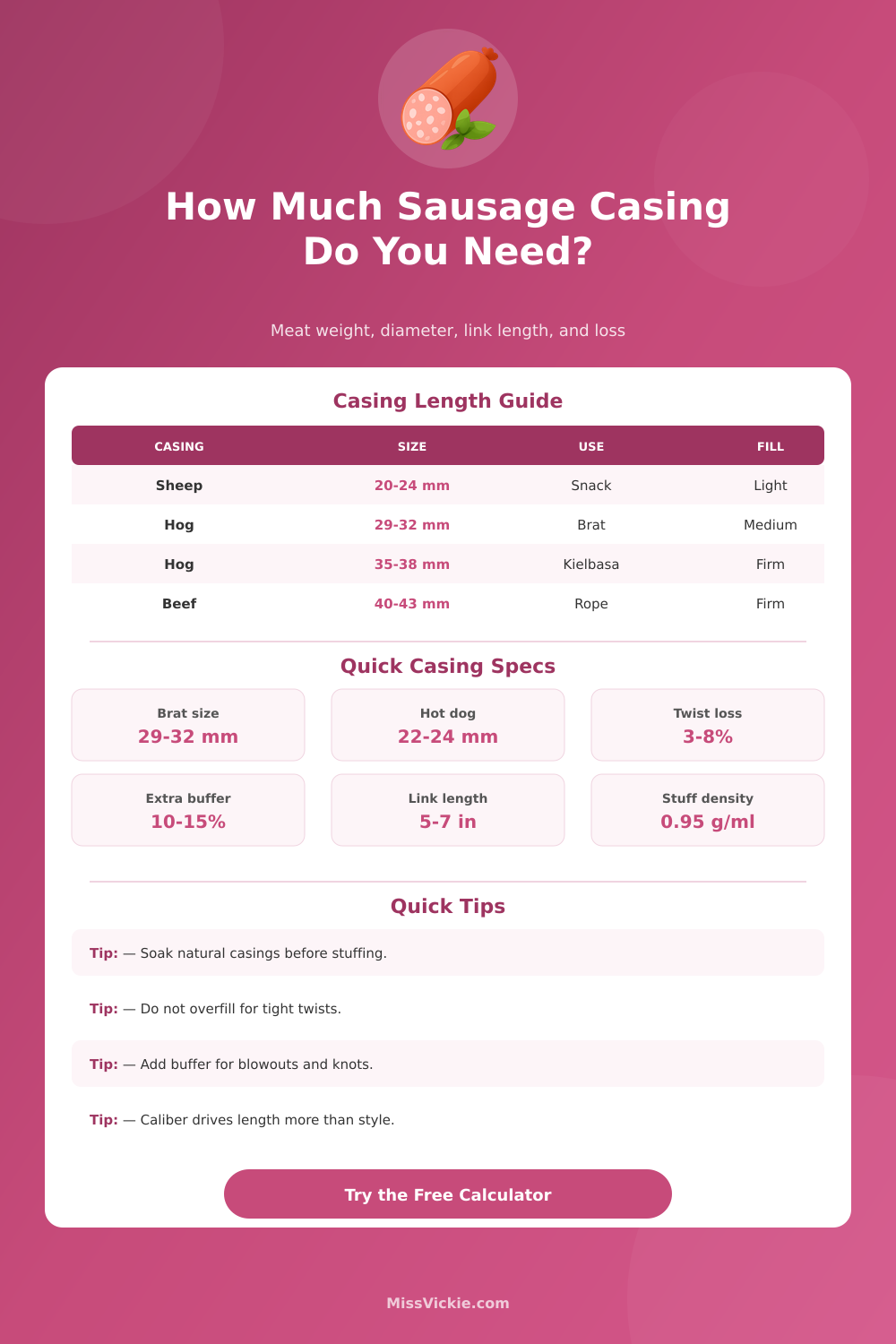
Meat weight, casing diameter, link length, stuffing density, and twist loss
Sausage Casing Calculator
Estimate casing length, link count, stuffed volume, and final yield from batch weight, selected casing caliber, link length, stuffing density, twist loss, casing type, and trimming buffer.
Load a common sausage project, then adjust the batch size, diameter, density, twist spacing, casing type, and final yield assumptions.
Casing Length Breakdown
| Casing diameter | Cross-section area | Approx fill per foot | Approx fill per meter | Common link use |
|---|---|---|---|---|
| 19 mm | 2.84 cm2 | 2.9 oz | 0.60 kg | Snack sticks and skinny breakfast links |
| 22 mm | 3.80 cm2 | 3.9 oz | 0.80 kg | Hot dogs and small sheep links |
| 26 mm | 5.31 cm2 | 5.5 oz | 1.11 kg | Large sheep or narrow hog links |
| 30 mm | 7.07 cm2 | 7.3 oz | 1.48 kg | Brats, Italian sausage, fresh grill links |
| 32 mm | 8.04 cm2 | 8.3 oz | 1.68 kg | Standard hog casing dinner links |
| 35 mm | 9.62 cm2 | 9.9 oz | 2.02 kg | Kielbasa, smoked sausage, larger coils |
| 38 mm | 11.34 cm2 | 11.7 oz | 2.38 kg | Large hog casing rope sausage |
| 42 mm | 13.85 cm2 | 14.3 oz | 2.91 kg | Beef round, bologna, chunky smoked links |
| Link style | Typical length | Best diameter range | Stuffing firmness | Twist loss starting point |
|---|---|---|---|---|
| Breakfast link | 3 to 4 in / 7.5 to 10 cm | 19 to 24 mm | Soft to medium | 6% to 9% |
| Hot dog | 5 to 6 in / 13 to 15 cm | 21 to 24 mm | Medium | 5% to 7% |
| Bratwurst | 5 to 7 in / 13 to 18 cm | 29 to 32 mm | Medium | 4% to 6% |
| Italian sausage | 6 to 8 in / 15 to 20 cm | 30 to 35 mm | Medium | 4% to 6% |
| Kielbasa coil | 12 to 18 in / 30 to 46 cm | 35 to 38 mm | Firm | 2% to 4% |
| Ring bologna | 18 to 24 in / 46 to 61 cm | 38 to 43 mm | Firm | 2% to 4% |
| Summer sausage chub | 10 to 16 in / 25 to 41 cm | 50 to 76 mm | Tight | 1% to 3% |
| Ready-to-stuff batch | 22 mm casing | 32 mm casing | 38 mm casing | 6 inch links at 32 mm |
|---|---|---|---|---|
| 2.5 lb / 1.13 kg | 9.4 ft / 2.9 m | 4.4 ft / 1.3 m | 3.1 ft / 0.9 m | 8 links |
| 5 lb / 2.27 kg | 18.9 ft / 5.8 m | 8.8 ft / 2.7 m | 6.2 ft / 1.9 m | 17 links |
| 10 lb / 4.54 kg | 37.8 ft / 11.5 m | 17.6 ft / 5.4 m | 12.5 ft / 3.8 m | 35 links |
| 15 lb / 6.80 kg | 56.7 ft / 17.3 m | 26.4 ft / 8.0 m | 18.7 ft / 5.7 m | 52 links |
| 25 lb / 11.34 kg | 94.5 ft / 28.8 m | 44.0 ft / 13.4 m | 31.2 ft / 9.5 m | 88 links |
| Casing or process | Soak or prep cue | Fill behavior | Yield loss note | Calculator adjustment |
|---|---|---|---|---|
| Natural sheep | Rinse and soak until pliable | Delicate, avoid tight stuffing | More blowout risk in tiny sizes | Use 12% to 18% buffer |
| Natural hog | Rinse salt, soak, flush inside | Flexible and forgiving | Good for fresh grill sausages | Use 8% to 14% buffer |
| Beef round | Longer soak for heavy walls | Strong and smoke friendly | Often used for larger pieces | Use 6% to 12% buffer |
| Edible collagen | Usually stuff dry as directed | Uniform but can split if tight | Less variable diameter | Use 5% to 10% buffer |
| Fibrous casing | Soak per supplier directions | For chubs, not eating casing | Drying can be 20% to 45% | Use firm or tight fill |
| Fresh cooked links | No drying stage | Medium fill leaves twist room | Often 12% to 22% cook loss | Use medium firmness |
| Smoked sausage | Dry surface before smoke | Firm fill helps shape hold | Often 15% to 28% loss | Use firm fill and 4% loss |
Sausage making require you to determine the correct amount of casing to use once you have seasoned the meat. The amount of casing that you will need is not always immediate obvious to the sausage maker. The diameter of the casing will change the amount of volume that the casing can hold per inch of sausage link length.
The amount of volume that the casing can hold will determine how much the meat will stretch within the casing. Should you not calculate the amount of casing that you will need, you will either run out of casing before you have finished all of your seasoned sausage meat, or you will have extra casing that you will not be able to use. The calculator will calculate for you the amount of casing length that is required once you enter the weight of the meat that you will be using, the diameter of the casing that you will use, and the length of each link of sausage that you will create.
How to Calculate Sausage Casing Length
These three number are the primary variables that you will need to consider and these three variables will determine the calculation of the required length of casing. The casing diameter is the most important of these variables because the diameter is expressed as a squared number in the calculation of the volume of casing. For example, a sausage casing that is 32 millimeters in diameter can hold more than twice the amount of seasoned meat per foot than a casing that is 22 millimeters in diameter.
Consequently, five pound of seasoned meat will fill fewer links of 32 millimeter casings than it will 22 millimeter casings. These difference are expressed for you on the calculator so that you do not have to calculate these variables yourself. Natural casings can vary in thickness.
Casings that are made from sheep casings are thin and tender but are likely to split if high fill pressures is used. Hog casings are thicker than sheep casings and are, therefore, more forgiving of different cooking processes. Beef rounds are thicker than hog casings and hold its shape better during long smoking processes.
The calculator lists these different types of casings so that you can adjust the suggested buffer for the amount of casing according to the type of casing that you will use. Soft fill settings must be used with casings that are small in size and delicate so that the casings have time to properly expand when the sausage links is twisted. Twist loss is the length of the casing that is lost due to the knots in the links of sausage.
It is easy to under-estimate the amount of casing loss due to these initial knots in the links of sausage. This is especially true for links of sausage that are to be used as breakfast links as there will be more twists in the links of breakfast sausage than in dinner sausages. The buffer for casing loss accounts for other potential problems in addition to these initial twists in the links.
For example, the casing may tear during the stuffinig process or the link may slip during the sausage making process. Both of these factor are considered in the design of the calculator. Stuffing density will impact the amount of sausage casing that you will need but is often overlooked in the sausage making process.
Mixes that contain leaner meats will pack more into the casing than mixes that contain more fat. Emulsions will be somewhere in the middle of the range of the leaner and the fat mixes. The default stuffing density is 0.96 grams per milliliter.
This density will work for most types of fresh sausages but can be adjusted according to the density of the seasoned meat that will be used. The firmness selector impacts the amount of casing length as well. Soft fill allows for the links to expand when they are twisted but tight fill indicate that the casing will be packed more tightly into the sausage making process.
Cook loss and reserve percentages will not impact the amount of casing length that is required but will impact the amount of sausage that you will have after it is cooked. You should consider these percentages in the creation of your sausage. Smoked kielbasas, for example, will lose 22% of their weight during the smoking process.
Consequently, the weight of the smoked kielbasa will be less than the raw weight of the seasoned sausage that was used to make the kielbasa. It is also important to reserve some of the seasoned sausage for test patties that will be cooked and tasted to ensure that the flavor is proper and that the sausage will not be over-promised in how much sausage will be produced by the batch of seasoned meat. The reference tables located on this page are intended to allow the sausage maker to very quickly understand the different links of sausage that can be made given various amounts of seasoning and casing sizes.
The tables show how the weight of the sausages can change with the changing of the diameter of the casing. Additionally, the tables show the link lengths of various types of sausages which allows the sausage maker to more easily understand which sizes of casings should be used for which types of sausages. For example, the range of link lengths for sausages that are between 30 and 32 millimeters in diameter include bratwurst and Italian sausages while rope-style sausages will be between 38 and 40 millimeters in diameter.
These tables is based on the understanding of the various sausages that have been made by numerous individuals stuffing numerous batches of sausages. The majority of the issues that are encountered in the making of sausages are due to the fact that the individual treats the length of the casing as a fixed number. It is common for an individual to purchase a hank of casing from the casing supplier in whole lengths but find that they run out of casing before the meat is fully used up; this often occurs if the casing diameter was too large for the amount of seasoned meat.
Stuffing the sausage links too tightly can also result in the links bursting during the twisting of the sausages. Thus, while the calculator is an essential tool for computing the length of casing that will be needed for your batch of sausages, the calculator cannot replace the need for the sausage maker to check the calculations that the calculator makes before they begin the stuffing of the seasoned sausage meat. After using the casing length calculator for several batches of sausages, you will have an understanding of the relationship between the weight of the meat, the diameter of the casing, and the length of the links of sausage.
You will understand that increasing the diameter of the casing will save the sausage maker the amount of casing that is needed. However, you will also understand that decreasing the length of each link will increase the amount of casing that is needed due to the increased amount of twisting of the links. This understanding of the relationship between these three variables is essential for the making of sausages but the calculator is still an essential tool to provide accuracy in the calculations for these variables.
The reference tables on the page are a helpful tool for the understanding of the relationships between the variables of casing length, weight, and diameter. You will begin to understand, for instance, that increasing the diameter of the sausages will save casing and that shorter links will require more casing due to the increased amount of twists in those links. While this knowledge of the relationship between the variables is helpful for the sausage maker, the calculator is an essential process for the accuracy of these variables.
Thus, the calculator is a repeatable process after seasoning the meat but before beginning to stuff the meat with the seasoned sausage.