Sausage Calculator
Scale a sausage batch from meat weight to finished links: target fat, salt, seasoning, water, binder, casing size, link length, test patty reserve, and cooked yield.
Batch Breakdown
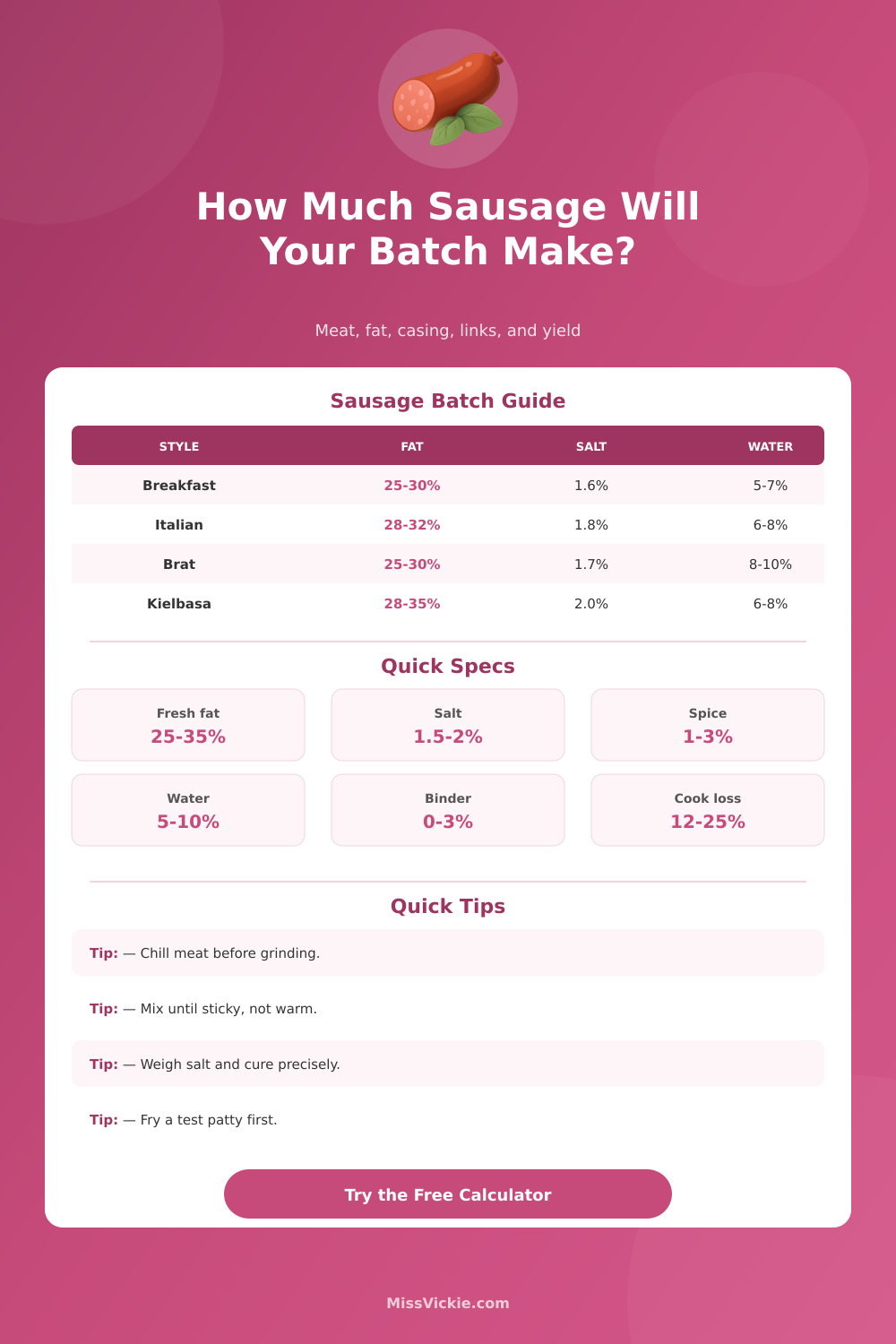
| Style | Fat Target | Salt | Seasoning | Liquid | Casing |
|---|---|---|---|---|---|
| Breakfast Sage | 25% to 30% | 1.5% to 1.7% | 0.8% to 1.3% | 4% to 7% | Patties or 22 to 26 mm |
| Sweet Italian | 28% to 32% | 1.7% to 1.9% | 1.2% to 1.8% | 6% to 8% | 30 to 35 mm hog |
| Bratwurst | 25% to 30% | 1.6% to 1.8% | 0.9% to 1.5% | 8% to 10% | 30 to 35 mm hog |
| Kielbasa | 28% to 35% | 1.8% to 2.2% | 0.9% to 1.6% | 6% to 8% | 35 to 42 mm |
| Andouille | 28% to 35% | 1.8% to 2.2% | 2.0% to 3.2% | 5% to 7% | 35 to 42 mm |
| Chorizo | 30% to 40% | 1.8% to 2.3% | 3.0% to 5.0% | 3% to 6% | 30 to 35 mm |
| Merguez | 22% to 30% | 1.7% to 2.1% | 2.2% to 3.8% | 4% to 7% | 22 to 26 mm |
| Turkey Herb | 10% to 18% | 1.4% to 1.7% | 1.0% to 1.6% | 8% to 12% | Patties or 26 to 32 mm |
| Casing Size | Best Use | Approx Fill | Typical Link | Notes |
|---|---|---|---|---|
| No casing | Patties, bulk sausage | By patty weight | 2 to 4 oz | Best for quick testing and breakfast sausage |
| 22 mm sheep | Snack sticks, merguez | 0.42 oz/in | 4 to 5 in | Small links cook quickly and dry faster |
| 26 mm sheep | Breakfast links | 0.58 oz/in | 4 to 6 in | Good for narrow fresh links |
| 32 mm hog | Italian, bratwurst | 0.88 oz/in | 5 to 7 in | All-purpose fresh sausage size |
| 35 mm hog | Kielbasa, dinner links | 1.05 oz/in | 6 to 8 in | Plump bite with room for coarse grind |
| 42 mm beef | Smoked coils | 1.50 oz/in | 8 to 12 in | Use for larger smoked sausage |
| 50 mm casing | Coils, summer sausage | 2.10 oz/in | 12 in or coil | Better planned by total stuffed length |
| Meat Plus Fat | 1.6% Salt | 1.8% Salt | 7% Water | 1.5% Binder | 2% Binder |
|---|---|---|---|---|---|
| 2.5 lb / 1.13 kg | 18 g | 20 g | 79 g | 17 g | 23 g |
| 5 lb / 2.27 kg | 36 g | 41 g | 159 g | 34 g | 45 g |
| 10 lb / 4.54 kg | 73 g | 82 g | 318 g | 68 g | 91 g |
| 15 lb / 6.80 kg | 109 g | 122 g | 476 g | 102 g | 136 g |
| 25 lb / 11.34 kg | 181 g | 204 g | 794 g | 170 g | 227 g |
| Raw Batch | 2 oz Links | 3 oz Links | 4 oz Links | 6 oz Links | Cooked At 18% Loss |
|---|---|---|---|---|---|
| 3 lb / 1.36 kg | 24 | 16 | 12 | 8 | 2.46 lb / 1.12 kg |
| 5 lb / 2.27 kg | 40 | 26 | 20 | 13 | 4.10 lb / 1.86 kg |
| 8 lb / 3.63 kg | 64 | 42 | 32 | 21 | 6.56 lb / 2.98 kg |
| 10 lb / 4.54 kg | 80 | 53 | 40 | 26 | 8.20 lb / 3.72 kg |
| 25 lb / 11.34 kg | 200 | 133 | 100 | 66 | 20.50 lb / 9.30 kg |
Sausage making involve a few different variables that must be calculated before the making of sausage. Sausage making involves decisions about the amount of meat trim that will be used, the amount of fat that will be added, and the amount of salt and seasoning that should be added to the mixture of meat and fat. The amount of sausage links that will fit into the casings must also be considered before the creation of the sausage mixture.
Each of these variables can change quickly and other variables will change with these changes. For instance, changing the fat percentage will change the amount of fat that is required to be added to the mixture. Changing the target weight of the links will change the number of links that will be created, which will impact the amount of raw sausage mixture that needs to be prepared.
How to Calculate Sausage Ingredients
Thus, each of these variables can impact each of the other variables in the sausage making process, and people often have to estimate the amount of each of these variables, which can lead to mistakes in the sausage making process. The calculator allows the sausage maker to calculate each of these variables once the sausage maker has decided on the weight of the meat trim, the fat level of the meat trim, the target fat percentage of the sausage links, and the fat source that will be used in the sausage. The fat content of the fat source that is to be used can impact the accuracy of the calculations.
For instance, pork back fat contains approximately ninety percent fat by weight, but belly trim contains only approximately fifty-five percent fat. Using the incorrect percentage of fat for the fat source that will be used will lead to incorrect calculations of the other variables. The salt, seasoning, water, and binder percentages can also be set for the batch of sausage links that will be created.
These percentages is calculated based on the total weight of the meat and fat that will be used in the batch of sausages. By calculating these percentages based on the weight of the meat and fat, the sausages will not contain too much salt. The size of the casing links and the length of the links will determine the amount of sausage mix that must be prepared.
A thirty-two millimeter hog casing will hold approximately point eight eight ounces of sausage mix per inch of length. A thirty-five millimeter casing will hold more than one ounce of sausage mix per inch of length. By setting these values for the size of the casings and the length of the links, the calculator can determine the total number of links that will be created by the batch of sausages.
This value will be based on the total weight of the sausage mixture. Additionally, a small percentage of the total batch can be reserved for test links to ensure that the flavor and texture of the links are as desired, and to account for the loss of the mixture while preparing the sausages. The percentage of loss during the cooking process can be entered into the calculator separately from the other variables.
For instance, sausages that are poached will lose less of their total weight than sausages that are grilled. The fat percentage that will be used in the batch is the most important variable regarding the texture of the links that are created. Using too little fat will create links that are dry and lack texture.
Using too much fat will cause the fat to render during the cooking process that will result in links that are too loose and crumble during the eating of the sausages. The target fat percentage for most fresh sausages is between twenty-five and thirty-five percent total fat. Using lean meats like turkey or venison will require the addition of fat from another source to achieve the same texture as a fresh pork sausage link.
The calculator will show the amount of fat from the chosen fat source that will be required to achieve the target fat percentage, eliminating the guesswork in the addition of fat from another source. The amount of salt that will be added to the batch of sausages must be calculated similarly to the fat percentage. The amount of salt should be calculated based on the total weight of the meat and fat that will be used in the batch.
Most sausage styles will use a salt percentage between one point five and two point two percent. The percentage of salt can be so narrow for sausage recipes because such a change to the salt percentage will be noticeable to the individuals who consume the sausages. Additionally, the amount of salt will impact the amount of binding of the proteins in the raw meat links.
Thus, the percentage of seasoning ingredients can be entered separately in the calculator from the percentage of salt in the batch of links. The amount of water or other liquids that will be used in the batch of sausages will have two impacts on the batch. First, the liquid will assist in maintaining the temperature of the sausage mixture during the grinding of the sausage mixture.
Maintaining the temperature will prevent the fat from smearing. Second, the liquid will increase the yield of the batch of sausages links. The liquid will remain in the links during the cooking process.
The amount of liquid that will be used in the batch of sausages can be set by the type of sausage links that will be created. For instance, bratwurst or fresh sausages will contain more liquid than smoked sausages. Additionally, binders will help the links to retain the liquid during the cooking process.
Binders will be required for batches of sausages of more than ten pounds. The casing link size and length tables are useful in that the real fill rates for the casings may change from the percentages that are published for those sizes of casings. For instance, the size of the meat trim, the grind size of the meat, and the pressure with which the links are stuffed into the casings will change the amount of sausage mixture that can be placed into the casings.
Therefore, it is recommended that the sausage makers have extra casings that are soaked in water and ready to use in case some of the links are too long or too short. Additionally, the percentage of loss during the cooking process may also change. The percentage of loss that is entered into the link preparation calculator will change based on the fat level of the links, as well as the method with which the links will be cooked.
Links that contain a high percentage of fat will lose more of their total weight during the cooking process than links that are leaner in comparison. The reference tables that are included in the recipe for sausage links will reveal the amounts of salt, water, and binders that are required for different batch sizes of links. These links will help ensure that the batch sizes that are created will have the same percentages of each of these ingredients.
Additionally, the link tables will reveal the number of links that are created by different batch sizes of raw sausage links. These links will prove to be helpful for cooks that wish to scale their recipes for sausage links up or down. By calculating the amount of each of the variables for the sausage links prior to the beginning of the sausage making process, the cooks can make certain to think about each of the steps that will be performed prior to beginning to prepare the meat.
For instance, the fat percentage, salt amount, and link size can be chosen prior to the butchering of the meat. Thus, the cooks will be able to make certain that they do not, for instance, add salt after the meat has been ground. Additionally, by calculating each of the variables for the batch of links, cooks will be able to ensure that the batch size of links to be made will be within the amount of casings that are available to the cooks, and within the amount of storage space that is available.
For instance, cooks will be able to ensure that they do not attempt to make a twenty pound batch of sausages if they have only enough storage space for twelve pounds of sausage links. The skill of making links involves learning which of these variables are adjustable in the link making process, and which of these variables are fixed due to the equipment or ingredients that will be used in the link making process. By using the link mixture calculator, cooks will be able to make adjustments to the variables that are adjustable in the link making process.
Thus, over time, cooks will begin to have an understanding of the adjustments that are required to create a good batch of links. Each of these links will become intuitive for the cooks who use them often. Thus, using the link mixture calculator will transform the creation of links that are successful into a process that can be replicated time after time with success.