Door torque, hinge geometry, assist force, and safety factor
Smoker Door Counterweight Calculator
Estimate the counterweight or spring force needed to make a heavy smoker door lift smoothly while leaving enough residual weight for a controlled close.
Choose a common pit door setup, then adjust the door weight, hinge distance, opening angle, arm length, assist style, and safety factor.
Calculation Breakdown
| Door geometry | Typical CG distance | Torque behavior | Calculator note |
|---|---|---|---|
| Round pipe door, top hinge | 40-55% of door arc depth | Heaviest as the lid swings up | Good for fixed counterweights |
| Raised hinge or strap hinge | Measure from hinge pin to door center | Can reduce or increase leverage | Use hinge offset correction |
| Flat horizontal lid | About half the lid depth | Peak torque near horizontal | Check at full working open angle |
| Vertical cabinet door | Usually half the door width | Low gravity torque unless it lifts upward | Spring assist may be for hold-open |
| Insulated vault door | Often forward of the inner skin | Heavy and slow moving | Use higher safety factor |
| Smoker size | Common arm length | Practical range | Build caution |
|---|---|---|---|
| Mini 14-16 inch pipe | 8-12 inches | Short arms need more weight | Keep clear of the stack and handle |
| Backyard 20 inch offset | 12-18 inches | Good balance for shop plate | Mock up before final welds |
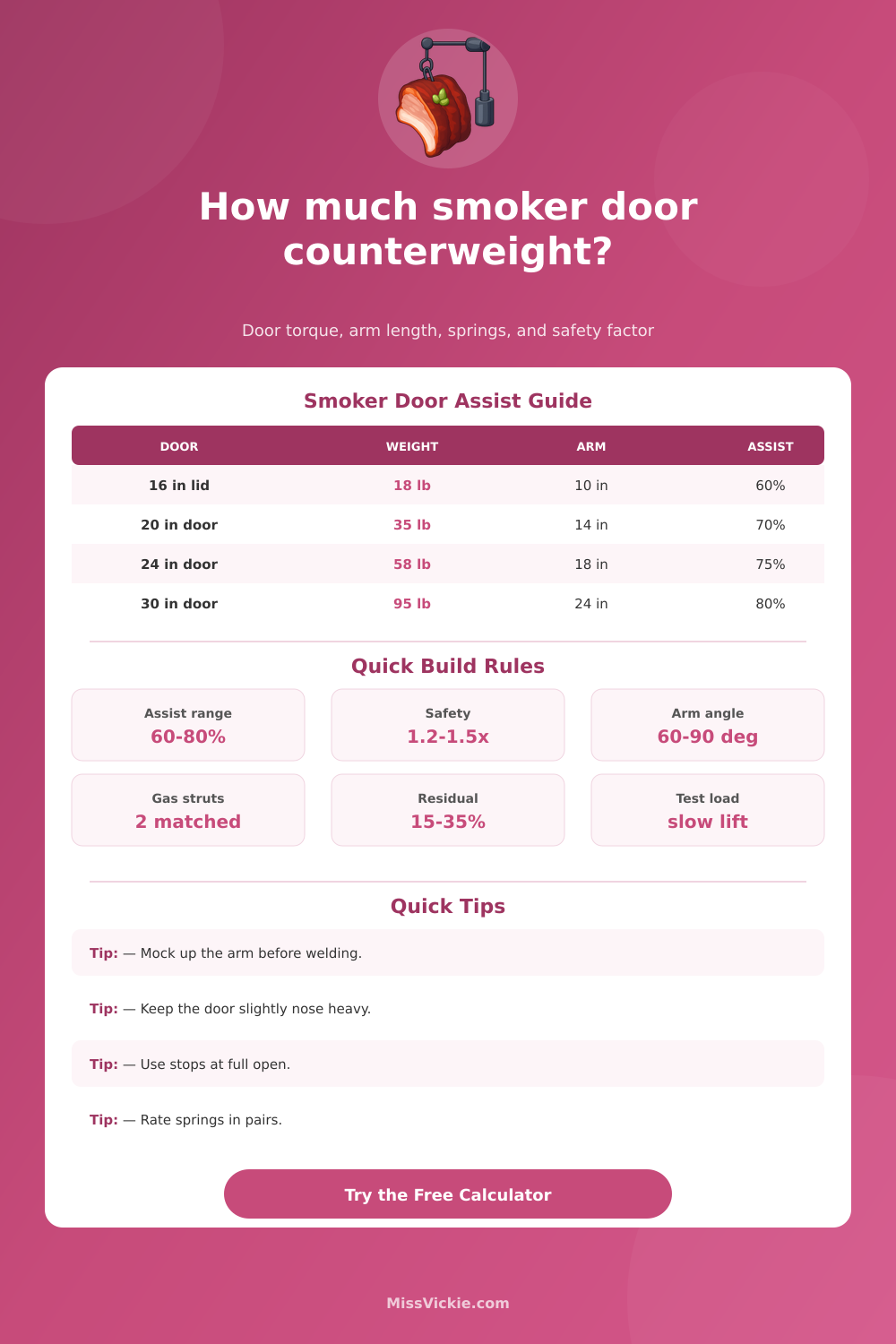
| 24 inch cook chamber | 16-22 inches | Often works with 35-60 lb doors | Add a full-open stop |
| Large trailer pit | 20-30 inches | Long arms reduce ballast weight | Watch transport clearance |
| Cabinet or vault | Bracket specific | Often better with springs | Check seal compression at close |
| Assist hardware | Best use | Force estimate | Adjustment note |
|---|---|---|---|
| Fixed counterweight | Offset pipe lids | Assist torque divided by arm leverage | Simple, durable, needs swing clearance |
| Gas spring pair | Cabinet and clean builds | Spring torque divided by bracket leverage | Heat shields are important near firebox |
| Extension springs | Budget shop builds | Use working force at open position | Add retention cables and guards |
| Hybrid weight plus spring | Heavy trailer doors | Split assist by selected spring share | Easier to tune than one huge weight |
| Condition | Suggested factor | Residual target | Why it matters |
|---|---|---|---|
| Known door weight, smooth hinges | 1.15-1.25 | 20-35% unassisted | Predictable motion and easy closing |
| Heavy door or rough hinge pins | 1.25-1.4 | 18-30% unassisted | Overcomes friction and fabrication variance |
| Hot firebox area | 1.35-1.5 | 20-35% unassisted | Springs and gas struts lose force with heat |
| Unknown plate thickness or wet paint | 1.4-1.6 | 25-40% unassisted | Leaves room for final tuning |
| Public or competition trailer | 1.45-1.75 | 20-35% unassisted | Repeated use needs stops and redundancy |
To build a smoker door that opens and closes easy, one must understand how the weight, leverage, and angle of the smoker door relate to one another. Because the smoker door will have a certain weight, the planners of the smoker door will need to calculate the various factors that will determine the smoker door’s ease of opening and closing. A smoker door that is too heavy will be difficult for a persons to lift when opening the smoker door.
Yet, a smoker door that is too light may open due to the force of wind or physical contact with the smoker door. Many smoker door designers want the smoker door to be able to carry a portion of its own weight when in the open position. This portion of the smoker door’s weight ensure that it will remain in a stable position when closed against the smoker gasket.
How to Make a Smoker Door Easy to Open and Close
To enter the smoker door weight and distance from the hinge to the smoker door’s center of gravity. This distance from the smoker door hinge to the center of gravity of the smoker door are important in that it will determine the torque of the smoker door. For example, a round pipe lid will have a center of gravity further from the smoker door hinge than a flat plate lid.
Thus, the round pipe lid will have more torque than the flat plate lid of the same weight. The hinge offset must also be entered into the smoker door calculator. This hinge offset change when the smoker door hinge is moved from its center.
Additionally, the angle to which the smoker door will open must be entered. The torque of the smoker door will change with the angle of the smoker door. The smoker door designer can set the assist percentage and safety factor with the smoker door calculator.
The assist percentage will allow the smoker designer to set how much of the smoker door’s total weight that is desired to be offset. For instance, an assist percentage of 50% will allow the smoker designer to set the smoker door to feel light in weight, yet still have some of the smoker door’s weight to ensure it remains against the smoker gasket when not in motion. The safety factor is used to account for other variables in the smoker door that cannot be accounted for in the smoker door calculator.
For instance, the safety factor can account for the drag of the hinge grease, or the loss of force of the smoker door’s spring when the smoker door becomes hot from use in the smoker. Using a safety factor will ensure that the smoker door is not too heavy to open with use of the smoker door for many seasons. The smoker door calculator will output the torque, counterweight mass, spring force, and the residual lift of the smoker door.
The value of the torque will be the measure of the smoker door’s rotational force. The counterweight mass will be the measurement of the mass of an object that must be attached to one end of an arm to balance the smoker door. The spring force is the force in the gas struts or extension springs, depending on the radius of the smoker door brackets.
The residual lift is the effort that the smoker designer will feel when using the smoker door handle. This value will determine how easy to use the smoker door during operation of the smoker. The reference tables will help the smoker designer determine other variables of the smoker door.
For example, the reference tables will show the various arm lengths required for smokers of different sizes. For example, a short arm length can be used with a small pipe lid, but a longer arm length is required for a trailer smoker door to ensure that the counterweight does not become an obstacle in the smoker’s operation. Additionally, the reference tables will show the difference in center of gravity between insulated smoker doors and standard smoker doors.
It is common for smoker designers to make two mistake with smoker doors. The first is to tune the smoker door to be weightless. A smoker door that is weightless will open from the force of the wind against the smoker door.
The second mistake is to set the size of the smoker door’s springs to balance the smoker door when in the closed position. The force required to open the smoker door will change with the angle of the smoker door. Thus, a physical test with temporary weights on the smoker door may be required.
Mocking up the arm of the smoker door prior to welding it will save the smoker door designer time in that they will be able to avoid having to cut or reweld the smoker door’s arm. Another mistake that many smoker door designers make is not considering the effect that heat and smoke will have on the smoker door over time. For instance, smoker door’s springs will lose their force if they are near the smoker’s firebox.
Additionally, the resistance that the smoker door hinge pin may experience due to smoke residue buildup on the smoker door’s hinge pins. Thus, the safety factor can be used to ensure smoker door’s assist percentage is not to the highest level of assistance for use with the smoker door for many cooking seasons. The smoker designer will use the information provided by the smoker door calculator along with the information in the reference tables to determine the specifications of the smoker door design.
The designer will then use their discretion and knowledge of smoker doors in making the final decision for the smoker door’s specifications.